
23.02.1878–28.05.1927
Boris Kustodiev
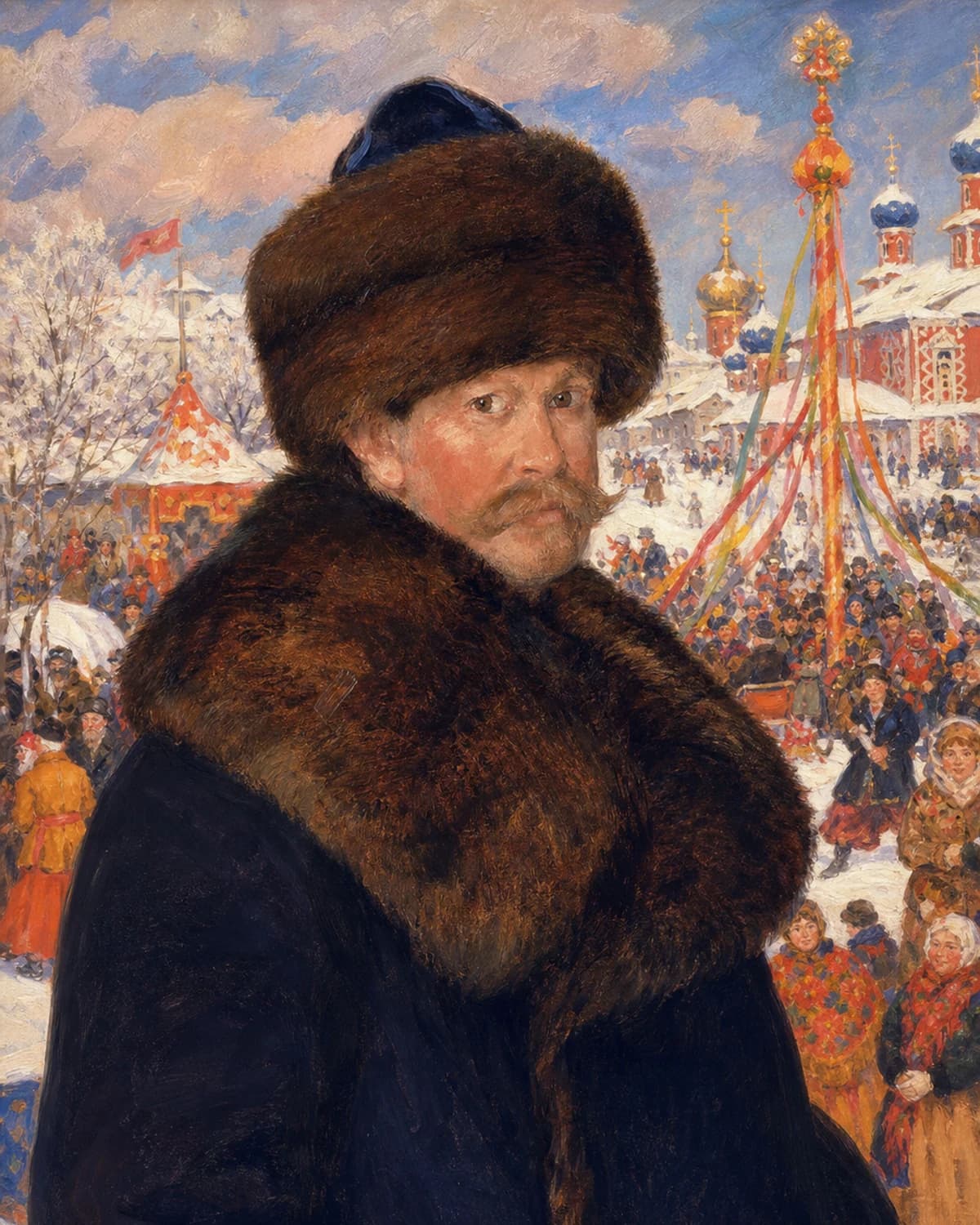
Boris Kustodiev (1878–1927), Repin’s pupil and assistant, painted fairs, Maslenitsa revels, merchants’ wives at the samovar and the Volga towns of his Astrakhan childhood. From 1916 he could not walk, and he made his most cheerful canvases in a wheelchair. He also worked as a portraitist, an illustrator of Leskov and Gogol and a stage designer; he was an Academician of painting from 1909.
Biography
In 1926 Kustodiev had no clean canvas for “Russian Venus”. He turned over a picture of his own, “On the Terrace”, and began to paint on the back. By then he could sit in his special chair for no more than two or three hours a day, and at times he could not hold a brush. Today the work stands on a glass stand in the Nizhny Novgorod Art Museum, and visitors see both pictures at once, front and back. In 1984, when the heating pipes burst in the museum, water washed away part of the paint layer, and the restorer Pavel Baranov spent a whole year bringing the canvas back.
Kustodiev was born on 23 February (7 March) 1878 in Astrakhan, into a clerical family. His father taught philosophy, the history of literature and logic at the theological seminary and died before his son was two. His mother brought up four children, took in embroidery and on feast days played the piano in merchants’ houses. The family rented the side wing of a rich merchant’s house, and the artist later recalled that the whole merchant way of life was right under his nose, as in a play by Ostrovsky.
In Astrakhan he was taught drawing by Pavel Vlasov, a pupil of Perov; the lessons were paid for by an uncle, Stepan Nikolsky. In 1896 Kustodiev entered the Higher Art School of the Academy of Arts, spent his first year under Vasily Savinsky, then moved to Ilya Repin’s studio, and at the same time studied sculpture with Dmitry Stelletsky and etching with Vasily Mathé. Repin wrote that he had great hopes for him and invited him to assist on the enormous “Ceremonial Sitting of the State Council on 7 May 1901”. The student made portrait studies and, by various accounts, painted about a third of the portraits or the whole right-hand part of the canvas. In the same years he painted his own portraits of his friends: Ivan Bilibin (1901), Mathé (1902).
For his competition picture he nevertheless chose a genre scene, “At the Market”. In the autumn of 1900 he went to Kostroma Governorate to find material and there met Yulia Proshinskaya; they were married in St Petersburg on 8 January 1903. On 30 October 1903 he graduated with a gold medal, receiving the title of artist and the right to a travelling scholarship abroad. “At the Market” itself has not survived.
In December 1903 he arrived in Paris with his wife and infant son, studied in René Ménard’s studio and travelled to Spain. About six months later he came home and wrote to Mathé that he was once again “in our blessed Russian land”. Then came Kostroma Governorate and the series “Fairs” and “Village Holidays”.
1905 made him a caricaturist: he drew for the satirical magazines Zhupel (Bugbear), Adskaya Pochta (Hell’s Mail) and Iskry (Sparks), and his sheet “Introduction. Moscow” became widely known. At the same time he first took up book illustration, and he kept at it for the rest of his life. In 1904 he was among the founders of the New Society of Artists, from 1907 he belonged to the Union of Russian Artists, and in 1909, on Repin’s nomination, he became an Academician of painting. He turned down a teaching post at the Moscow School of Painting, Sculpture and Architecture in place of Serov: he did not want to move and lose time for his own work. On 7 October 1910 he left the Union together with other Petersburg artists and joined the revived World of Art.
The first signs of spinal disease appeared in 1909. In 1911 he spent several months in a Swiss clinic, and operations brought only temporary relief. From 1915 until the end of his life Kustodiev lived in Petrograd, at 7 Vvedenskaya Street. That same year, while he was working in Moscow on sets for the Art Theatre, pain tormented him at night. In 1916, after another operation in Petrograd, the surgeons managed to restore movement to his arm, but his legs failed. “Now my whole world is my room,” he wrote. And these were the very years that produced his loudest and brightest pictures: “Maslenitsa” (1916), “Fairground Booths”, “The Beauty” (1915), for which the actress Faina Shevchenko posed, and “Merchant’s Wife at Tea” (1918), with a watermelon, a samovar and a cat. The Volga towns in them are painted from memories of childhood. Benois thought that the real Kustodiev begins where there is a fair, printed cotton and a “brawl of colours”, while his fashionable ladies come out limp. I think there is some truth in this, although the portraits of Chaliapin (1922) or of Pyotr Kapitsa and Nikolay Semyonov (1921) argue against it.
For him the theatre began in 1911 with Ostrovsky’s “An Ardent Heart”. Ostrovsky suited him best later too: the provinces and the merchant class were his own material. Later came “The Tsar’s Bride” (1920) at the People’s House and Zamyatin’s “The Flea”, after Leskov, at the Second Moscow Art Theatre (1925); the director Alexei Diky recalled that as a director he found nothing to correct in the designs.
Of his book work the illustrations most often remembered are those for Leskov’s “The Darner” (1922) and “Lady Macbeth of the Mtsensk District” (1923).
After the revolution he decorated Petrograd for the first anniversary of October and drew posters and lubok prints. “The Bolshevik” (1919–1920) is now in the Tretyakov Gallery, and “Festivities in Honour of the Second Congress of the Comintern on Uritsky Square” (1921) in the Russian Museum. In 1923 he joined the Association of Artists of Revolutionary Russia.
In March 1927 the People’s Commissariat for Education allowed him to go to Germany for treatment at Otfrid Foerster’s clinic and allocated money for the trip. It never took place: on 28 May 1927 Kustodiev died in Leningrad. He was buried in the Nikolskoye Cemetery of the Alexander Nevsky Lavra, and in 1948 his remains and the tombstone, made after a design by his friend and biographer Vsevolod Voinov, were moved to the Tikhvin Cemetery.
Related context
Associations
Works connected through artistic movements, cultural context and period. Priced works available in this market appear first.








Profile notes
Profile and sources
Image
Artist image
На основе открытого изображения: Boris Kustodiev; Wikimedia Commons; Public domain.
