
1600–1660
Bichitr
Bichitr, a miniature painter at the court of the Great Mughals, worked under the emperors Jahangir and Shah Jahan from about 1615 into the 1640s, and possibly longer. He painted official portraits of emperors, princes and nobles, scenes of court receptions and elephants, and took part in illustrating the “Padshahnama”. European prints gave him modelling in light and shade, reflections and individual motifs.
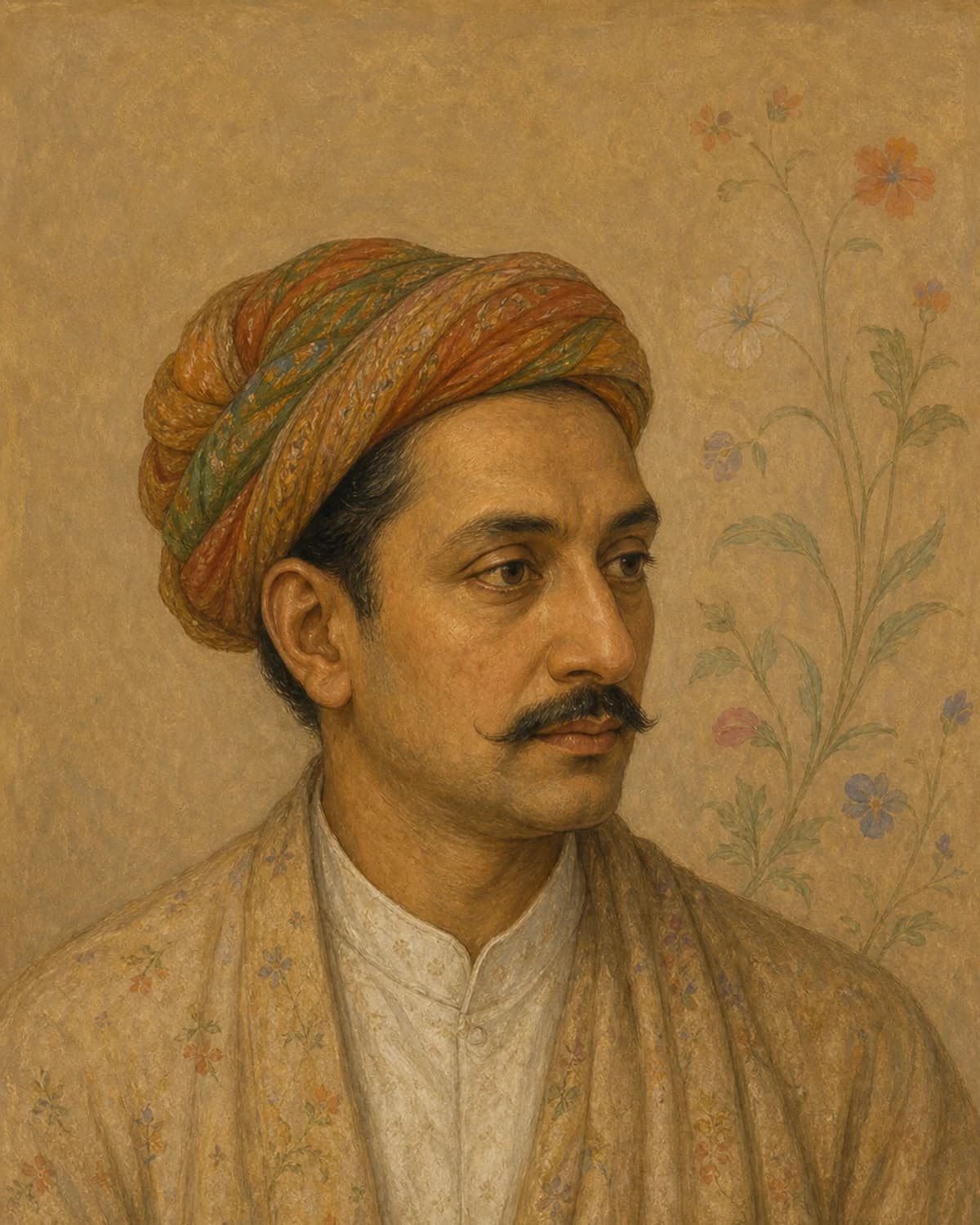
Biography
The emperor Jahangir sits on an hourglass throne and hands a book to a bearded Sufi shaikh. Beside them the Ottoman sultan and the King of England wait their turn, and among those standing is a figure in Indian court dress who is taken to be the painter himself. After him, inserting oneself into such scenes became a custom in Mughal painting. He copied King James I from a portrait by John de Critz and the sultan, it seems, from a painting by Giovanni Bellini; European putti fly above the throne. The carpet underfoot, meanwhile, is deliberately flat, with no European perspective at all. The miniature is called “Jahangir Preferring a Sufi Shaikh to Kings” and is dated to about 1615–1618. Its meaning needs no caption: for the emperor a holy man matters more than any sovereign.
This is one of Bichitr’s earliest known works, and the manner in it is already fully mature.
Little is known of his life. The years of his birth and death have not been established. From the clothing in his self-portraits scholars conclude that he was a Hindu; he was probably brought up at court, received a good education and knew Persian. His teacher is usually taken to be Abu’l Hasan, Jahangir’s leading painter, and Bichitr’s early style does look like a variant of that master’s manner. From about 1615 he worked in the imperial workshop, the kitabkhana. His patron was the powerful courtier Asaf Khan.
His finest period came under Shah Jahan. A great many official portraits of the 1630s can be attributed to Bichitr: he seems to have painted every person of any importance in the empire, and the scholar Stuart Cary Welch compared him to Van Dyck. Prince Shah Shuja enthroned beside Maharaja Gaj Singh of Marwar; Jujhar Singh Bundela kneeling in submission to Shah Jahan (a composition that Rembrandt later copied in a sketch); Shah Jahan with Asaf Khan, where God the Father looks down on the emperor from the clouds and the light that comes from him, together with a dove, reaches the emperor’s halo, so that the whole scene alludes to the Christian Trinity. There were animals too: Prince Dara Shikoh riding a pink elephant, a portrait of an elephant called Alam Guman. Bichitr also worked on the illustrations to the “Padshahnama”, the chronicle of Shah Jahan’s reign now kept at Windsor Castle; one of his pages shows the emperor, during his accession ceremonies on 8 March 1628, receiving his three eldest sons and Asaf Khan.
His line is precise and firm, his colour clean and resonant, his patterning bold. Milo Beach wrote of a brilliant but hard line and of the cold formality his pages produce; Wheeler Thackston thought him the most observant of the court painters. Bichitr’s faces are almost documentary, his figures are shown in profile or three-quarter view, and he took cast shadows and trompe-l’oeil reflections from the Europeans. To my mind, it is this coldness that makes his portraits so convincing: there is no flattery in them, only rank, fabric and face. Around 1630 a shift can be seen from the soft early manner to a more restrained one.
The last works attributed to Bichitr with certainty date from the 1640s. Among them are “Darbar of Aurangzeb” and “Episode in a Bazaar”, which was never finished.
Related context
Associations
Works connected through artistic movements, cultural context and period. Priced works available in this market appear first.
Profile notes
Profile and sources
Image
Artist image
На основе открытого изображения: Bichitr / Mir Ali Heravi; Wikimedia Commons; CC0.
