
14.10.1853–31.05.1927
Benedito Calixto
Benedito Calixto began with signboards and wall decorations in Santos, studied at the Académie Julian in Paris, and all his life painted the coast of São Paulo: the port of Santos, seascapes, old views of the towns. He worked for the Museu Paulista, carried out some seventeen church commissions, photographed his subjects for his history paintings and wrote books on the history of the colonial captaincies.
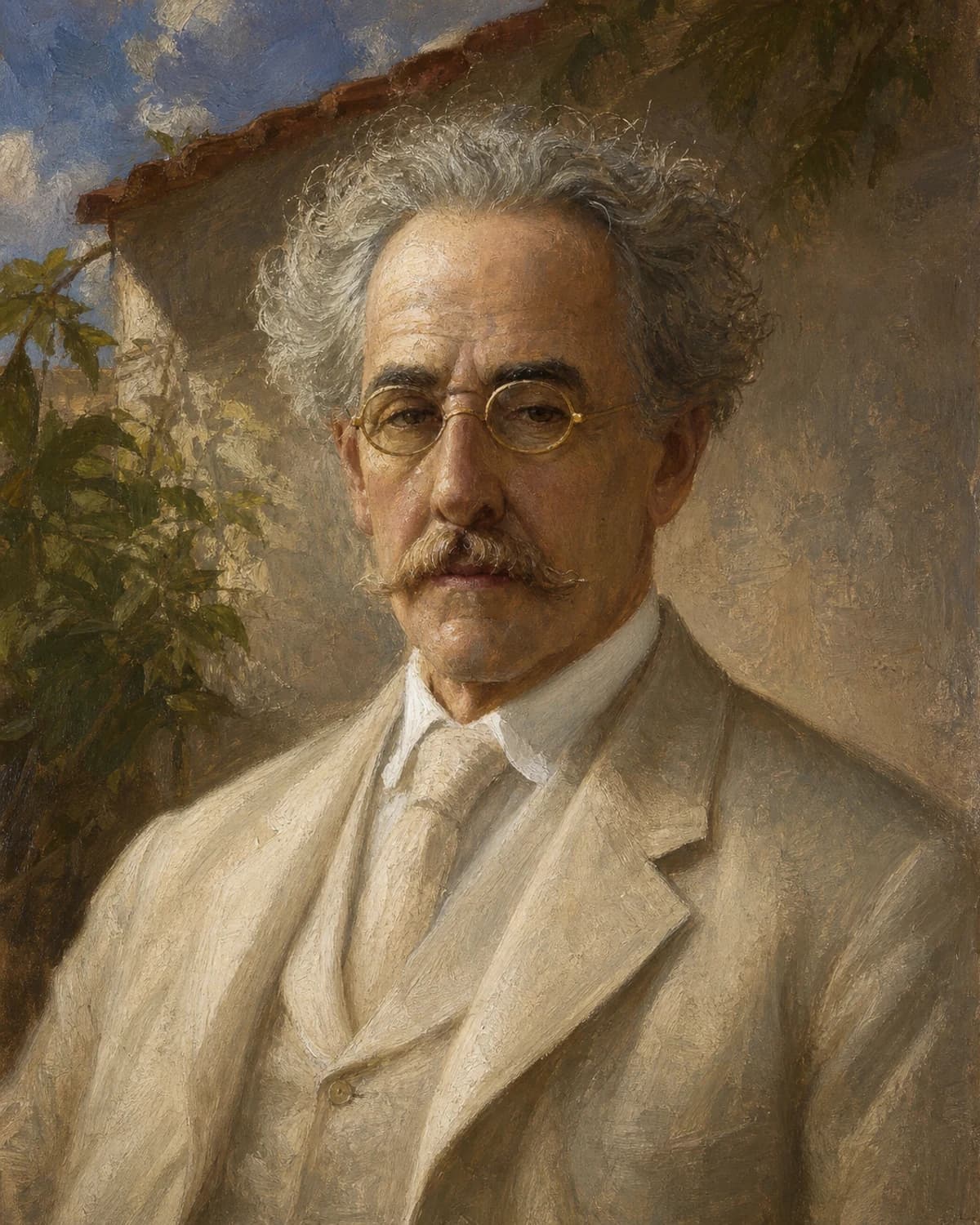
Biography
From Paris Benedito Calixto brought back to Santos, besides the painting “Far from Home”, a camera. From then on he photographed scenes, poses and the arrangement of figures for future history and religious pictures, and later set up a photographic laboratory in his house in São Vicente.
This was the mid-1880s; he was in his thirties.
He was born on 14 October 1853 in the village of Conceição de Itanhaém on the southern coast of the province of São Paulo, to João Pedro de Jesus and Anna Gertrudes Soares, one of eight children. His father, a carpenter and blacksmith, taught him his trade. There was little work at home, and the young Calixto left for Santos, where he painted advertising signs and landscapes on the walls of mansions. Then he lived with his uncles in Brotas: one was the bandmaster of the town band and taught him the rudiments of music, the other took him along to clean and repaint the statues in the parish church. There his first paintings on canvas appeared, and then portraits and views of estates commissioned by local landowners. In 1881 he exhibited for the first time in São Paulo and returned to Santos, to signboards and decorative commissions; that same year he painted “The Landing of Martim Afonso de Sousa”, the first artist to take up this subject. In 1882 the engineer Garcia Redondo commissioned him to paint the ceiling and the curtain of the new Guarany theatre. After this work the merchant elite of Santos paid for him to study in France.
In 1883 he settled at Asnières, outside Paris. He first studied with Jean-François Raffaëlli, but the Impressionist manner did not suit him, and he moved to the Académie Julian, under Tony Robert-Fleury, Gustave Boulanger, Jules Lefebvre and William Bouguereau. For the painting “A Scene of the Flood” he won second prize in a history painting competition.
After his return Calixto painted the port and the changing town and portraits of the people of Santos, and taught drawing at the Colégio Azurara. In the early 1890s he moved to São Paulo. There he received his first large commission, “Flooding of the Várzea do Carmo” (1892), and critics praised the accuracy with which the city is shown; in 1893 came “Proclamation of the Republic” and “The Gospel in the Jungle”. In 1894 he returned to the coast, to São Vicente, and lived there for the rest of his life. In 1895 his first book, “The Village of Itanhaém”, came out, and in the same year he was admitted to the Historical and Geographical Institute of São Paulo; later he was one of the founders of a similar institute in Santos. He drew up maps of Santos and wrote stories and articles for local newspapers. In 1904 he won a gold medal at the World’s Fair in St. Louis for the painting “The Hewers”.
From 1902 he painted for the Museu Paulista in São Paulo. When Afonso d’Escragnolle Taunay took charge of the museum in 1917 and began preparing a display for the centenary of independence, Calixto was commissioned to paint views of old São Paulo. The models were photographs by Militão Augusto de Azevedo from 1862 and 1887, and some of the photographs the artist transferred to canvas in their entirety, merely adding bright colour. For the same museum he painted the portrait of the bandeirante Domingos Jorge Velho with his lieutenant Antônio Fernandes de Abreu; this picture did much to fix the familiar image of the bandeirante pioneer. The history of the colonial captaincies, of Itanhaém and São Vicente, occupied him as a writer too: his book “Capitanias Paulistas”, begun as a journal publication in 1915, came out in 1924.
Most of his later commissions came from the Church. In 1909 the Bishop of São Paulo, Duarte Leopoldo e Silva, commissioned ten canvases for the church of Santa Cecília, and Calixto first studied the life of the saint. In all, some seventeen church commissions are known, in São Paulo, on the coast and in the interior of the state, in Rio de Janeiro and in Espírito Santo. Pope Pius XI honoured him for his religious works. His last large work was “Salome Receives the Head of John the Baptist” and “The Transfiguration”, begun on 10 December 1923 for the parish church of Bocaina; he himself considered them the best he had done in church painting. To my mind, for all that, he is still recognised first of all by his seascapes and views of Santos.
His last exhibition was held in June 1926 at the Teatro Coliseu in Santos. Benedito Calixto died on 31 May 1927 in São Paulo, at the house of his son Sizenando, leaving about a thousand paintings; shortly before his death he had been negotiating the decoration of two more churches. In Santos, in an old mansion on Avenida Bartolomeu de Gusmão, the Pinacoteca named after him holds about sixty of his works.
Related context
Associations
Works connected through artistic movements, cultural context and period. Priced works available in this market appear first.








Profile notes
Profile and sources
Image
Artist image
На основе открытого изображения: Benedito Calixto; Wikimedia Commons; Public domain.
