
22.05.1858–12.06.1935
Belmiro de Almeida
Belmiro de Almeida, painter of “Arrufos” (The Spat, 1887), his best-known picture, studied at the Imperial Academy of Fine Arts in Rio de Janeiro and in Paris, and for decades lived now in Brazil, now in France. He painted in the manner of the Impressionists and Pointillists, drew caricatures for Rio magazines and modelled the “Manequinho”, the figure of a boy that became the mascot of the Botafogo club.
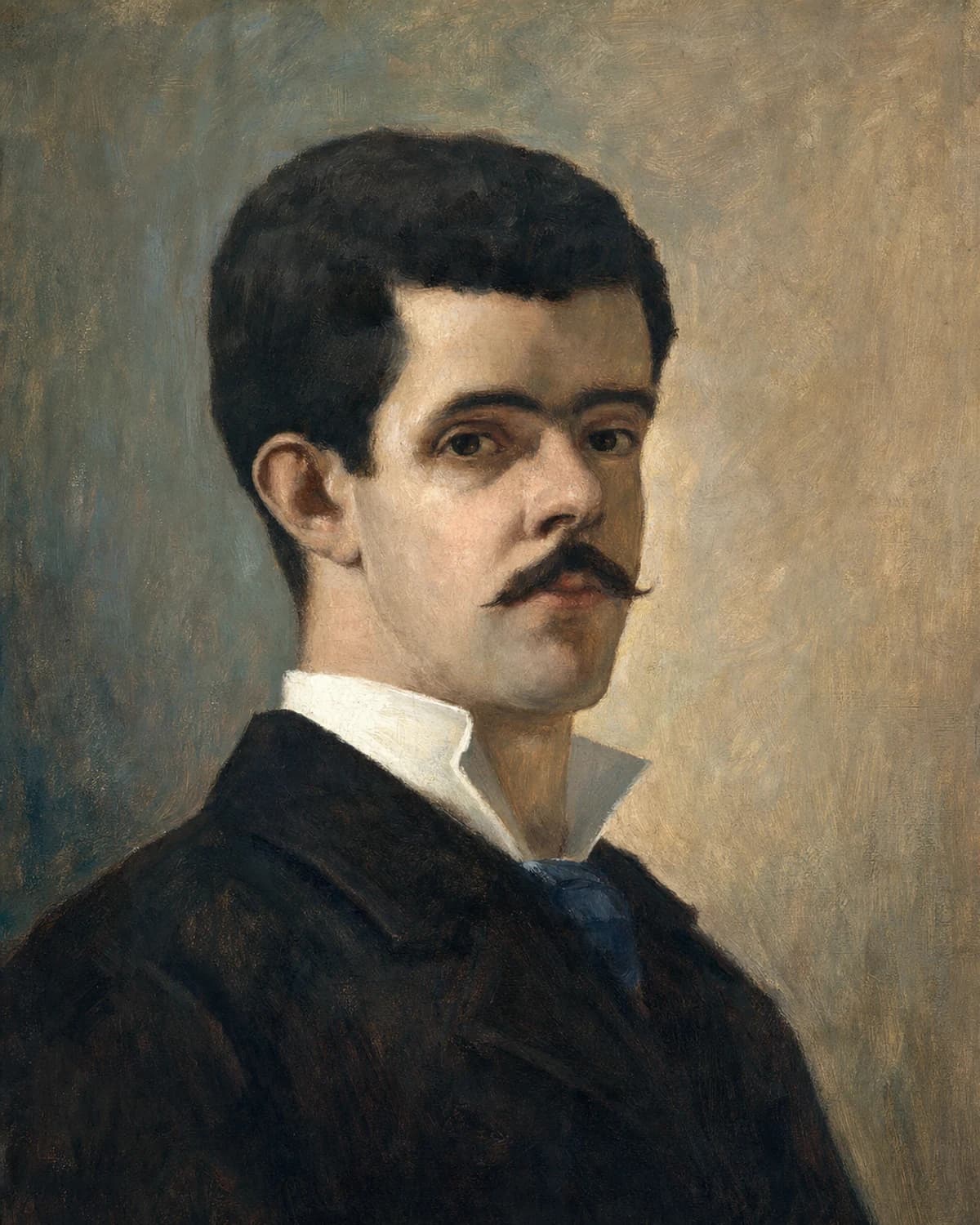
Biography
In 1887 Belmiro de Almeida showed the public “Arrufos” (The Spat), a picture of a quarrel painted with light irony. It provoked controversy among viewers and critics alike. The poet and critic Gonzaga Duque sat for the artist, and twelve years later Duque returned the favour: in his novel “Mocidade Morta” (The Death of Youth, 1899) one of the characters is drawn from Belmiro.
It is still his best-known picture and is kept in the National Museum of Fine Arts in Rio de Janeiro.
Belmiro Barbosa de Almeida was born on 22 May 1858 in Serro, in the province of Minas Gerais; Rio de Janeiro is sometimes given as his birthplace. He began studying drawing and painting at the Liceu de Artes e Ofícios in Rio. He then entered the Imperial Academy of Fine Arts, where his teachers were Agostinho José da Mota, João Zeferino da Costa and José Maria de Medeiros. In 1886 he painted two pictures centred on a freed Black man known in Rio as “Prince Obá”, the name taken by Cândido da Fonseca Galvão. In the late 1880s Belmiro went to Europe and lived for long periods in Rome and Paris. He studied at the Académie Julian, worked in the studio of Jules Lefebvre, exhibited at the Salons and held solo exhibitions. The French capital captivated him so much that from then on he lived by turns in Paris and in Rio.
His manner kept changing. In “Efeitos do Sol” (Effects of the Sun, 1892) he renders the light and air of a country landscape in an Impressionist way; in the portrait of twelve-year-old Abigail Seabra and in landscapes of Dampierre he uses the Pointillist dot; and in “Mulher em Círculos” (Woman in Circles, 1921) he tries out a Futurist aesthetic. In his European works he readily painted the peasant life among which he lived. I think this changeability is what makes him interesting: he tried almost everything he saw in Paris.
In Brazil, from 1893 to 1896, he taught drawing on an interim basis at the National School of Fine Arts, standing in for Pedro Weingärtner, and in 1916 the school invited him to take charge of the class of drawing from the live model. At the National Salon of Fine Arts he won a second-class gold medal in 1894. He devoted much of his time to caricature, drawing for the leading Rio magazines, among them “A Cigarra” and “O Malho”. He also worked as a sculptor. His best-known sculpture, the “Manequinho”, is modelled on the Manneken Pis in Brussels; it stands on a square in the Botafogo district, in front of the Botafogo club’s building, and has become the club’s mascot.
After the First World War Belmiro settled in Paris for good, but went on sending works to exhibitions in Brazil and in 1921 won the grand gold medal. He died in Paris on 12 June 1935. The 39th chair of the Brazilian Academy of Fine Arts bears his name.
Related context
Associations
Works connected through artistic movements, cultural context and period. Priced works available in this market appear first.








Profile notes
Profile and sources
Image
Artist image
На основе открытого изображения: Belmiro de Almeida; Wikimedia Commons; Public domain.
