
29.05.1924–10.08.2009
Behjat Sadr
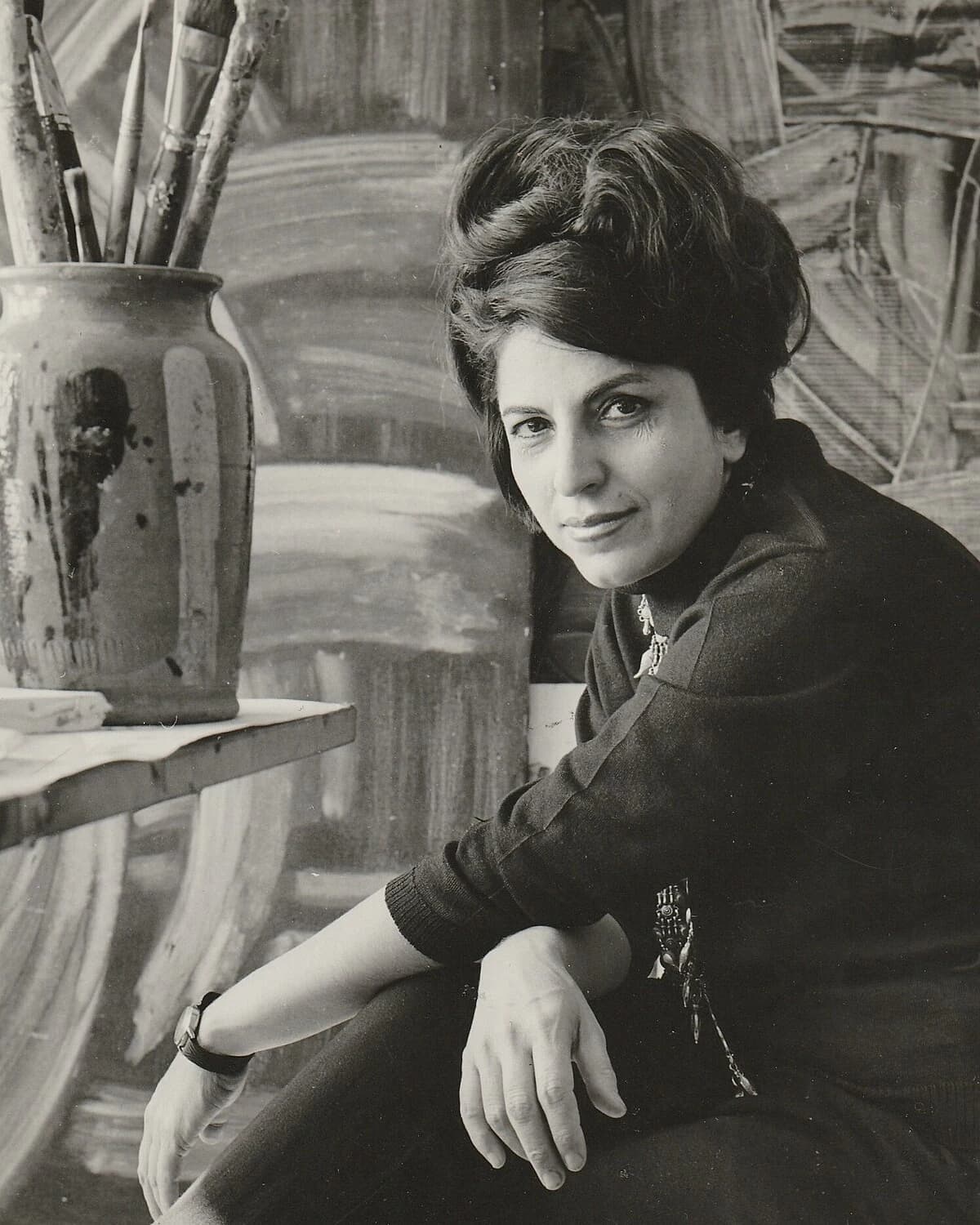
Behjat Sadr (1924–2009) came to Rome on a scholarship to study academic painting and soon gave it up for abstraction: she spread her canvases on the floor, poured industrial paint and worked with broad knives. In 1962 she won the main prize at the Tehran Biennale, taught at the University of Tehran for almost twenty years, and from 1980 lived in Paris.
Biography
Behjat Sadr said that one day in class she chose, for a still life, not a bowl of fruit but a fan lying in a corner of the room. Its blades and mechanism let her play with lines, and from then on that interested her more than likeness to the object.
She was born on 29 May 1924 in Arak. In the late 1940s she taught in Tehran and studied in the workshop of Ali Asghar Petgar, a follower of Kamal-ol-Molk, then entered the Faculty of Fine Arts at the University of Tehran. The school of Kamal-ol-Molk held to classical European painting, and she found it of little interest. By some accounts she graduated in 1954.
Then came a scholarship to study in Italy. In Rome Sadr worked in the studio of Roberto Melli and later studied at the Academy of Fine Arts in Naples. The story goes that the turning point was a long piece of string that fell to the floor: in its loops and curves Sadr saw a composition ready-made. I have no documents confirming this episode; it is her own account. Either way, she soon abandoned the academic manner. The easel and brushes gave way to large tins of industrial paint, plasterers’ and palette knives, scrapers and huge canvases that she laid on the floor. What drove her to such tools, she said, was the wish to make broader movements with her whole body. Her early series are close to Art Informel and Abstract Expressionism: continuous fields of repeated, curving strokes.
In 1956 she took part in the Venice Biennale: Iran had no pavilion then, and a few works, among them her still life, were shown by the artist Marcos Grigorian. In the same year she won second prize at San Vito Romano. Her first solo exhibition took place at the Il Pincio gallery, and in 1958 she showed her work at the La Bussola gallery in Rome. In Rome her friendship deepened with the poet Forugh Farrokhzad, who had earlier been her student in Tehran.
After returning to Iran, Sadr became a professor at the University of Tehran. The year of her return is given variously (1957 or 1959). She taught for almost twenty years. In 1962, at the third Tehran Biennale, she won the main prize; in the same year she took part in the São Paulo Biennale and again in Venice. For the façade of the Hilton hotel in Tehran she made, at about the same time, two large ceramic panels with a total area of 90 square metres.
In the 1960s, as accounts of her career describe it, an “organic” period began in her painting: the rhythms of tree trunks, flocks of birds, mountain passes in the Alborz. At the end of the decade she turned to optical and kinetic experiments, including installations with painted Venetian blinds; the work was received coolly in Iran. From 1968 comes the “rhythmic” period, in which black increasingly dominates. In 1974–1979 she poured industrial paint onto supports lying on the floor, then removed and reshaped it with broad knives. The supports were metal, aluminium and boards. Her daughter calls these years the most productive. Two sabbatical stays in Paris fell in 1968 and 1975.
In 1980, a year after the Iranian Revolution, Sadr moved to Paris with her daughter. She could no longer work on huge canvases on the floor, and began to introduce her own photographs into abstract compositions, producing what are called photo-paintings.
Sadr died on 10 August 2009 in Corsica, at Zonza, while swimming. Her writings more than once express a wish to die at sea. In 2006 the director Mitra Farahani made a documentary about her, “Behjat Sadr: Time Suspended”. In 2020 an endowment fund in her name was established. Her work has since been shown in London, Paris and New York, including the exhibition “Action, Gesture, Paint” (2023).
Profile notes
Profile and sources
Image
Artist image
Mitra Goberville; Wikimedia Commons; CC BY-SA 4.0.
