
1911–21.09.1975
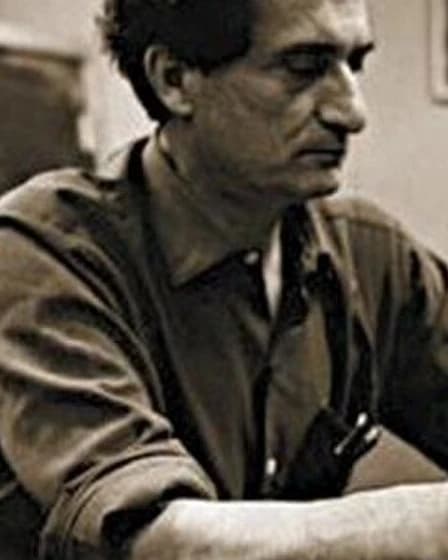
Bedri Rahmi Eyüboğlu
Bedri Rahmi Eyüboğlu (1911–1975) left Görele on the Black Sea to study in Istanbul and then in Paris, and came back to Turkey to teach for forty years at the Academy of Fine Arts. He painted, made mosaics for hospitals, housing districts and the world’s fair in Brussels, cut woodblock prints and published poetry. His panels can still be seen in Istanbul and Ankara.
Biography
A mosaic panel of 250 square metres for the Turkish pavilion at the world’s fair in Brussels in 1958 won Eyüboğlu first prize. For an artist who had begun with canvases, it was a long step towards the wall and the city.
He was born in 1911 in Görele on the Black Sea, the second of five children. His father, Mehmet Rahmi, was a civil servant and for a time governor of Trabzon, and the family lived in various parts of the country. His elder brother Sabahattin became a well-known writer, and his younger sister Mualla one of the first restoration architects in Turkey, known for her work on the Harem of Topkapı Palace. Bedri Rahmi finished school in Trabzon, where in 1928 he also began to write poetry. In 1929 he went to Istanbul, to the Academy of Fine Arts. Two years later he interrupted his studies and went to France with his brother: he learned French in Dijon and Lyon, then worked in André Lhote’s studio in Paris. There he met Ernestine Leibovici, his future wife (in Turkey she was known as Eren Eyüboğlu). It was she who organised his first solo exhibition, at the Hasefer Gallery in Bucharest in 1935. Sources give different dates for the marriage: 1933 or 1936. Eyüboğlu received his diploma in 1936, after returning to Turkey.
From 1936 he exhibited with the D Group, an association of Turkish painters. In 1937 he was taken on at the Academy as assistant and interpreter to the French painter Léopold Lévy. He did not leave the Academy until his death.
He regarded as a turning point the assignments to which the government sent him: Edirne in 1938, Çorum and Iskilip in 1942. Anatolian village scenes, folk patterns and folk literature became the basis of his art. In 1943 he painted murals for the Lido restaurant in Istanbul, and in 1946 a large panel for the opera house in Ankara. Later he founded the Group of 10 for young artists. On a second trip to Paris, in 1950, he was strongly impressed by an exhibition of African art at the Musée de l’Homme. He then took up woodblock printing, wanting his work to be within reach of many people. He simplified his drawing, broke it into blocks and taught his students the same technique.
He made many mosaics. Among them are panels for Ankara (the Etibank building, 1953), the children’s hospital and Hacettepe Hospital (1954–1955), the residential walls of the 4th Levent district in Istanbul (1956–1957) and a trade complex in Istanbul (1963–1965). In 1960 he made a panel for NATO headquarters in Paris; when France left the organisation, it was moved to Brussels. A stained-glass window to his design was installed at the Turkish embassy in Bonn. In the same year, 1960, he was invited to the United States on grants from the Rockefeller and Ford foundations and was a guest professor at the University of California, Berkeley. His works are in museums in America, Europe and Turkey, including Istanbul Modern in Istanbul.
He wrote as much as he painted. From 1952 to 1958 he kept an art column in the newspaper Cumhuriyet (described in the sources as both daily and weekly). His first poem, “Letter to the Creator” (Yaradana Mektup), appeared in 1941, and the collection “Black Mulberry” (Karadut) in 1948. Then came “Salt” (Tuz, 1952), “All Three” (Üçü Birden, 1953), “All Four” (Dördü Birden, 1956), “Black Mulberry 69” (Karadut 69, 1969) and Dol Karabakır Dol (1974); Yaşadım (“I Lived”) came out in 1977, after the author’s death. Among his longer poems, “The Saga of Istanbul” (İstanbul Destanı) is best known.
Eyüboğlu died on 21 September 1975 in Istanbul and was buried in Küçükyalı Cemetery. In 1976 the newspaper Milliyet posthumously named him artist of the year. Among his students is named the Iranian painter Akbar Behkalam.
Related context
Associations
Works connected through artistic movements, cultural context and period. Priced works available in this market appear first.








Profile notes
Profile and sources
Image
Artist image
zapkolik; Wikimedia Commons; CC0.
