
16.11.1932–09.01.2026
Beatriz González
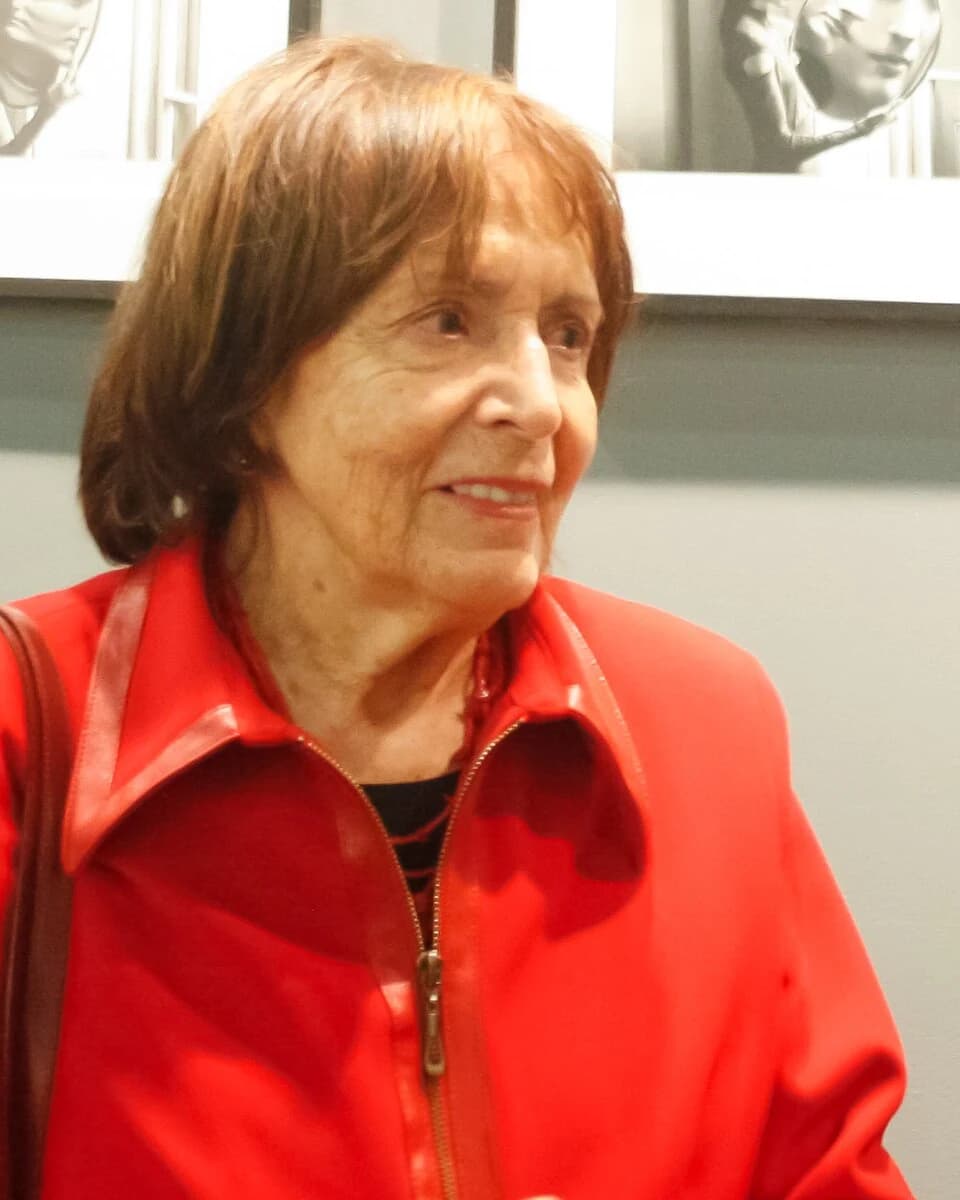
Beatriz González (1932–2026), a Colombian artist from Bucaramanga, took pictures from newspapers, postcards and holy cards and repainted them in flat colour on canvas, on cheap furniture, on sheet metal. In the 1960s and 1970s her work made people laugh; after 1985 it turned to mourning. She was also a historian of nineteenth-century Colombian art and for fifteen years curated the collections of the National Museum of Colombia.
Biography
In 1965 the jury of the Salon of Colombian Artists refused to accept a young artist’s painting and brushed it off as a “bad Botero”. Marta Traba, a critic and her former teacher, got the decision reconsidered. The painting was not merely accepted: Beatriz González won a special prize for it, and that was the start of her reputation. The work was called “The Suicides of Sisga”.
It is based on a newspaper photograph. Before throwing themselves from the dam on the Sisga river near Bogotá, two young farmers had their portrait taken by a photographer, and many local papers reprinted it in black and white. What attracted González, she said, was the very poor quality of the photograph, with its simplified, almost distorted faces.
She was born on 16 November 1932 in Bucaramanga, the youngest daughter of Valentín González Rangel and Clementina Aranda Mantilla. Her childhood and youth fell in the years of La Violencia, the civil violence that engulfed Colombia in the 1940s and 1950s, and this largely shaped her view of the country. In 1956 she travelled to Europe for the first time, then studied architecture for two years at the National University of Colombia, but did not complete the course and in 1958 returned to Bucaramanga. In 1959 she entered the art faculty of the University of the Andes in Bogotá, where her teachers were the Argentine critic Marta Traba and the Spanish painter Juan Antonio Roda, and she graduated in 1962; she later studied printmaking at the academy of fine arts in Rotterdam. Her first solo exhibition was held in 1964 at the Museum of Modern Art of Bogotá.
She was often counted among the pop artists, but she herself did not accept the label. She considered herself first of all a painter, and said of her painting that in it she had painted “the joy of the underdeveloped”. Her material was pictures that were already passing from hand to hand: newspaper photographs, postcards, holy cards, reproductions of old masters. In the 1960s came series of ink drawings after photographs from the tabloid press, in which crimes of passion and political murders sit alongside advertisements for headache cures. In the 1970s, after finding herself one day in a hardware store, she began buying the factory-made furniture found in modest homes and transferring famous images onto it. In “The Last Table” Leonardo’s “Last Supper”, painted on metal sheets, lies on a dining table in imitation wood: in Colombian homes this picture was hung above the front door as a charm against thieves. The pope’s face turned up on bedside tables, where a holy image usually hangs. The “Mona Lisa” took the place of the mirror in a huge antique coat rack, and the long title of the work, “I Was Born in Florence and Was 26 Years Old When My Portrait Was Painted”, is to be spoken, as the parenthesis instructs, in a low, sweet voice. A mother and child from a popular printed picture she placed inside a hospital crib found in the street. When she painted three presidents, Turbay, Lleras Restrepo and Betancur, in Native feather headdresses beside an Amazonian Indigenous man, many saw it as mockery of their governments.
In 1985 guerrillas of the M-19 movement seized the Palace of Justice in Bogotá; 94 people died. After that, she said, she could no longer laugh.
Her palette darkened. Her subjects became death, the drug trade and the most painful events of Colombian history, and mourning took the place of humour. Her starting point was still the work of newspaper photojournalists, but now these were photographs of grief.
She gave no less time to art history and to museums. Her main interest was the nineteenth century: she researched the history of Colombian caricature and the work of José María Espinosa, Ramón Torres Méndez and other artists of the period. At the Museum of Modern Art of Bogotá she headed the education department and in 1978 founded a school for gallery guides; from 1984 she sat on the art advisory committee of the Banco de la República; in 1975–1982 she advised the National Museum of Colombia, and later, until 2004, she was chief curator of its art and history collections. To my mind, this second, museum work also explains her painting: all her life she watched how pictures travel and how they are understood far from where they were born. The University of Antioquia gave her an honorary master’s degree in the arts (2000), the Ministry of Culture awarded her its prize for life and work (2006), and the University of the Andes made her an honorary doctor (2020).
Wide international recognition came late. In 2017 her work was shown at documenta 14 in Athens and Kassel, in 2018 the Museo Reina Sofía in Madrid exhibited her in the Palacio de Velázquez, and in 2019 the Pérez Art Museum Miami mounted her first retrospective in the United States, nearly 150 works from six decades. Her work is in the Museum of Modern Art in New York, Tate in London, the Museo Reina Sofía and the Museum of Fine Arts, Houston. The years 2025–2026 brought her exhibitions at the Pinacoteca de São Paulo and the Barbican Centre in London. Beatriz González died in Bogotá on 9 January 2026, at the age of ninety-three.
Profile notes
Profile and sources
Image
Artist image
Galeria Nouvelle; Wikimedia Commons; CC BY-SA 4.0.
