
1560–1600
Basawan
Basawan worked in the Mughal imperial workshop from about the late 1550s until 1600 and took part in almost all of Akbar’s great manuscripts, from the “Tutinama” to the “Akbarnama”. The chronicler Abu’l-Fazl ranked him fourth among the best painters at court, and for the “Razmnama” he painted more leaves than Daswanth, who was ranked higher.
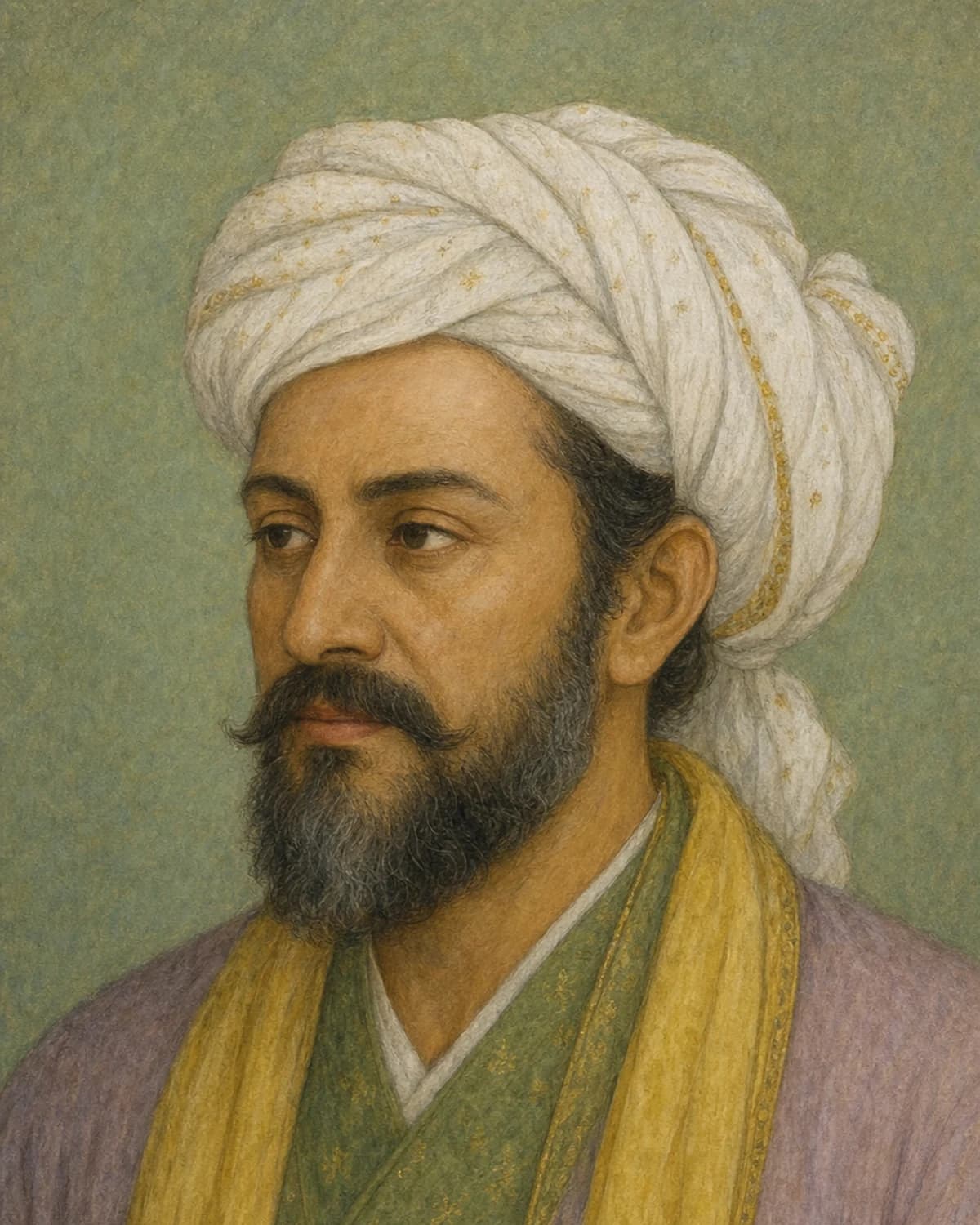
Biography
On a double-page spread of the “Akbarnama”, the emperor Akbar sits astride the elephant Hawai, known for his violent temper. The elephant has run amok and chased another elephant, Ran Bagha; this happened on a bridge by the fort at Agra, and the bridge gave way beneath them. Akbar is trying to master the beast, while on the right the courtiers, led by the vizier Atga Khan, have folded their hands in prayer, each with his own face and his own fear. Basawan painted this scene around 1590.
No documents about the artist himself survive: neither the year of his birth nor the year of his death is known.
He was, it seems, a Hindu who came to court as a young man from somewhere in northern India, in the second half of the 1550s. In the first years of Akbar’s reign the workshop needed many illustrators, and they were recruited from all the provinces. Basawan studied with Mir Sayyid Ali and above all with Abd al-Samad. In the “Ain-i-Akbari” Abu’l-Fazl devoted a separate chapter to the workshop and in his list of the seventeen best painters placed Basawan fourth, after Mir Sayyid Ali, Abd al-Samad and Daswanth; in drawing, colour and portraiture, he wrote, many connoisseurs preferred Basawan to Daswanth.
The first manuscript he worked on was the “Tutinama”, the “Tales of a Parrot” (1560–1565, Cleveland Museum of Art), a Persian translation of Sanskrit tales that was then being illustrated for the first time. His leaves there are recognised by their archaic architecture, like that of the Hindu miniatures of the “Chandayana” from Mandu; they are more conventional than his mature work. At the same time work was going on on the huge “Hamzanama”, and his contribution to it is considered substantial; the leaf “Asad ibn Karib Attacks the Night Camp of Malik Iraj” in the Metropolitan Museum shows that he could paint battles too, although they were not his favourite subject. In the “Anvar-i Suhayli” (1570–1571) one miniature is attributed to him, a parable of a pious man deceived first by a thief and then by a demon, and his Persian training is plain in it. In 1580 Jesuits from Goa, Rodolfo Acquaviva and Antonio Monserrate, arrived at court and gave Akbar seven volumes of the Royal Polyglot Bible with engravings; European prints had reached India even earlier. Basawan proved receptive to them: he copied them, varied them, and set European figures among multicoloured Persian rocks. In his best works the Indian, the Persian and the European come together, sometimes eclectically, sometimes in close harmony. By the 1580s he had surpassed his colleagues both in quality and in the number of leaves: in the “Razmnama”, the Persian translation of the “Mahabharata” (about 1582–1586), 33 illustrations are his and 30 Daswanth’s; in the “Timurnama” (about 1584) he has 13, Daswanth eight.
In the “Darabnama”, made in Lahore around 1585, he has only one miniature, “Tamarusa and Shapur on the Island of Nigar”. King Harikus’s city on stilts in the middle of the water resembles an idealised Lahore, Akbar’s new capital, and the face of a man bailing water out of a boat is shown frontally, which is unusual both in older Indian and in Persian painting. To my mind, this leaf shows best of all how far he had come since the “Tutinama”.
Manuscripts were usually made jointly: a leading master supplied the composition and drawing, others applied the colour, others again painted the faces. An artist could do a work entirely on his own only on a separate leaf outside a book. Such, probably, is the “Flight of the Simurgh” (around 1590, Aga Khan collection, Geneva), on a subject from Nizami’s “Haft Paykar”: the hero, clinging to the bird’s claws, is carried off to the lands of paradise. The two men in the Simurgh’s beak, as the art historian S. C. Welch observed, are not in the poem. In Jami’s “Baharistan” (Lahore, 1595) the Sufi Abu’l Abbas rebukes a dervish who is proud of his rags, and the figures are placed on a terrace so that real depth is felt. In the “Khamsa” of Amir Khusrau Dihlavi (1596–1597) a Muslim pilgrim learns devotion from a Brahmin lying prostrate on the road to the temple of Shiva at Somnath; the distant landscape with a bridge is borrowed from a European model, perhaps Adriaen Collaert’s engraving “Africa” after Maerten de Vos.
Around a hundred works are associated with his name. Among the signed drawings in the Musée Guimet in Paris are variations on European engravings, for example “Young Woman and Old Man”, which repeats the subject of Saint Luke painting the Virgin. It is thought that around 1600, after the death of Abd al-Samad, he became head of the imperial workshop in Lahore; according to another version, this happened as early as 1585, after Daswanth’s death. From about 1600 his name stops appearing in the marginal inscriptions of miniatures. His son Manohar also became a painter and worked for Akbar and then for his heir, Jahangir.
Related context
Associations
Works connected through artistic movements, cultural context and period. Priced works available in this market appear first.
Profile notes
Profile and sources
Image
Artist image
На основе открытого изображения: sailko; Wikimedia Commons; CC BY-SA 3.0.
