
29.01.1905–04.07.1970
Barnett Newman
Barnett Newman (1905–1970) found his language in 1948 with “Onement I”: an even field of colour cut by a thin vertical stripe. He destroyed his early work, critics met his first solo show with hostility, and recognition came only in the 1960s. He is one of the leading colour field painters, and Donald Judd and Frank Stella built on his example.
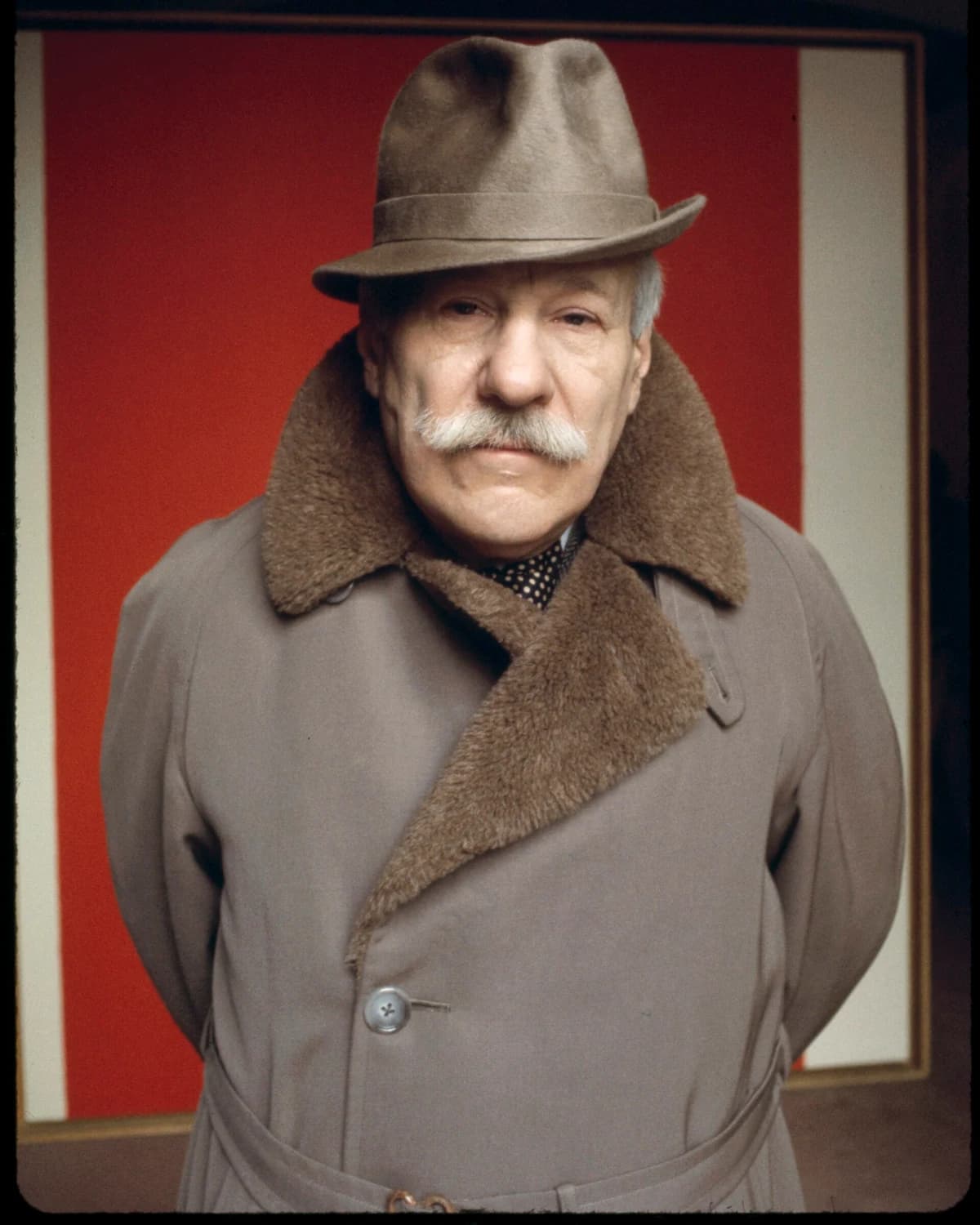
Biography
Once Newman printed a set of instructions and pasted it on a gallery wall: visitors were asked to come right up close to his canvases. To many people his large single-colour fields seemed empty. Up close, he believed, a painting makes a person aware of himself.
His “The Wild” (1950) is 2.43 metres high and 4.1 centimetres wide. Apart from the vertical stripe, there is nothing in the picture.
Barnett Newman was born on 29 January 1905 in New York to Jewish immigrants from Poland. He studied painting at the Art Students League under Duncan Smith and John Sloan, studied philosophy at City College, worked in his father’s clothing business and later earned a living by teaching, writing articles and criticism. In 1934, while working as a substitute teacher at Grover Cleveland High School, he met Annalee Greenhouse, also a teacher, and on 30 June 1936 they married. From the 1930s he painted in an expressionist manner, but later destroyed everything he had made before the age of forty.
In the 1940s Newman thought and wrote more than he exhibited. He composed catalogue forewords and reviews, organised exhibitions, and as early as 1944 tried to describe the newest American art, drawing up a list of “the men in the new movement”: Gottlieb, Rothko, Pollock, Hofmann, Baziotes, Gorky and the former Surrealists Matta and Wolfgang Paalen; Motherwell stood on the list with a question mark. He himself, in 1944–1945, drew in the manner of Surrealist automatism, in calligraphic lines. In 1947, as he approached his mature style, he wrote that art worthy of the name speaks of life, man, nature, death and tragedy. In 1948, together with Baziotes, Rothko, Motherwell and David Hare, he opened the Subjects of the Artist school on Eighth Street, where Jean Arp, John Cage and Ad Reinhardt came to give public lectures; the school made no money and closed in the spring of 1949. The same year, 1948, is the date of “Onement I”, now in the Museum of Modern Art in New York. Newman believed that it was in this series that he found himself.
The thin vertical stripes, which he called “zips”, divide the picture and bind it into a single whole. In the first works the field around them is uneven; later the colour becomes pure and flat. Many canvases long remained untitled, and the titles Newman gave them later often refer to the Old Testament and Jewish tradition: “Adam”, “Eve”, “Uriel” (1954), “Abraham” (1949). The very dark “Abraham” also bears the name of the artist’s father, who died in 1947. Earlier came “The Command” and “Euclidean Abyss” (both 1946–1947), later the huge “Vir Heroicus Sublimis” (1950–1951).
His first solo exhibition, at the Betty Parsons Gallery in New York (it is dated 1950, sometimes 1948), was savaged by the critics. After that Newman almost stopped showing his work for several years. He and his wife lived mainly on her teacher’s salary until the late 1950s, when his paintings began to sell steadily. The influential critic Clement Greenberg wrote about him with enthusiasm, but Newman was taken seriously only towards the end of his life; recognition came when he was about sixty, and until then he was overshadowed by more colourful figures such as Jackson Pollock.
Many consider his chief work to be “The Stations of the Cross”, a series of black-and-white paintings from 1958–1966. It carries a subtitle, the words of Christ on the cross: “Lema Sabachthani”, “Why hast thou forsaken me”. Newman believed they spoke to his own time as well, and the series is often read as a memorial to the victims of the Holocaust. In 1963–1964 he made a cycle of lithographs, “18 Cantos”, which in his words were meant to call music to mind. His best-known sculpture, “Broken Obelisk” (1963), is an inverted obelisk standing with its point on the apex of a pyramid.
He painted his late pictures in acrylic instead of oil, in pure, bright colour, often on very large canvases: the series “Who’s Afraid of Red, Yellow and Blue” (1966–1970), “Voice of Fire” (1967, National Gallery of Canada, Ottawa), the triangular “Chartres” (1969). His largest work, “Anna’s Light” (1968), named in memory of his mother, who died in 1965, is 8.5 metres wide. To my mind, the easiest way to understand what he was after is to stand right up against such a canvas, as he asked. His rejection of the expressive brushwork used by Clyfford Still and Mark Rothko, and the hard edges of his flat colour fields, made him a precursor of Minimalism; he had a marked influence on Donald Judd, Frank Stella and Bob Law.
Barnett Newman died in New York on 4 July 1970, at the age of sixty-five. In 1979 his widow, Annalee, founded the Barnett Newman Foundation; in 2004 the complete catalogue of his work was published, and in 2018 the foundation gave more than seventy works to the Jewish Museum in New York.
Related context
Associations
Works connected through artistic movements, cultural context and period. Priced works available in this market appear first.








Profile notes
Profile and sources
Image
Artist image
Bernard Gotfryd; Wikimedia Commons; Public domain.