
10.01.1903–20.05.1975
Barbara Hepworth
Barbara Hepworth (1903–1975) was among the first sculptors to pierce a figure right through, and from 1939 she lived in St Ives, in Cornwall. There she worked in stone, wood and bronze, and there she also drew operating rooms. Her “Single Form” stands in front of the United Nations building in New York. After her death her studio in St Ives became a museum.
Biography
In 1947–1949 Barbara Hepworth made nearly eighty drawings of operating rooms, in chalk, ink and pencil, with surgeons at work. The occasion was the illness of her daughter Sarah, who had been admitted to hospital in 1944. The surgeon Norman Capener, who had become her friend, invited her to watch operations. Hepworth noted that the surgeon’s approach and the sculptor’s are alike.
She was born on 10 January 1903 in Wakefield, in West Yorkshire, the eldest child of a civil engineer who worked for the county council. At school she won prizes for music. From 1920 she studied at Leeds School of Art, where she became friends with Henry Moore; their friendly rivalry lasted many years. She then won a county scholarship and from 1921 studied at the Royal College of Art in London, receiving her diploma in 1924. Finding a place in a profession dominated by men was not easy.
On a travelling scholarship she went to Florence. In the competition for the Prix de Rome Hepworth came second, and the sculptor John Skeaping won. In May 1925 she married him in Florence. The Italian sculptor Giovanni Ardini taught her to carve marble. In 1926 the couple returned to London and exhibited their work in their own flat. In 1929 their son Paul was born.
In 1931 she fell in love with the abstract painter Ben Nicholson. Both were still married. She divorced Skeaping in March 1933. It was then that her first sculptures with a hole cutting right through the figure appeared; Moore later followed the same path. In 1933 she travelled with Nicholson to France, where they visited the studios of Jean Arp, Pablo Picasso and Constantin Brâncuși, and she joined the Paris-based group Abstraction-Création. The same year, together with Nicholson, Paul Nash, the critic Herbert Read and the architect Wells Coates, she founded Unit One, a group that sought a way to unite Surrealism and abstraction in British art. In 1934 she and Nicholson had triplets, Rachel, Sarah and Simon. Hepworth argued that a woman artist is deprived of nothing by the kitchen or by children, provided she does some work every day, even half an hour, so that the images grow in her mind. Her marriage to Nicholson took place on 17 November 1938. In 1937 she had designed the layout of “Circle”, a survey of Constructivist art prepared by Nicholson, Naum Gabo and Leslie Martin.
In 1939, with the outbreak of war, the family moved to Cornwall. From 1949 until her death Hepworth lived and worked at Trewyn Studio in St Ives. She called finding the studio something like magic: there were a yard and a garden where she could work in the open air. On 8 February 1949 she and Nicholson founded the Penwith Society of Arts; among its nineteen founding members were Peter Lanyon and Bernard Leach. From that year she had assistants, sixteen in all; for the two Irish limestone figures of “Contrapuntal Forms” she hired the first three: Terry Frost, Denis Mitchell and John Wells. The work was shown at the Festival of Britain in 1951. In 1950 her works were exhibited in the British Pavilion at the Venice Biennale. In 1951 she and Nicholson divorced. From then on she stopped working only in stone and wood and turned to bronze and clay. She designed the garden in St Ives together with the composer Priaulx Rainier and used it to view her large bronzes.
Her eldest son Paul was killed on 13 February 1953 in a plane crash in Thailand, where he was serving with the Royal Air Force. In his memory “Madonna and Child” stands in the parish church of St Ives. Exhausted, in part by this loss, in August 1954 she went to Greece with her friend Margaret Gardiner. On her return she found a consignment of Nigerian guarea hardwood that Gardiner had sent. Between 1954 and 1956 six works were carved from it, many inspired by the Greek trip, for example “Corinthos” (1954) and “Curved Form (Delphi)” (1955).
International success followed. In 1959 Hepworth won the Grand Prix at the São Paulo Biennial. In 1960 she bought a former cinema and dance hall, the Palais de Danse, across from Trewyn and made a studio there for large commissions. In 1961 she was commissioned to make a memorial to Dag Hammarskjöld, the second Secretary-General of the United Nations, who had died in a plane crash. “Single Form” was installed in 1964 in the plaza in front of the United Nations building in New York; a smaller version stands in Battersea Park in London. Her relations with American galleries were difficult. Her first exhibition in New York took place in 1957, and at the opening, by her own account, she pulled faces at the cameras and left as soon as she could. Three years later, for the sake of the commission and larger opportunities, she exchanged her earlier dealers for Marlborough. I may be wrong, but in this choice one can see what it cost her: she sacrificed personal loyalties to her work.
In 1958 she was made a Commander, and in 1965 a Dame Commander, of the Order of the British Empire. She received honorary degrees from the universities of Birmingham, Leeds, Exeter, Oxford, London and Manchester. In 1968 she was given the Freedom of St Ives, and in Gorsedh Kernow, the Cornish assembly of bards, she received the bardic name Gravyor, “Sculptor”. In 1973 she became an honorary member of the American Academy of Arts and Letters. In her later years she tried lithography: suites in 1969 and 1971 at the Curwen Gallery, among them “The Aegean Suite”, after her trip to Greece. In 1970 “Opposing Forms” appeared.
Hepworth died on 20 May 1975 in an accidental fire at Trewyn Studio, at the age of seventy-two.
Her home and studio became the Barbara Hepworth Museum, run by the Tate since 1980. In 2011 The Hepworth Wakefield opened in Wakefield, designed by David Chipperfield.
Related context
Associations
Works connected through artistic movements, cultural context and period. Priced works available in this market appear first.








Profile notes
Profile and sources
Image
Artist image
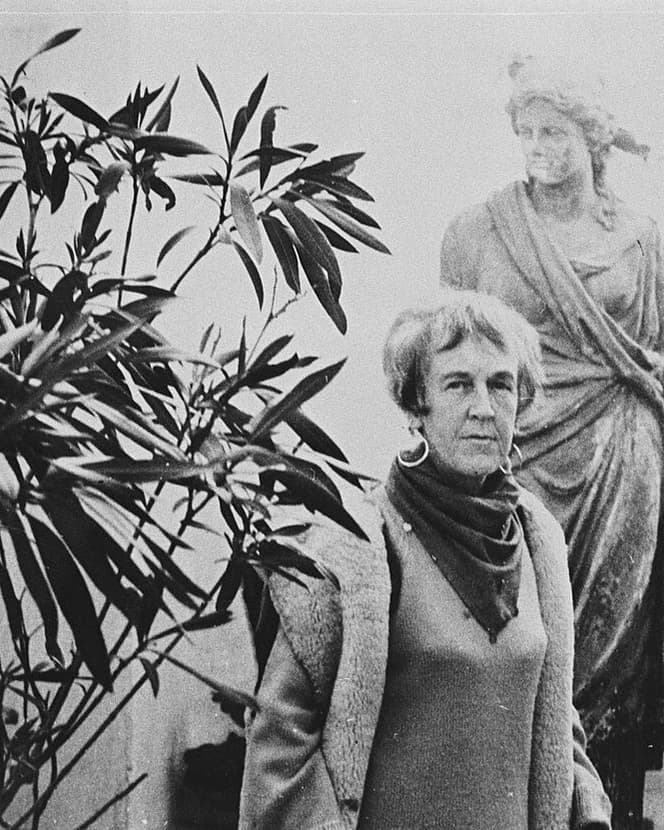
Geoff Charles; Wikimedia Commons; CC BY-SA 4.0.
