
29.02.1908–18.02.2001
Balthus
At thirteen, Balthus (born Balthasar Klossowski, later Klossowski de Rola) published a series of drawings about a lost cat named Mitsou, with a preface by Rilke. His 1934 exhibition in Paris and “The Guitar Lesson” brought him scandalous fame. He painted portraits, landscapes and interiors with adolescent girls, directed the French Academy in Rome and died in Rossinière, Switzerland.
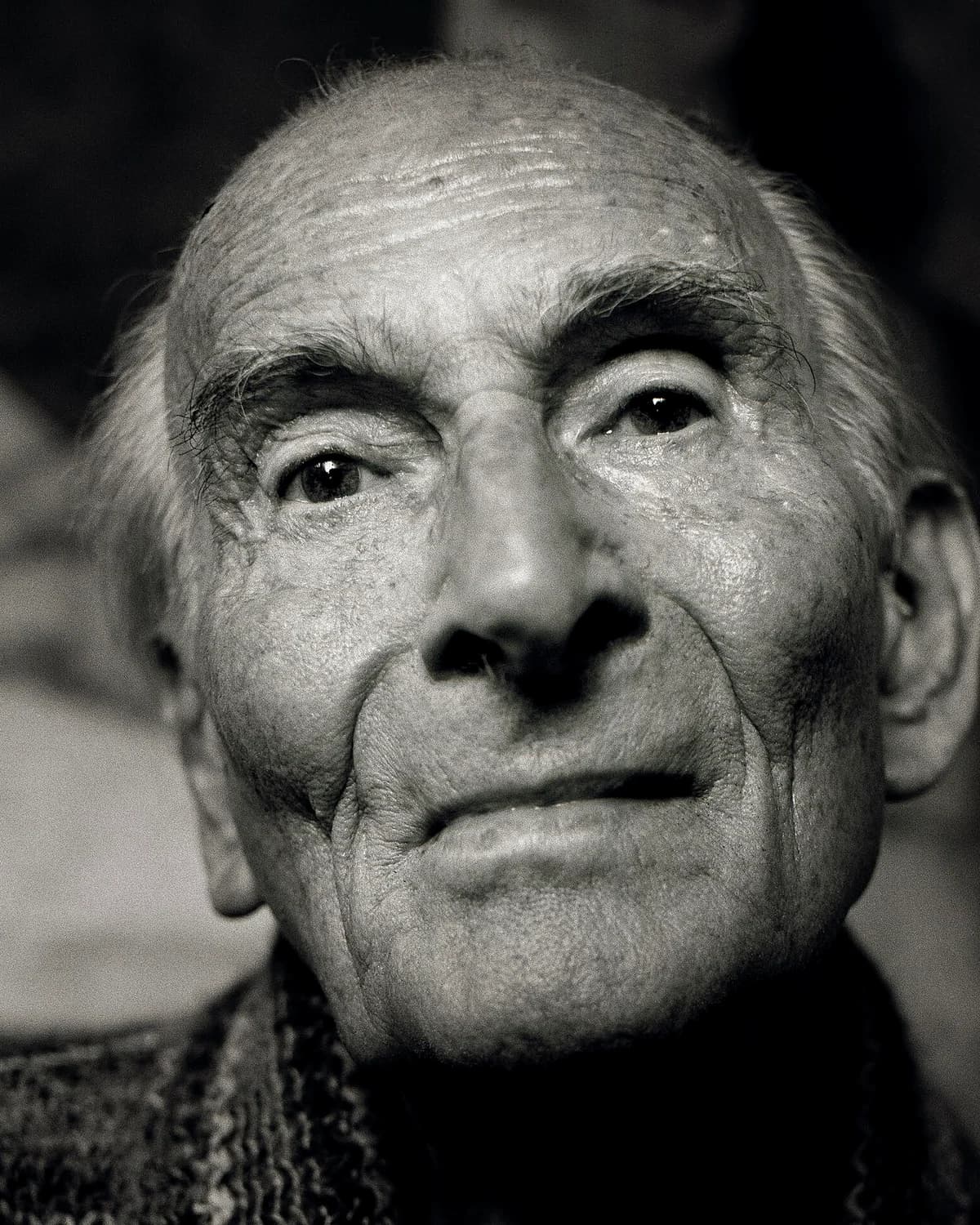
Biography
In 1921 a small book called “Mitsou” appeared: forty drawings about a boy who loses his cat, with a preface by Rainer Maria Rilke. The artist who made the drawings was thirteen. Later he took the name Balthus, which goes back to a childhood nickname.
He was born on 29 February 1908 in Paris, the son of Erich Klossowski, a painter and art historian, and the painter Elisabeth Dorothée Spiro, whom friends called Baladine. His older brother Pierre Klossowski became a writer and philosopher. André Gide, Pierre Bonnard and Maurice Denis visited the house. The family held German citizenship, and soon after the First World War began they had to leave Paris: first for Switzerland, then for Berlin. In 1917 his parents separated, and his mother settled in Geneva with her sons and, some time later, became close to Rilke. Balthus himself told differing stories about his mother’s origins, and his biographer Nicholas Fox Weber disputes them. The title of count and the name “de Rola” the artist took for himself later, citing his father’s Polish nobility.
In 1926 he visited Florence and copied frescoes by Piero della Francesca. The first independent work of this circle is thought to be the tempera wall paintings in the Protestant church of the Swiss village of Beatenberg (1927). In 1930–1931 he served in the army in French Morocco, as a clerk, and there sketched the composition “La Caserne” (“The Barracks”).
In 1933 Balthus settled in Paris. His first exhibition, at Galerie Pierre in 1934, caused a scandal. “The Guitar Lesson” shows a girl arched backwards across the lap of her teacher, who holds her like an instrument; viewers were troubled by the eroticism, and also by the resemblance of the composition to the “Pietà of Villeneuve-lès-Avignon”. The Surrealists welcomed him in Paris. Breton and Picasso admired his early painting, and he was friends with Artaud, Miró, Giacometti, Derain, Michel Leiris and René Char. He himself did not want to be called a Surrealist: he painted realistically, with an almost photographic stillness in his figures. In 1935 he designed the sets and costumes for Artaud’s production of Shelley’s “The Cenci”. In 1935–1939 he painted a series of portraits of a girl, Thérèse Blanchard, the best known of which is “Thérèse Dreaming” (1938). His shows at Pierre Matisse’s gallery in New York began in 1938, although Balthus never went to the United States. In 1937 he married Antoinette de Watteville, from a Bernese family.
He insisted that paintings should be looked at, not read, and refused to provide biographical notes. For the catalogue of his London exhibition in 1968 he asked that it begin with the statement that nothing is known about Balthus.
In 1940, when France was occupied, he left for Savoy, to a farm at Champrovent, where he painted “The Living Room” and “Landscape near Champrovent”. In 1942 he moved to Switzerland, to Bern, and from 1945 lived in Geneva, where he became a friend of the publisher Albert Skira. In 1946 he returned to France. For a production of “Così fan tutte” in Aix-en-Provence (1950) he designed the sets together with Cassandre, and for Camus’s “The State of Siege”, directed by Jean-Louis Barrault (1948), the sets and costumes. From 1953 he lived at the Château de Chassy in the Morvan and finished “The Room” (1952) and “Le Passage du Commerce Saint-André” (1954) there. He painted portraits, landscapes and still lifes, and from the 1940s more and more often adolescent girls in domestic settings, with a mirror, a cat or a butterfly. He denied that his works were erotic, and said that they acknowledged the uncomfortable facts of children’s sexuality.
In 1956 an exhibition at the Museum of Modern Art in New York made him known in America. In 1961 André Malraux, the French Minister of Culture, appointed him director of the French Academy in Rome. Until 1977 he lived at the Villa Medici, became friends with Federico Fellini and Renato Guttuso, and turned to casein tempera: some paintings he worked on for six, seven, even ten years. On a trip to Japan he met Setsuko Ideta and married her in 1967. He became fascinated by Japanese art and wore kimonos embroidered with the Rola arms. In 1968–1973 he painted a series of “The Card Players”.
In 1977 Balthus settled in Rossinière, in a large chalet. Retrospectives in 1983–1984 were held at the Centre Pompidou and at the Metropolitan Museum of Art in New York. In 1991 he received the Praemium Imperiale of Japan. He was one of the few living artists whose work hung in the Louvre: “The Children” (1937) came there from Picasso’s collection. In 1996 Damian Pettigrew made a film about him, “Balthus Through the Looking Glass”.
Balthus died on 18 February 2001 in Rossinière. The President of France, Jacques Chirac, attended the funeral, and Bono of U2 sang.
Related context
Associations
Works connected through artistic movements, cultural context and period. Priced works available in this market appear first.








Profile notes
Profile and sources
Image
Artist image
Неизвестен; Wikimedia Commons; CC BY-SA 4.0.
