
06.01.1819–18.01.1886
Baldassare Verazzi
Baldassare Verazzi (1819–1886), a native of Caprezzo in Piedmont, studied at the Brera Academy in Milan and in 1849 painted a scene of fighting at Palazzo Litta, placing a self-portrait in it. In 1855 or 1856 he left for Argentina, decorated the old Teatro Colón in Buenos Aires and worked in Montevideo, and he died at Lesa on Lake Maggiore.
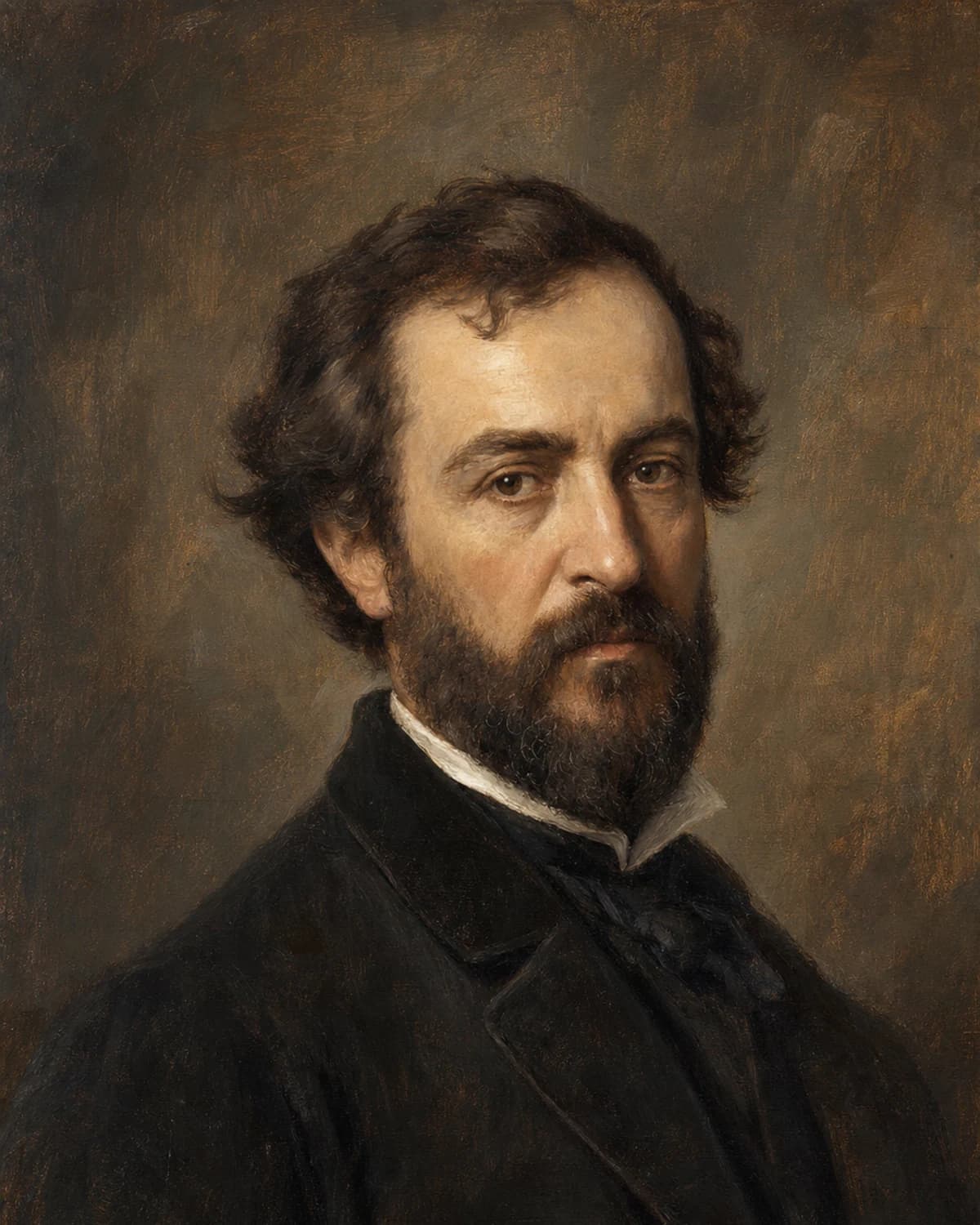
Biography
Among the wounded at the foot of the barricade in “Episode from the Five Days” there is the painter himself. Baldassare Verazzi painted it in 1849, a year after the uprising against the Austrians, and showed himself as a fallen fighter. The canvas, also known as “Fighting at Palazzo Litta”, is now in the Museum of the Risorgimento in Milan.
He was born on 6 January 1819 in Caprezzo, in Piedmont. By some accounts his origins were modest. From 1833 to 1842 he studied at the Brera Academy in Milan; later, in 1851, he worked under Francesco Hayez. It is sometimes reported that Hayez had already been his teacher at Brera and that Verazzi was a favourite pupil who won prizes, but the accounts differ. The date of Verazzi’s return to Milan is unclear. For the courtyard of Brera he painted a fresco on the life of Leonardo da Vinci; by custom, such a commission went to the best graduate. His pictures were shown in Turin and Milan. Among the early works named are “The Holy Family in Egypt”, “The Parable of the Good Samaritan” (1851) and “Raphael Presented by Bramante to Pope Julius II” (1854).
In 1848 he took part in the struggle against Austrian rule. After the uprising was suppressed he was pursued and lived as an exile; according to one account, he took refuge in Cannobio and restored the frescoes of the old church there.
He went to Argentina in 1855 or 1856, either at the invitation of a consul or together with other artists hired for the building of the first Teatro Colón. The building opened in 1857. Verazzi and the decorator Cheronetti painted the ceiling and the foyer. These paintings did not survive: the theatre was rebuilt as the Banco de la Nación. Verazzi taught drawing and painting, held an exhibition in 1856, and counted the Argentine painter Cándido López among his pupils. Most of his commissions were family portraits. A group of eight people, the Iraola and Gómez family (1858), was praised in the newspapers for its complete likeness to the sitters. “Portrait of a Father with His Two Daughters” is in the National Museum of Fine Arts in Buenos Aires. He also painted subjects from Argentine history, among them “The Battle of Pavón”.
His life in Buenos Aires was restless. In 1858 his painting “The Execution of Mary Stuart” caused a scandal: in the face of the executioner people recognised the Carbonaro Juan Bautista Cúneo, a prominent figure in the Italian community and a friend of Giuseppe Mazzini and Giuseppe Garibaldi. Several people challenged Verazzi to duels, and he had to repaint the executioner’s face. In 1862 he publicly demanded, through the newspapers, that a rival, the Italian painter Ignacio Manzoni, show his diplomas. The allegorical portrait of General Urquiza (1860), with a winged Victory crowning the hero, he displayed in his studio for a month. Apparently Urquiza had not been consulted: he did not come to the exhibition and refused to receive the painter at his estate. After crossing the ocean more than once, the picture ended up in Paraná, in the White Room of the Casa Gris.
I would not take this story as the decisive reason for his departure; there are no documents on his motives. But in 1862 Verazzi moved to Montevideo and worked there until 1866. In 1863 the church authorities commissioned a series of frescoes from him in the rotunda of the Central Cemetery. He painted portraits of generals and colonels, including Fructuoso Rivera and León de Palleja; many of them are now in the National Historical Museum in Montevideo. Then he returned briefly to Buenos Aires.
He came back to Italy, stopping in Rio de Janeiro to paint his last American pictures. He settled in Lesa on Lake Maggiore, kept up his ties with Caprezzo, and painted lake landscapes together with his son Serafino (1875–1945), also a painter. Verazzi died in Lesa on 18 January 1886. His altarpieces and other church works remain in churches in Lombardy and Piedmont, including Caprezzo.
Related context
Associations
Works connected through artistic movements, cultural context and period. Priced works available in this market appear first.








Profile notes
Profile and sources
Image
Artist image
На основе открытого изображения: Baldassare Verazzi (1819-1886); Wikimedia Commons; Public domain.
