
30.10.1940–present
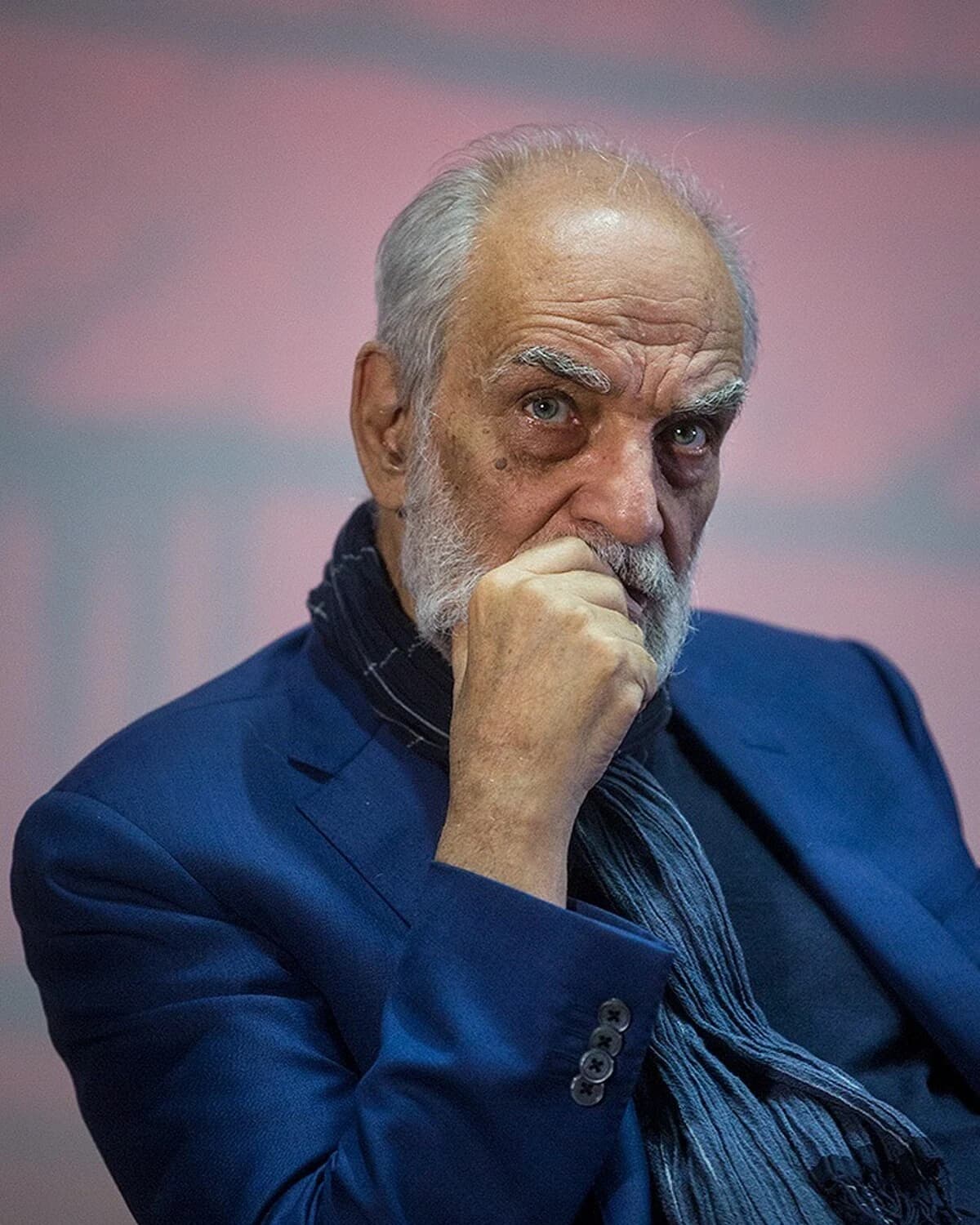
Aydin Aghdashloo
Aydin Aghdashloo (born 1940) paints in gouache on canvas faceless dolls, floating objects casting shadows on the ground, and old masters with every mark that time has left on them. In 1976–1979 he took part in creating Tehran’s museums, after the revolution he took Iranian art to exhibitions in China, Japan and Italy, he writes books on art, and in 2016 he received the Legion of Honour.
Biography
After the eight-year war with Iraq, blades appeared on Aydin Aghdashloo’s canvases: that was how he painted the missiles that fell on the cities. Beside them, abandoned huts, green rotting window frames with the glass knocked out, old doors with rusted locks. All of it is about slow ruin, about how hard times pass.
He paints almost always in gouache on canvas.
He was born on 30 October 1940 in Rasht, in the Afakhray neighbourhood, the son of Mohammad-Beik Aghdashloo and Nahid Nakhjevan. His father, an Azerbaijani and a member of the Musavat party, took his surname from the small town of Agdash. Seeing talent in the boy’s school drawings and his hand-made models, his father took him to Habib Mohammadi, a painter and teacher in Rasht; later, when the boy was living with his aunt, she enrolled him in the drawing classes of Monsignor Basile, and there he first learned what oil paint was. In 1959, at nineteen, he entered the School of Fine Arts of Tehran University, and in 1967, in his final year, he left without finishing. From his youth he drew posters for exhibitions, books and films.
His first solo exhibition was held in 1975 at the Iran-America Society in Tehran: floating objects, dolls, things about the Renaissance. Objects had begun to float in his work at about thirty, each casting a shadow on the ground; the dolls were faceless, with a glance at Giorgio de Chirico, and later they grew into the large series “Years of Fire and Snow”. In his words, the faceless dolls let him say in paint the suspicious and illusory things that live in the subconscious. His other line is old masters painted anew, but with everything that time has done to them: Bahram Beyzai wrote that copying was not the whole art of those masters, just as it is not the whole of Aghdashloo’s, and that in these repaintings admiration goes hand in hand with sorrow for the mortality of the painters themselves and of their pictures. For Beyzai’s books he made several paintings: “Ayyar-nameh”, “A Modern Preface to the Shahnameh”, “The Scroll of Sheikh Sherzin”. Iranian miniature has stayed with him for good, and he takes any classical Iranian style to say something about the present day.
In 1976–1979 he took part in creating the museums of Tehran: the Glassware and Ceramics Museum, the Reza Abbasi Museum, the Museum of Contemporary Art, as well as the museums in Kerman and Khorramabad. After the 1979 revolution he assembled and coordinated exhibitions, not of his own work, but important for contemporary Iranian art to be seen at home and abroad: “Iranian Art, from the Past until Today” in China, “Past Iranian Art” in Japan, contemporary Iranian painting with a traditional basis in Bologna. He ran art classes and for a time taught painting at Al-Zahra University in Tehran.
He writes books too: criticism of contemporary art and of the art of the past, of Iran and of the world, among them “Agha Lotf-Ali the Painter from Shiraz”, “Years of Fire and Snow”, “Words and Other Interviews”, “Terrestrial and Heavenly”; he is also known as a film critic. Until 2014 he had had only one solo exhibition at home; in November 2014 a second opened, at the Asar Gallery in Tehran. On 12 January 2016, at the French embassy in Tehran, he was presented with the Legion of Honour. In October 2021 his work was included in the exhibition “Memling Now”, on the influence of Hans Memling on contemporary art; in the summer of 2022 he spoke at a commemoration of his long-time friend and collaborator Abbas Kiarostami, and in August and September 2022 he took part in the exhibition “A Nostalgic Glimpse Into the Recent Art of Iran” at the Homa Art Gallery in Tehran.
Profile notes
Profile and sources
Image
Artist image
Ali Khara; Wikimedia Commons; CC BY 4.0.
