
16.06.1863–29.07.1898
Arturo Michelena
Arturo Michelena (1863–1898) won a medal at the Paris Salon of 1887 for “The Sick Child” and a gold medal at the Exposition Universelle of 1889 for “Charlotte Corday”, then returned to Caracas and became the official painter of President Joaquín Crespo. His best-known picture, “Miranda in La Carraca” (1896), is in the National Art Gallery in Caracas.
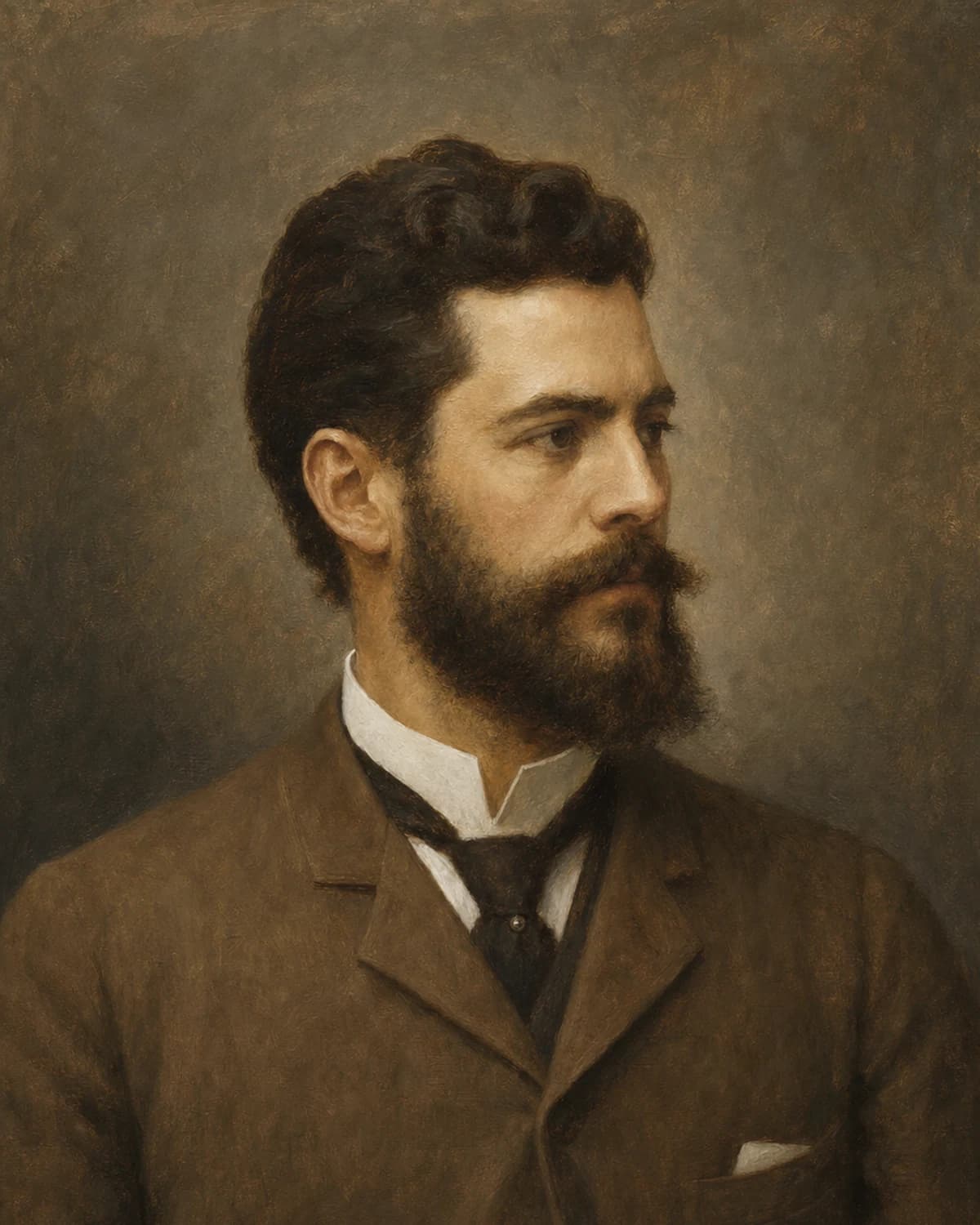
Biography
In June 1896 the writer Eduardo Blanco sat for Arturo Michelena in his house in the Caracas district of La Pastora. Blanco was cast as Francisco de Miranda in the last days of his life, in the prison of the arsenal of La Carraca at San Fernando, in the Spanish province of Cádiz, where Miranda spent the years from the end of 1813 until his death in 1816. The artist did not take the face from Blanco: he modelled it on a lithograph by Carmelo Fernández of 1841 and a medallion by Charles-Étienne Gaucher of 1793. On the wall to the right a ring with a chain is set into the masonry; on a small table to the left is a pile of books, and another book lies on the bed.
The picture was painted for the eightieth anniversary of Miranda’s death, for a competition that President Joaquín Crespo announced as part of the commemorations. On 18 July 1896 it was shown at the Municipal Theatre in Caracas, then, because of the crowds, it was kept on view for a whole week at the presidential residence, the Casa Amarilla, and that same year the state bought it.
Francisco Arturo Michelena Castillo was born on 16 June 1863 in Valencia, Venezuela. His father, Juan Antonio Michelena, was a painter; his mother, Socorro Castillo, was the daughter of the muralist Pedro Castillo. The boy began painting very early, under his father’s guidance. In 1874 the eleven-year-old Arturo drew the illustrations for the American edition of “Venezuelan Customs” by the journalist Francisco de Sales Pérez, and Pérez became his patron, introducing him to the circle around the statesman Antonio Guzmán Blanco in the hope of securing him a scholarship. Then came lessons with a French émigré, Constanza de Sauvage, a pupil of Eugène Devéria. From 1879 to 1882 father and son ran a private art school in Valencia and took commissions for portraits, wall paintings and copies of the Old Masters. In 1883 Arturo sent two pictures to the large exhibition in Caracas for the centenary of Simón Bolívar and won a silver medal for one of them; that work is still in the Bolívar Museum.
Two years later the government gave him a grant to study in Europe. He went to Paris together with Martín Tovar y Tovar, enrolled at the Académie Julian and studied with Jean-Paul Laurens. On Laurens’s advice he sent “The Sick Child” to the Salon of 1887 and won a gold medal, second class, the highest award a foreigner had received up to then. The picture was later bought by the Astor family and taken to New York. Two years after that, at the Exposition Universelle of 1889, he was awarded another gold medal, for Charlotte Corday being led to her execution.
That same year he unexpectedly returned to Venezuela, married Lastenia Tello Mendoza, a well-known art collector, and went back to Paris with her. In 1890 he illustrated Victor Hugo’s “Hernani”. The Venezuelan government commissioned from him a painting to be presented to New York in gratitude for the hospitality shown there to the exiled General José Antonio Páez. The result was “Vuelvan Caras” (“About Face”): Páez at the Battle of Las Queseras del Medio.
In 1892 Michelena fell seriously ill and, on his doctors’ advice, moved back to Venezuela for good. In Caracas he painted fashionable portraits, became the official painter of President Crespo and received a large commission for decorations at the Miraflores Palace, the presidential residence. It seems to me that the “Miranda” of these years says more about him than the official commissions: the cramped cell, the chain on the wall, the books.
Michelena died in Caracas on 29 July 1898, at the age of thirty-five, and many of his works were left unfinished. He left about two hundred paintings and some five hundred drawings, sketches and studies. One of the smaller copies of the “Miranda”, which he never sold, was bequeathed by his widow to the city hall of Valencia; it was thought lost until in 1972 it was found in the basement of the former municipal council, and it now hangs in the mayor’s office.
Related context
Associations
Works connected through artistic movements, cultural context and period. Priced works available in this market appear first.








Profile notes
Profile and sources
Image
Artist image
На основе открытого изображения: Anonymous Unknown author; Wikimedia Commons; CC0.
