
08.04.1867–01.09.1943
Arthur Streeton
Arthur Streeton (1867–1943) painted landscapes in “gold and blue” around Melbourne and Sydney and was one of the leading artists of the Heidelberg School. His “Golden Summer, Eaglemont” was the first work by an Australian-born artist to be shown at the Royal Academy in London. He spent a quarter of a century living mainly in England, was a war artist in France during the First World War and was knighted in 1937.
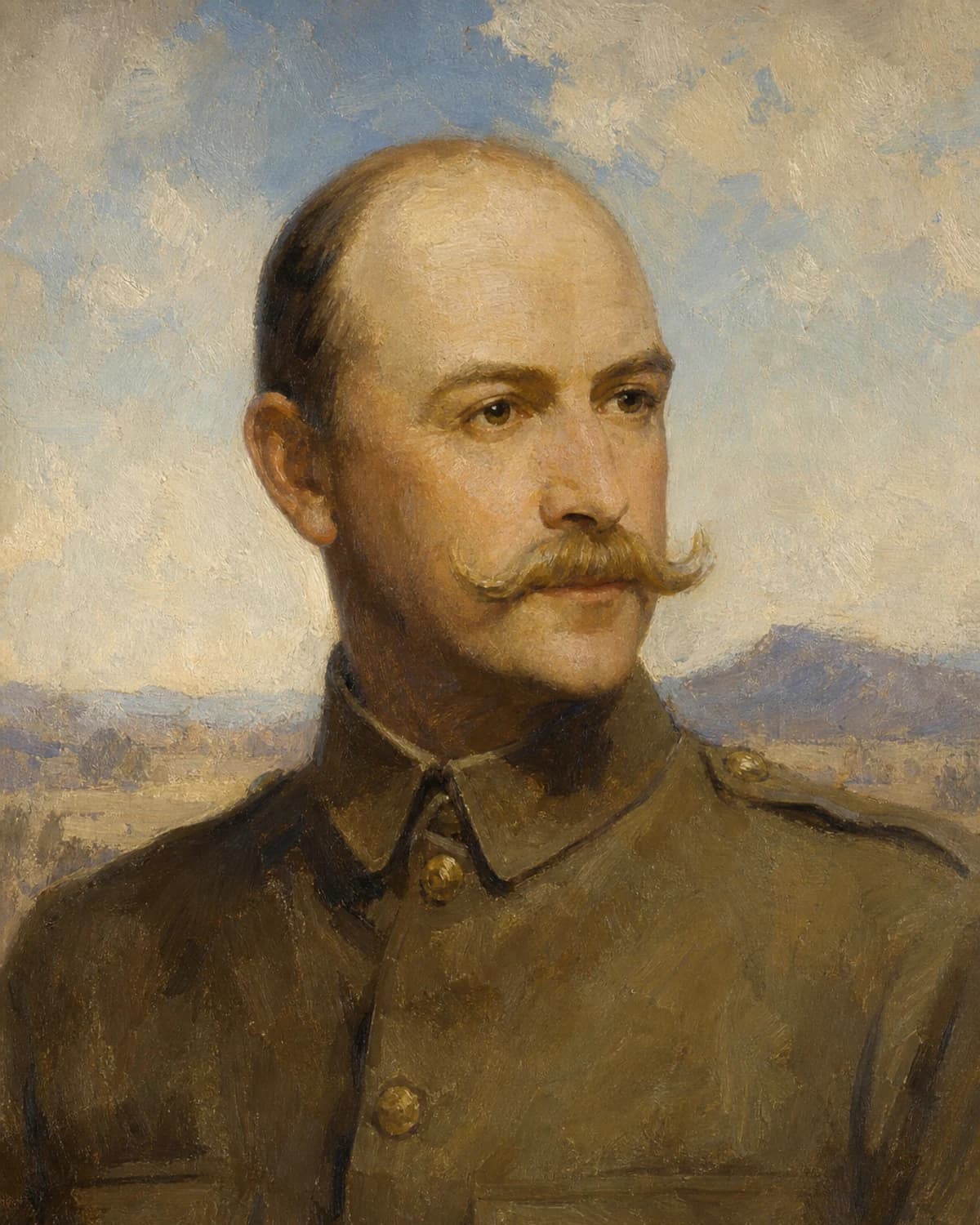
Biography
In 1893 a mining company was planning to sink a coal mine on the shore of Sydney Harbour, at Cremorne, and to cut down a great many gum trees to do it. Arthur Streeton wrote a letter to Sydney's Daily Telegraph that came to be known as “Streeton's shriek”. He predicted that charming Cremorne would vanish and that where young people in white muslin had gathered for their festivities there would be grimy coal ships, smoke and darkness. In 1895 he painted “Cremorne Pastoral”, the largest of his harbour views, a farewell portrait of what might be lost. The Art Gallery of New South Wales bought the picture and publicly backed the artist, and under pressure the government abandoned the mine.
To my mind, this is one of the first Australian paintings to stand up openly for nature.
Streeton was born on 8 April 1867 near Geelong, in Victoria, at Mount Duneed according to some sources and at Mount Moriac according to others, the fourth child of English settlers, Charles Henry and Mary Streeton. In 1874 the family moved to the Melbourne suburb of Richmond. From 1882 he studied under George Folingsby at the National Gallery of Victoria school; in 1885 he exhibited for the first time with the Victorian Academy of Arts and was apprenticed to the lithographer Charles Troedel. He began painting in oil around 1884, taking French plein-air painting, Millet and Corot, as his model.
In the summer of 1886–1887 the nineteen-year-old Streeton was painting sketches on the beach at Mentone, and there he met Tom Roberts and Frederick McCubbin. They liked his work and invited him to their artists' camps at Mentone and Box Hill. Soon Charles Conder joined them, and so the core of the future Heidelberg School came together. By 1888 Streeton was regarded as one of the most gifted young painters in Victoria.
In the dry summer of 1888 he took the train to Heidelberg, eleven kilometres from the centre of Melbourne, and set out to find the spot where Louis Buvelot had painted “Summer Afternoon near Templestowe” in 1866, in Streeton's words the first fine landscape painted in Victoria. On the way back, wet canvas in hand, he met Charles Davies, who gave him “artistic possession” of an abandoned house on the summit of Mount Eagle, with a view across the Yarra Valley to the Dandenong Ranges. Streeton spent his first nights there with the tenant farmer Jack Whelan, sleeping on the bare floor; the house, he recalled, creaked and seemed full of ghosts, but tobacco and wine weighed against the darkness. In the mornings he went down to the village to eat and then set off into the bush with a billycan of milk and his paints. In January 1889 Conder and Roberts came to Eaglemont, as the house came to be called. They lived amid heat, drought and flies, without the bare necessities, and were, in Streeton's words, “a happy trio”. Conder and Streeton painted the same views in a light palette of “gold and blue”, which Streeton considered Australia's natural colour scheme.
It was here that “Golden Summer, Eaglemont” (1889) and “Still Glides the Stream, and Shall for Ever Glide” (1890) were painted, sunlit pastures stretching away to distant blue hills. In 1891 the artists of the Boyd family took “Golden Summer” to Europe, where it became the first painting by an Australian-born artist to be exhibited at the Royal Academy in London, and in 1892 it received an honourable mention at the Paris Salon.
On 2 June 1890, with Melbourne in the grip of a depression, Streeton sailed for Sydney and soon moved to Curlew Camp on the harbour shore, where Roberts later joined him. From 1891 he travelled widely in rural New South Wales, painting the Hawkesbury River and “Fire's On”, while in Sydney he decorated fans, furniture and musical instruments and borrowed elongated vertical formats from Japanese kakemono scrolls. His first solo exhibition was held in Melbourne in 1896.
In 1897 he sailed for London by way of Port Said, Cairo and Naples. In 1900 he exhibited at the Royal Academy and in 1903 he joined the Chelsea Arts Club, but he did not achieve in England the success he had at home, and he paid for his time there with sales in Australia. In 1906–1907 he lived in Australia again and painted at Mount Macedon. In 1908 he married a Canadian violinist, Esther Leonora Clench; the Venetian studies from their honeymoon, among them “The Grand Canal”, were shown in Melbourne in 1909.
During the First World War, at forty-eight, Streeton enlisted together with Roberts in the British Royal Army Medical Corps and rose to the rank of corporal at a London hospital. In May 1918 he was appointed an official war artist with the Australian forces and sent to France, attached to the 2nd Division. He did not paint suffering, only the landscape of war; true pictures of battlefields, he explained, are very quiet-looking things, because everything is hidden and camouflaged. “Villers-Bretonneux” and “Boulogne” (both 1918) were painted in this way.
After the war he painted in the Grampians and the Dandenongs, and in 1923 he settled in Australia for good and built a house, Longacres, at Olinda. In 1928 he won the Wynne Prize, from 1929 to 1935 he wrote art criticism for the Melbourne newspaper The Argus, and in 1937 he was knighted. After his wife's death in 1938 he almost stopped painting. Sir Arthur Streeton died at Longacres on 1 September 1943 and is buried in Ferntree Gully cemetery.
Related context
Associations
Works connected through artistic movements, cultural context and period. Priced works available in this market appear first.








Profile notes
Profile and sources
Image
Artist image
На основе открытого изображения: George Washington Lambert; Wikimedia Commons; Public domain.
