
08.07.1593–1653
Artemisia Gentileschi
Artemisia Gentileschi (1593–1650s) trained in the Roman workshop of her father, the Caravaggist Orazio Gentileschi, and in 1616 became the first woman admitted to the Florentine Academy of the Arts of Drawing. She worked in Rome, Florence, Venice, Naples and London. Her best-known paintings are “Judith Slaying Holofernes”, “Susanna and the Elders” and “Self-Portrait as the Allegory of Painting”.
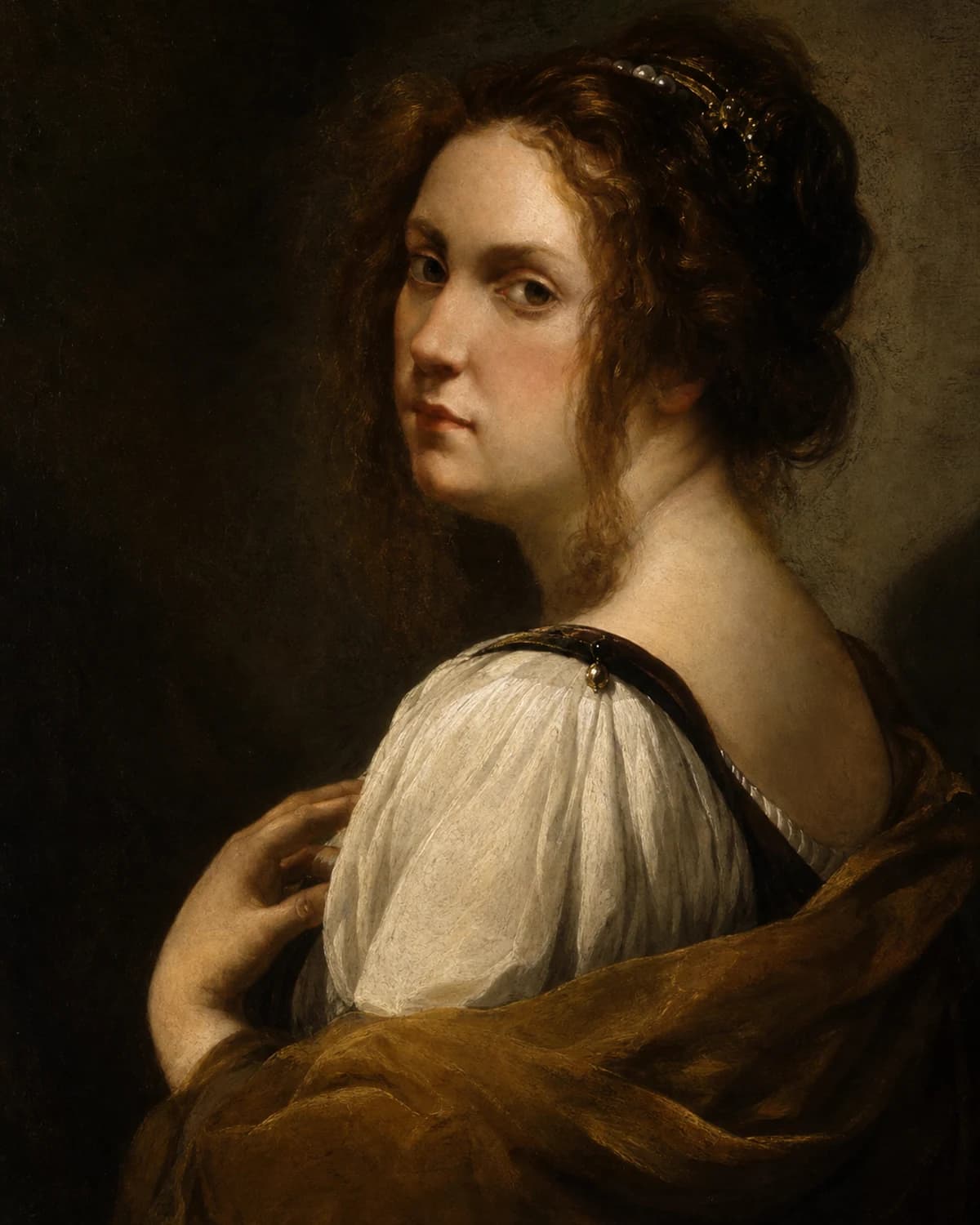
Biography
The “Susanna and the Elders” in the Schönborn collection at Pommersfelden castle carries a signature and a date: Artemisia Gentileschi, 1610. The painter is seventeen. It is the earliest of her surviving works, and I would begin getting to know her here, rather than with the court records where people usually begin.
Many painted this story from the Book of Daniel, and in their hands Susanna usually poses: she turns prettily, takes fright prettily. Artemisia’s Susanna twists awkwardly on a stone bench, holding up her palms against the two old men bending over her, and turns away. The pose is uncomfortable, ungainly, and for that very reason convincing.
Artemisia was born on 8 July 1593 in Rome, then the capital of the Papal States. Her father, Orazio Gentileschi, came from Pisa and was one of the first to take up Caravaggio’s manner: harsh light, deep shadow, models from the street cast as saints. In his workshop his daughter learned everything, from grinding pigments to composition. Her mother died in 1605, when the girl was twelve.
Then came what, for a long time, made her name known chiefly through court documents. In 1611 the painter Agostino Tassi, who worked alongside Orazio, raped her. In 1612 her father lodged a complaint. The records of the trial survive. During questioning Artemisia was tortured with thumbscrews: this was how the courts of the day tested whether a witness was telling the truth. Tassi was found guilty, but the sentence was never really carried out.
That same year, 1612, her father arranged her marriage to the Florentine Pierantonio Stiattesi, and Artemisia moved to Florence. There things went unexpectedly well. She enjoyed the patronage of Grand Duke Cosimo II de’ Medici and Grand Duchess Christina of Lorraine. Michelangelo Buonarroti the Younger, the great-nephew of Michelangelo, commissioned from her the “Allegory of Inclination” for a ceiling in the Casa Buonarroti. In 1616 she was admitted to the Academy of the Arts of Drawing, the first woman to be so, and this meant she could buy materials and sign contracts herself, without a husband or a father. She apparently met Galileo in Florence too; a letter she wrote to him in 1635 survives.
Judith turns up in her work again and again. In “Judith Slaying Holofernes” (the main versions are in Naples and Florence) both women go at it in earnest, the way people do manual work: the maidservant pins Holofernes to the bed, Judith cuts. Blood spurts onto the sheets. Twentieth-century critics were keen to see revenge on Tassi here. Perhaps, but then one has to explain why Caravaggio painted the same subject just as brutally. I side with the caution of today’s scholars: the biography explains a few things, but it is the painter’s decision that makes the picture.
In the early 1620s she returned to Rome, then lived for several years in Venice. In 1630 Artemisia moved to Naples, then the largest city in Italy, and opened a workshop there. Here, for the first time, she was entrusted with work for a cathedral: in Pozzuoli she painted “Saint Januarius in the Amphitheatre at Pozzuoli” and “Adoration of the Magi”.
At the end of the 1630s she went to London, to the court of Charles I, where her father was working. Orazio died there in 1639. The “Self-Portrait as the Allegory of Painting” in the Royal Collection is associated with the English years. She shows herself at work, brush in hand, with a chain on her breast from which hangs a mask pendant; this was how the theorists of the time advised depicting Painting herself. The result is a double portrait in one person: the painter and her craft.
Then Naples again. From 1649 her letters to the Sicilian collector Antonio Ruffo survive, and the voice in them is very recognisable: businesslike, proud, without a trace of timidity, especially when the subject turns to price. The last letter is dated 1650. Her last known commission dates from January 1654; by then she relied heavily on an assistant, Onofrio Palumbo. When she died is unknown. For a long time 1653 was given, which the documents suggest is wrong. Some suppose the plague of 1656, which wiped out a whole generation of painters in Naples. She was buried in the Neapolitan church of San Giovanni Battista dei Fiorentini; the tomb has not survived.
She was quickly forgotten, and her works circulated under the names of her father and other masters. The art historian Roberto Longhi brought her back with his article “Gentileschi, Father and Daughter” (1916). Since the 1970s and 1980s she has been written about as a central figure of feminist art history, and attributions are still being refined: a “David with the Head of Goliath” surfaced in London in 2020, and a “Susanna and the Elders” that once belonged to Charles I was found in the Royal Collection in 2023.
Artist works
Works by the artist
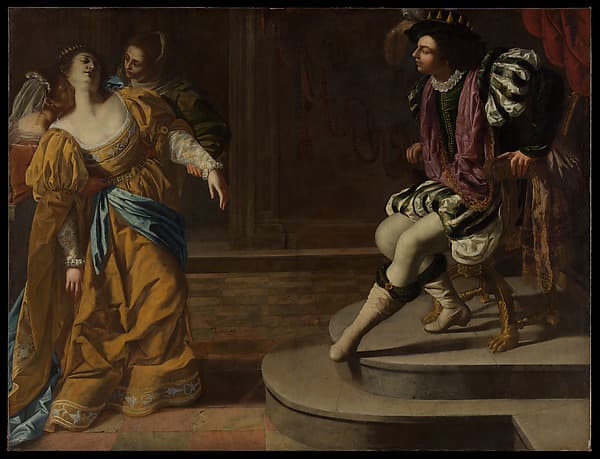
Works by Artemisia Gentileschi available in this edition of NEOARCA.
Related context
Associations
Works connected through artistic movements, cultural context and period. Priced works available in this market appear first.
Profile notes
Profile and sources
Image
Artist image
На основе открытого изображения: Artemisia Gentileschi; Wikimedia Commons; Public domain.
