
21.12.1856–01.06.1914
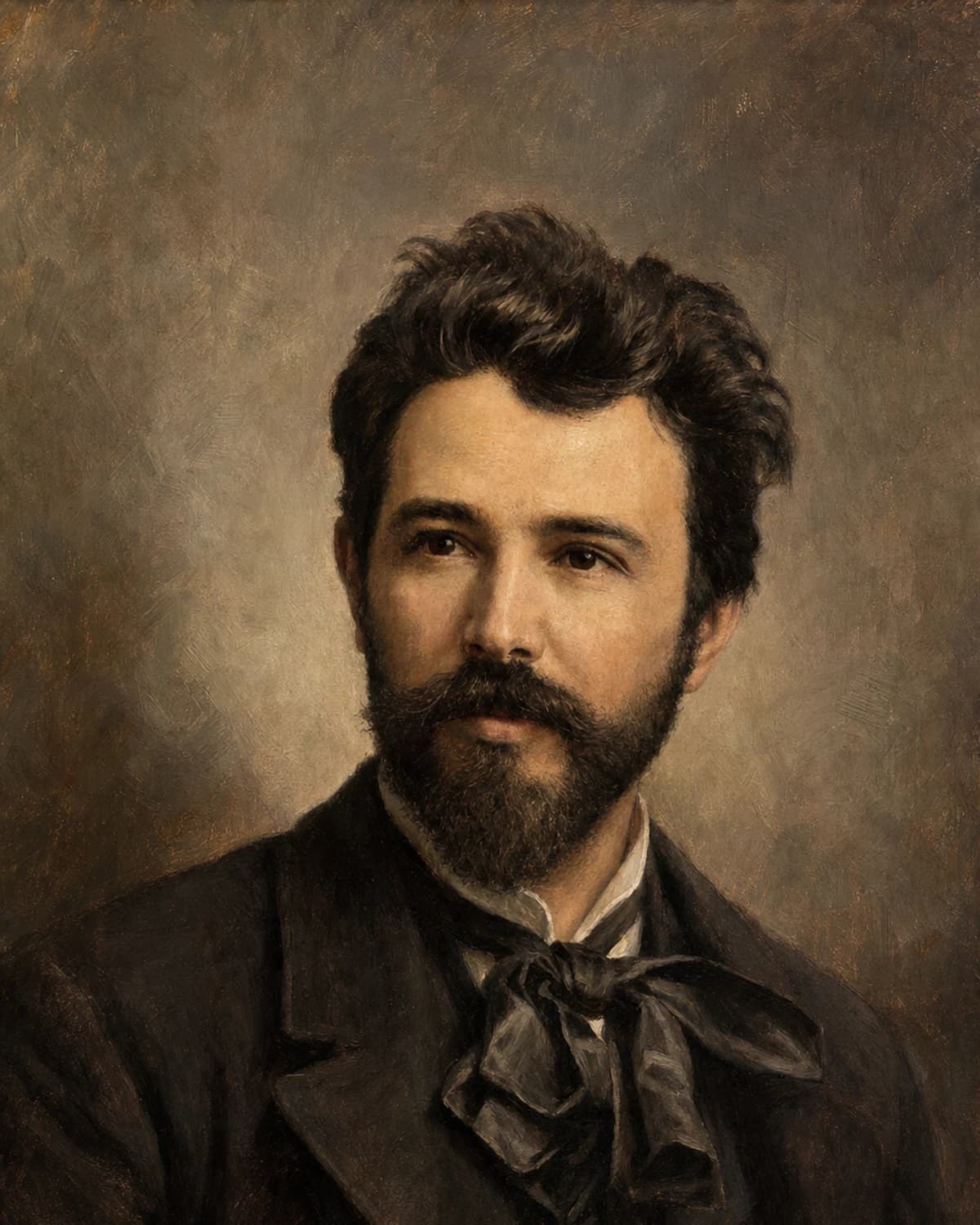
Árpád Feszty
Árpád Feszty was born into a family of German landowners in Ógyalla and became the author of the circular panorama “Arrival of the Hungarians”, painted for the millennium of the Hungarian state: about 1,800 square metres of canvas. He studied in Munich and Vienna, made his name with “Calvary” and a genre scene of miners, spent three years in Florence and published the book “My Peasants”. He died in Lovran in 1914.
Biography
The panorama with which Árpád Feszty’s name is linked was cut up during the Second World War into pieces about eight metres long. The pieces were rolled up and stored in various museum warehouses. The circular canvas, about fifteen metres high and almost 120 metres long, came back before the public only in 1995.
Feszty was born on 21 December 1856 in Ógyalla (now Hurbanovo in southern Slovakia), then part of the Austrian Empire. His surname at birth was Rehrenbeck: the family descended from German settlers, his father, Silvester Rehrenbeck, was a wealthy landowner, and Árpád was the fifth child. His father took the name Feszty in 1868, and on 21 April 1887 received a patent of nobility from the emperor and king, Franz Joseph, together with the title “of Martos”. Árpád attended school in Komárom, Pozsony (now Bratislava) and the Buda Realschule (a secondary school with a science and modern-languages curriculum), which he reportedly had to leave: with some fellow pupils he had founded a political and literary circle. At sixteen he reportedly spent a short time travelling with a company of strolling actors. In 1874 he went to Munich, where at first he studied the picture galleries more than he sat in classes; accounts of his academic studies differ. There he became close to the Czech-German painter Karl Kubinsky, who took him on as an assistant, and a landscape shown at the art union’s exhibition drew attention to the young man and brought him a state scholarship. Then came Paris and the success of his painting “Noon” at the 1878 World’s Fair, after which Feszty went to Venice to paint the lagoons. He believed that Venice developed his sense of colour, and to me that seems plausible: the landscapes of those years are noticeably lighter than the early ones.
In 1879, in his studio at Ógyalla, he painted a large canvas, “Encounter on the Steppe in Winter”, which aroused interest in artistic circles. In 1880 he won a scholarship and spent about three years in Vienna, studying at the school of the landscape painter Eduard Peithner von Lichtenfels. There he painted “Calvary”, followed by “Descent from the Cross” and “Saint Gellért”. He returned to Hungary in 1882, and “Calvary”, together with “Accident in a Quarry”, made him known. Genre scenes such as “The Victims” came off particularly well for him, by contemporary opinion. Feszty also painted murals for the Opera House and the city law court in Budapest.
For the millennium of the Conquest, in 1896, he created the panorama “Arrival of the Hungarians”, also called “The Taking of the Homeland”: two thousand figures on a circular canvas showing the arrival of the Hungarian tribes in 896. He did not paint it alone; he was helped by László Mednyánszky, Jenő Barcsay and Dániel Mihalik. Around the same time he painted “The Battle of Bánhida” and “The Betrothal of Chieftain Zsolt” for the counties of Komárom and Bihar.
Then Feszty left for a long stay in Florence, where he lived from 1899 to 1902 with his wife, Róza Jókai, the adopted daughter of the writer Mór Jókai. There he painted the triptych “The Burial of Christ”, which he showed in Budapest in 1902 and sent on an international tour. After returning home he painted mostly small pictures, while his financial difficulties grew. In 1906 he was awarded the Order of the Iron Crown, third class.
He was also a writer: in 1897 his book “My Peasants” was published in Budapest. His daughter Masa became a painter, and his brothers Adolf and Gyula were well-known architects.
Feszty died on 1 June 1914 in Lovran, on the Adriatic coast. He is buried in the family vault at Ógyalla, and a memorial plaque hangs at the Villa Flora in Lovran.
Related context
Associations
Works connected through artistic movements, cultural context and period. Priced works available in this market appear first.








Profile notes
Profile and sources
Image
Artist image
На основе открытого изображения: C. Angerer & Göschl; Wikimedia Commons; Public domain.
