
16.10.1827–16.01.1901
Arnold Böcklin
Arnold Böcklin (1827–1901) was born in Basel into a silk manufacturer’s family, studied in Düsseldorf and became a mature artist in Italy, where he lived for about twenty years in all. He painted nymphs, centaurs, sea monsters and five versions of “Isle of the Dead” (1880–1886). He also dreamed of flight and built a flying machine, because of which he fled Rome to escape arrest.
Biography
In Rome around 1855 Böcklin built a engine-less flying machine, like those Leonardo had drawn. Permission to test it in the great hall of the papal riding school was obtained through a cardinal of the German curia from Pius IX himself. The Inquisition issued a warrant for the artist’s arrest, and he left the city. More than twenty years later, around 1883, the experiment was repeated on the Tempelhof field in Berlin, and again it failed.
Böcklin was born on 16 October 1827 in Basel, the son of the silk manufacturer Christian Friedrich Böcklin. He learned drawing first at home, then, in 1845–1847, at the Düsseldorf Academy under the landscape painter Johann Wilhelm Schirmer and the history painter Theodor Hildebrandt. In Düsseldorf he shared lodgings with Rudolf Koller, and in 1847 the two travelled together to Belgium; Rubens made a strong impression on him. Then came the Netherlands and Switzerland, in 1848 Paris and study at the Louvre, and the studio of the landscape painter Alexandre Calame. Until 1850 he worked in Basel, where he painted his first characteristic landscapes.
From 1850 to 1857 he lived in Rome, with interruptions, and studied the old masters. The strongest influences on him were the landscape painters Gaspard Dughet and Franz Dreber. In 1853 he married Angela Pascucci, who became the model for many of his paintings. The couple had fourteen children; by one account five died in childhood and three more in his lifetime, by another eight died as children. In 1857 the family moved to Basel. Then came a series of moves. In Munich he received a commission to paint the dining room in the Hanover villa of the consul Karl Wedekind, and in March 1859 “Pan in the Reeds” made his name. From 1860 to 1862, with the support of Count Adolf Friedrich von Schack, he taught as a professor at the Grand-Ducal Saxon Art School in Weimar. Then Rome again, a trip to Naples and Pompeii, and in 1866 a return to Basel. In 1868 Jacob Burckhardt helped him obtain a commission for three frescoes for the garden room in Karl Sarasin’s house. Rudolf Schick assisted him, and within two months “Rest on the Flight into Egypt”, “King David with the Harp” and “The Road to Emmaus” were finished; today they are in the Kunstmuseum Basel.
In 1872, again in Munich, he painted “Self-Portrait with Death Playing the Fiddle”. In the picture he seems to be listening, while behind his shoulder a skeleton draws a bow across a single string.
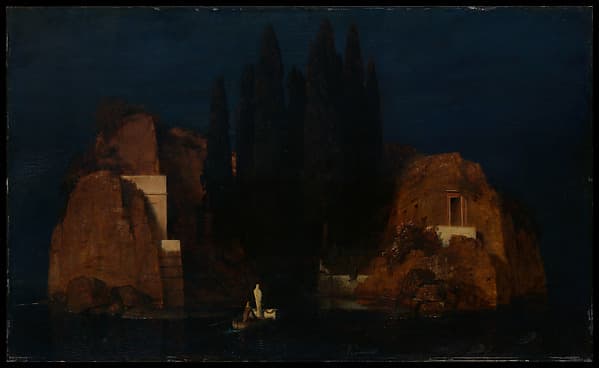
From the autumn of 1874 to April 1885 Böcklin lived in Florence. There he produced the cycle of five versions of “Isle of the Dead” (1880–1886): a rocky island, cypresses, a boat with a rower and a figure in white. By one account the first version was commissioned by a widow named Berna, who wanted a picture with a dreamlike atmosphere; it is also said that the idea was influenced by the English Cemetery in Florence, near his studio, where his small daughter Maria was buried. Böcklin did not give titles to his paintings, and did not sign or date them; most of the names were probably devised by von Schack, a regular buyer. The third version (1883) was bought by Hitler in 1933, and his collection held eleven works by Böcklin in all. Sergei Rachmaninoff wrote a symphonic poem inspired by the painting (1909), and in 1913 Max Reger composed “Four Tone Poems after Böcklin”.
From 1885 to 1892 he worked in Hottingen, near Zurich, in a studio built to the design of the architect Georg Lasius; Gottfried Keller was often a guest there, and in 1886–1891 Albert Welti worked with Böcklin. From 1888 he sat on the Swiss Federal Art Commission, in 1889 he received an honorary doctorate from the University of Zurich, and in 1890 he became an honorary citizen of Zurich. After a stroke in 1892 he settled near Florence with his wife and sons, then in Fiesole, at the Villa Bellagio.
In 1897, for his seventieth birthday, an exhibition was held at the Kunsthalle Basel, then in Berlin and Hamburg. Böcklin died on 16 January 1901 at San Domenico, near Fiesole. He was buried on 18 January in the Protestant cemetery of Allori in Florence. His son Carlo designed the gravestone, a Doric column, bearing a line from Horace: “Non omnis moriar”, “I shall not wholly die”.
Artist works
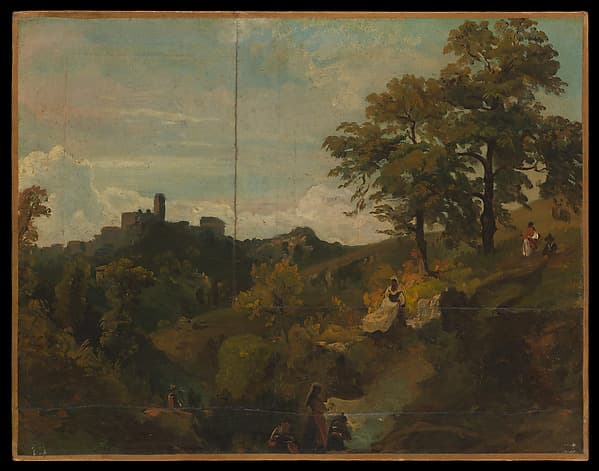
Works by the artist
Works by Arnold Böcklin available in this edition of NEOARCA.
Profile notes