
10.05.1889–18.09.1954
Armando Reverón
Armando Reverón studied in Caracas, Barcelona and Madrid, and from the 1920s lived at Macuto on the Venezuelan coast, in the “Castillete” he built himself. There he painted landscapes almost white with light, then sepia views of the port of La Guaira, and made life-size dolls and objects for his house. In 2007 the Museum of Modern Art in New York gave him a retrospective.
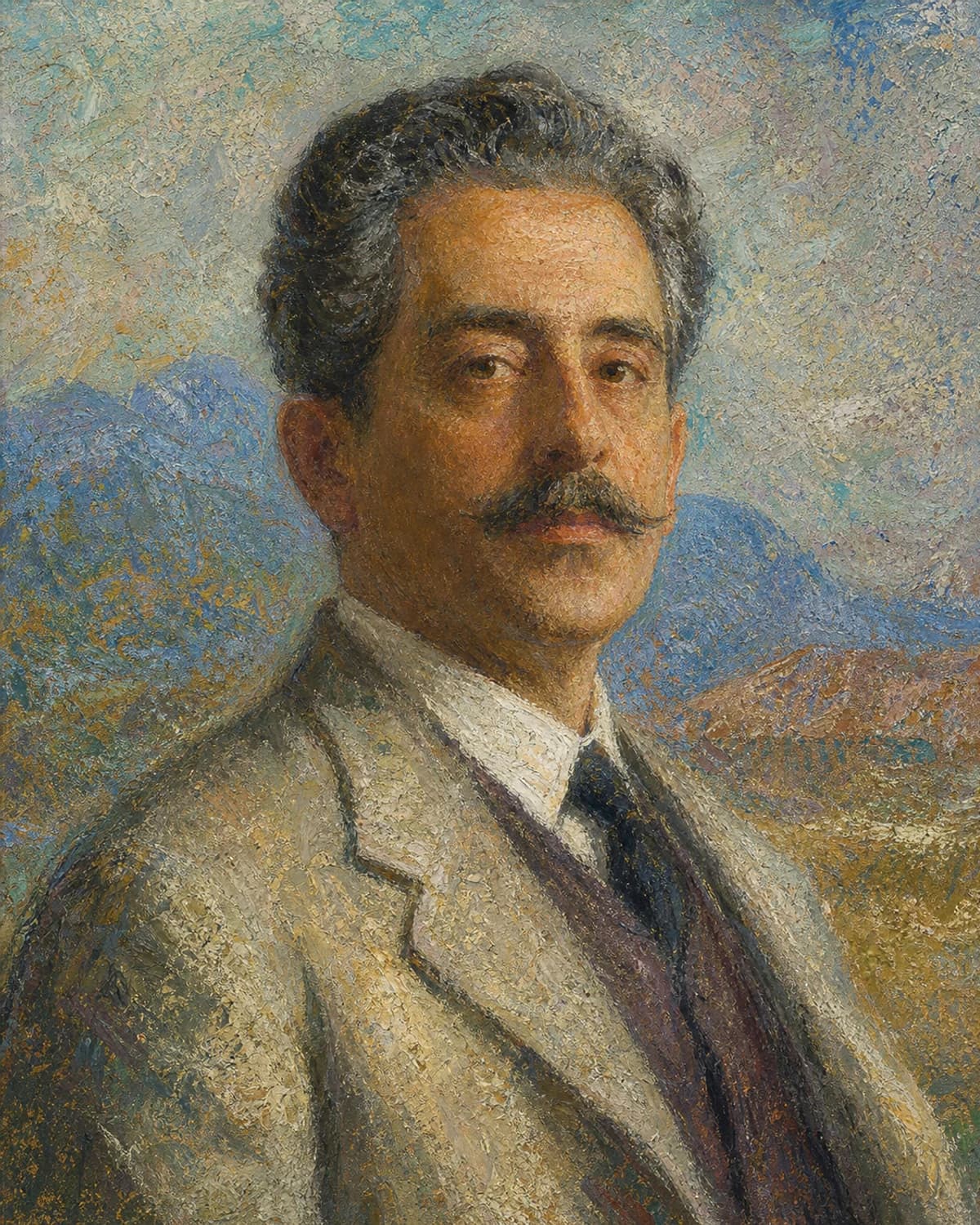
Biography
In 1950 Armando Reverón dictated seven pages about himself to the secretary of the School of Plastic Arts in Caracas. It is the only autobiographical document he left, and it is written in the third person. All his life the artist avoided talking about his family and childhood, so the beginning of his life has to be reconstructed from other people’s recollections.
He was born on 10 May 1889 in Caracas, an only child. In the mid-1890s he was sent to Valencia, to the Rodríguez-Zucca family, and grew up there. He was taught drawing by his maternal great-uncle Ricardo Montilla, who had once studied art in New York. In 1901 the boy received his first commission, from a local merchant, and copied Delacroix’s “Lion Hunt”.
In 1905 he returned with his mother to Caracas, and on 23 June 1907 he entered the Academy of Fine Arts. The director was Emilio Mauri; his teachers were Pedro Zerpa and Antonio Herrera Toro, whom he particularly revered; among his fellow students were Manuel Cabré and Rafael Monasterios. His early pictures are academic and dark, showing the influence of Cristóbal Rojas. During the students’ strike of 1909, which he did not join, the academy was closed, and in Valencia he painted his first major picture, “Girl Knitting”: his foster sister sits in the shade of a medlar tree. In 1911 he finished the course and, with Monasterios, held his first exhibition. That same year, with Herrera Toro’s support, he received a scholarship from the municipality of Caracas to study in Europe.
In Barcelona in 1911–1912 he studied at the Escuela de la Lonja, where drawing was taught by José Ruiz Blasco, Picasso’s father, and his palette grew lighter. Early in 1913 he moved to Madrid, to the Royal Academy of Fine Arts of San Fernando, to study under José Moreno Carbonero and Antonio Muñoz Degrain; it was Muñoz Degrain who pushed him to paint in the open air. At the Prado he was captivated by Velázquez, especially “Las Meninas”, and by Goya. In 1914 he went to Segovia to see Ignacio Zuloaga, spent six months at Chantilly with the French painter Fournier, and then settled in Paris, where the war caught up with him. The museums were closed, and he remained indifferent to the new painting, from Braque to Modigliani. In July 1915 Reverón returned to Spain, managed to see a large Goya exhibition at the Prado, and sailed home.
In Caracas he lectured on Goya, taught printmaking, gave a course in perspective and stage design, drew close to the anti-academic Círculo de Bellas Artes and taught drawing. At the carnival of 1918 he met Juanita Mota; she became his constant model and his companion to the end of his life. In 1919 the Russian-born painter Nicolás Ferdinandov arrived in Caracas, and under his influence began the so-called blue period: nocturnal pictures, cold in tone, built up in thick layers of oil.
On Ferdinandov’s advice Reverón moved to the coast, to Macuto.
In 1921 his mother helped him buy a plot there, and in 1923 a neighbour, Rosalía Martínez, let him have part of her land for a token sum. So the “Castillete” grew up: several huts with timber walls and thatched roofs, the main one serving as the studio. Neighbours remembered that the artist wrote letters for those who could not write and put on little plays with them. Here began the white period, as the critic Alfredo Boulton called it, roughly 1924–1932. Colour gradually left the pictures, white remained, and the landscape under direct sunlight all but dissolved. He painted on coarse burlap and unprimed canvas and tried gouache on paper. In 1933 a large exhibition of his work was held at the Ateneo de Caracas and was then shown at the Galerie Katia Granoff in Paris. To my mind the periods are best treated as a rough guide: different authors place their boundaries several years apart.
Then white gave way to sepia and ochre. In the late 1930s and early 1940s Reverón painted nudes and seascapes, the port of La Guaira, often directly on burlap, leaving its weave visible. From 1939 he began making life-size rag dolls, and later musical instruments, furniture and masks for the Castillete.
In 1945 and again in 1953 he stayed in the San Jorge sanatorium in Caracas and painted twelve pictures there: patients, nurses, the hospital garden. In 1951 the French cultural attaché Gaston Diehl invited Alain Resnais to Venezuela to make a film about him; Resnais did not come, and a short film was made by Margot Benacerraf, to whom Reverón gave a room in the Castillete. In 1953 he was awarded the National Prize for Painting, and he was preparing an exhibition for the Museum of Fine Arts in Caracas.
Armando Reverón died on 18 September 1954 in Caracas, at the San Jorge sanatorium. He lay in state at the Museum of Fine Arts, in a room next to an exhibition of models of Leonardo’s inventions. In 1955 a retrospective of four hundred works was shown there, part of which then travelled to Boston and Washington. In 1974 a museum devoted to him opened at the Castillete; it was badly damaged by the mudslides of December 1999. Since 2016 the artist’s remains have rested in the National Pantheon of Venezuela.
Related context
Associations
Works connected through artistic movements, cultural context and period. Priced works available in this market appear first.








Profile notes
Profile and sources
Image
Artist image
На основе открытого изображения: Granwiki; Wikimedia Commons; CC BY-SA 4.0.
