
08.07.1863–28.09.1942
Armando Menocal
Armando Menocal (1863–1942) painted “The Oath of Santa Gadea” in 1887 and sent his canvas “The Embarkation of Columbus by Bobadilla” to the World’s Columbian Exposition in Chicago, where the chains had to be removed from the picture. In 1895 he left his teaching post to join the Liberation Army, and after the war he returned to the San Alejandro academy and became its director in 1927.
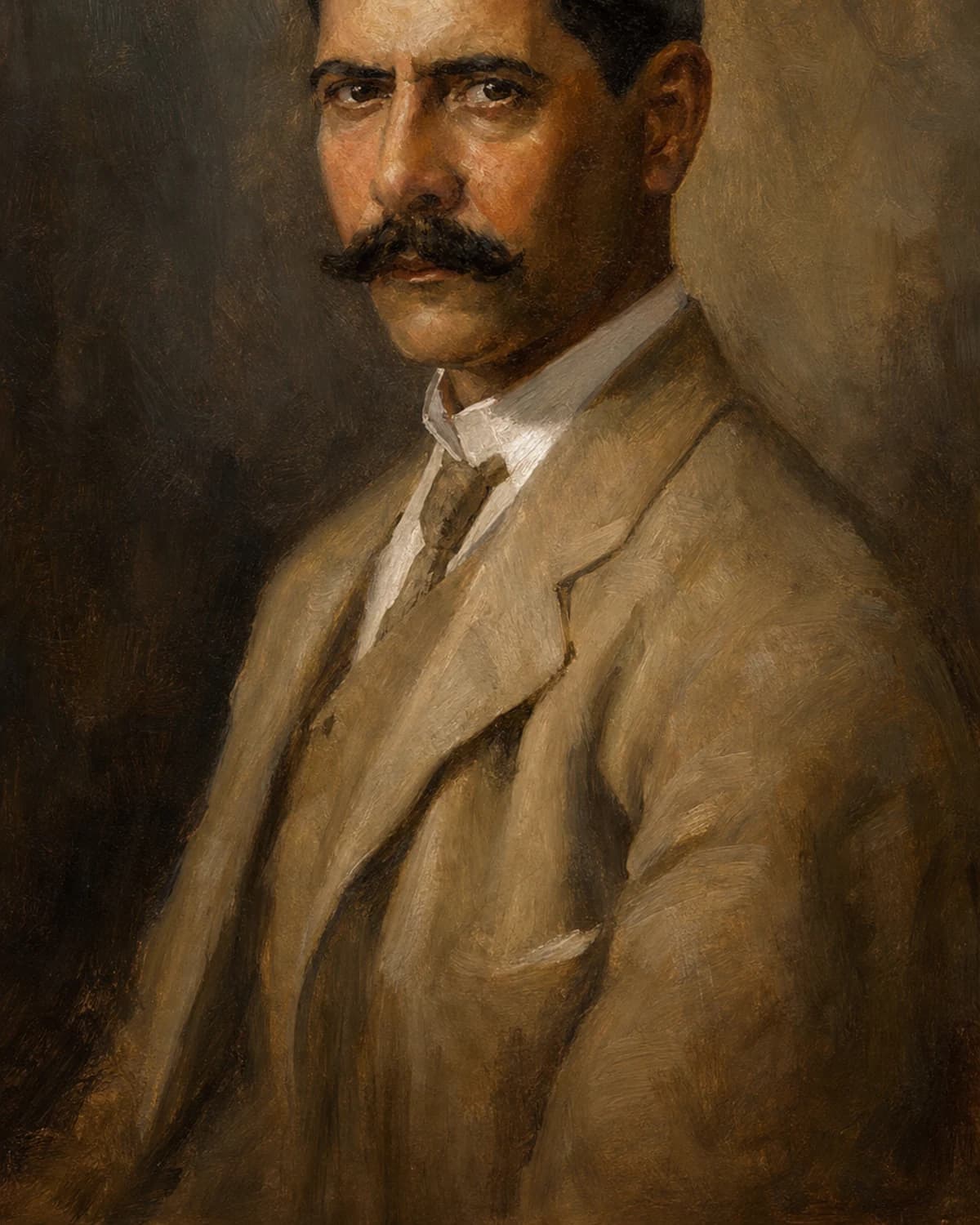
Biography
In 1893 an enormous canvas, 4.8 metres high and 3.3 metres wide, stood in the foyer of the Teatro Tacón in Havana. Armando Menocal’s picture showed how, in October 1500, Columbus and his brothers were removed from the government of Hispaniola. For the World’s Columbian Exposition in Chicago it had shown chains on the admiral’s legs, and the Spanish commission disliked this: according to its representative, Enrique Dupuy de Lôme, the work was politically unacceptable in that form. The chains were removed from the canvas, and in the exhibition catalogue it appears as number 61, among the works of five other Cuban participants.
Menocal was born on 8 July 1863 in Havana, the son of Rafael García-Menocal y Rivas and María del Rosario García-Menocal y Martín. He was the fourth and last child. The family came from Cantabria: an ancestor had settled in Havana in the seventeenth century, and the artist’s parents were distant relatives of each other. He was baptised on 7 August 1863. His father died when the boy was three (by other accounts, five), and the widow and her children were left in the care of her brother. His full surname is García-Menocal y García-Menocal, but he himself usually used the second part.
Little is known about his apprenticeship. From 1876 to 1881 he studied as an external student at the San Alejandro school of painting and sculpture, where his teachers are said to have included Miguel Melero, its director from 1878. Later he received a grant to study in Madrid, at the Royal Academy of Fine Arts of San Fernando. According to other accounts, in 1880 he went to Spain to study with Francisco Jover y Casanova; there he became acquainted with the work of Joaquín Sorolla and exhibited, winning awards. In May 1889 Menocal opened a studio in Havana. The first known reviews of his work were written by the poet and journalist Julián del Casal under the pseudonym “Hernani”: they appeared in the newspaper La Discusión on 27 December 1889 and 13 February 1890.
“The Oath of Santa Gadea” is dated 1887, which means it was painted before his return to Cuba. The subject is a legend: in December 1072 the Cid makes King Alfonso VI swear publicly, in the church of Santa Gadea in Burgos, that he had no part in the murder of his brother Sancho II. The heirs of the Count of Romrée gave the canvas to the Spanish town of Alfafar, and the transfer was formalised on 2 July 1965; in the summer of 2007 it was restored at the Polytechnic University of Valencia. Today it is kept in the town hall of Alfafar.
After the death of the teacher Diego Antonio de Herrera in July 1891, the rector of the University of Havana proposed Menocal for his place, and on 30 July he took up the post. Later he was given the chair of elementary drawing. Until 1895 he painted mainly portraits, and there were many of them, because private commissions kept coming. The single exception is “The Embarkation of Columbus”, discussed above. Whether any institution commissioned it is unclear from the sources available to me. When the war of independence began in 1895, Menocal left his chair and joined the Liberation Army. He rose to the rank of major in the Fifth Corps and did not give up painting. “The Death of Maceo” and “The Mambí Assembly” grew out of this experience. After the war he returned to San Alejandro, now as professor of landscape painting, and taught for almost his whole active life. In 1927 he was appointed director, and in 1940 he became director emeritus. Among his students is named Pastor Argudín Pedroso. Menocal was a member of the National Academy of Arts and Letters of Cuba and wrote for the magazine Bohemia; his paintings decorated public buildings in Havana. They are now in the National Museum of Fine Arts, among them “The Embarkation of Columbus” (since the late 1990s, after restoration) and a portrait of Lily Hidalgo of 1893.
He died in Havana on 28 September 1942.
Related context
Associations
Works connected through artistic movements, cultural context and period. Priced works available in this market appear first.








Profile notes
Profile and sources
Image
Artist image
На основе открытого изображения: Armando Menocal; Wikimedia Commons; Public domain.
