
15.01.1841–11.07.1910
Arkhip Kuindzhi
Arkhip Kuindzhi, the son of a Greek shoemaker from Mariupol, spent several years as a photo retoucher in Taganrog and got into the Academy of Arts only at the third attempt. In 1880 his “Moonlit Night on the Dnieper” was shown in a darkened room as the only picture in the exhibition, and two years later he stopped exhibiting for twenty years. He taught landscape to Roerich, Rylov and Bogaevsky and left all his money to a society of artists later named after him.
Biography
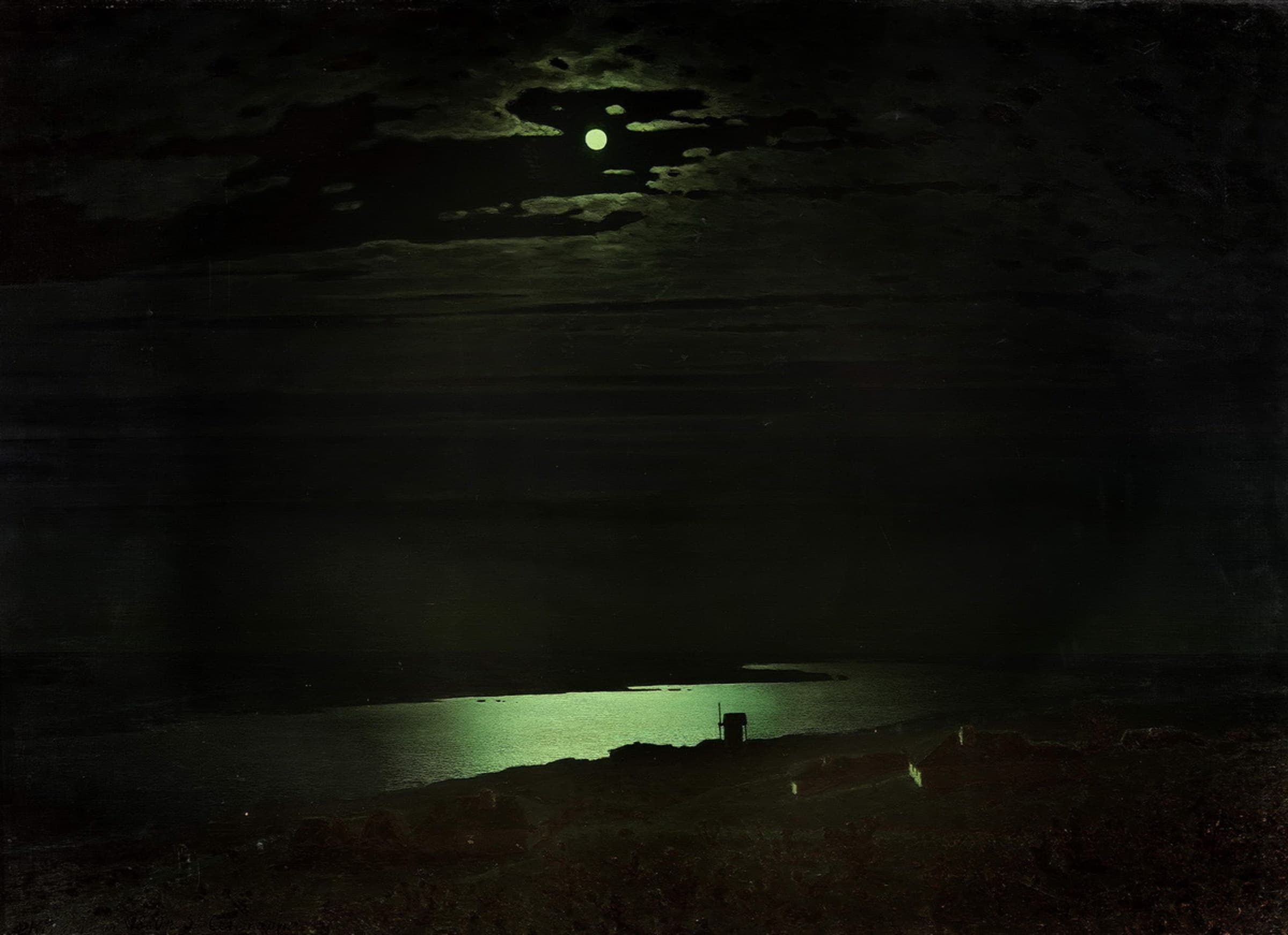
In the autumn of 1880 a single picture hung in a hall of the Society for the Encouragement of the Arts. Kuindzhi had the windows draped and the canvas lit by a beam of electric light. It was “Moonlit Night on the Dnieper”: a path of moonlight on the river, a dark bank, a greenish sky. The excitement was such that Kuindzhi was later accused more than once of hidden backlighting.
The secret lay in the paints. Kuindzhi experimented with pigments and was fond of bitumen, which darkens and decomposes over time. The picture was bought by Grand Duke Konstantin Konstantinovich, who, deaf to all persuasion, took it with him on a voyage round the world; the sea air did its work, and the landscape darkened.
Kuindzhi's year of birth has still not been firmly established. The accepted date is 15 (27) January 1841, although for a long time 1842 was given. When the Academy of Arts asked him to state the date, he confidently wrote “1841”, then, with doubt, “January”, and then crossed out the month several times. He was born in Mariupol, in the Karasu quarter, into the family of a poor Greek shoemaker; in Urum the surname means “goldsmith”. He was orphaned early and grew up with relatives, herded geese, counted bricks on the building site of a church, worked for a grain merchant. He spoke Greek, Russian, Ukrainian and Crimean Tatar. He drew on walls and fences.
In the summer of 1855, at fourteen, he was sent to Feodosia to study under Aivazovsky. The master was away. The boy was set to grinding paints and painting a fence; a relative of the master who copied his pictures gave him a few pointers, and Aivazovsky, when he came back, advised him to go to Odessa or St Petersburg. For the next ten years Kuindzhi retouched photographs in Mariupol, Odessa and Taganrog, where from 1860 to 1865 he worked for the photographer Isakovich. His own studies had to be done at dawn. “From four to ten was my own time,” he recalled.
The Academy turned him down twice. In 1868, for the picture “A Tatar Hut in the Crimea”, the Academy Council granted him the title of free artist; in 1870 he became an auditor and met Kramskoi and Repin. “Muddy Roads in Autumn” (1872), “Forgotten Village” (1874) and “The Chumak Road in Mariupol” (1875) were painted in the spirit of the Peredvizhniki, in dark, heavy tones. In that same year, 1875, he was admitted to the Association of Travelling Art Exhibitions, and then he married Vera Kechedzhi-Shapovalova, a merchant's daughter, in Mariupol. After the wedding the couple went to Valaam. “On the Island of Valaam” (1873) was the first of his pictures that Tretyakov bought. A close friendship bound him to Dmitri Mendeleev: Kuindzhi went to hear his lectures and came to his evenings, and to my mind that is where his interest in the physics of light came from.
With “Ukrainian Night” (1876) a different Kuindzhi begins. Flat white cottages, a deep blue sky, light built on complementary colours. At the 1878 Exposition Universelle in Paris the critic Edmond Duranty singled him out among the young Russian painters. “North”, “Birch Grove” and “After the Rain” (1879) showed how far he had moved from the Peredvizhniki programme. At the end of 1879 Mikhail Klodt published a sharp article about him anonymously; Kuindzhi demanded that Klodt be expelled from the Association, did not get his way, and left himself.
After “Moonlit Night” there was one more exhibition of a single picture, “Birch Grove” (1881), and then the coolly received “The Dnieper in the Morning”. In 1882 he showed two paintings in Moscow and fell silent.
For twenty years no one saw his new work.
He painted, and looked for durable pigments and grounds; some five hundred paintings and about three hundred drawings survive from those years. In 1886 he bought land in the Crimea near Kikeneiz, and at first he and his wife lived there in a hut made of branches. In 1888 he travelled to the Caucasus with Nikolai Yaroshenko and in the mountains saw a Brocken spectre, his own magnified shadow on an iridescent cloud.
From 1892 he was a professor at the Academy, and in 1894–1897 he ran the landscape studio of the Higher Art School until he was dismissed for supporting student protests. Among his pupils were Roerich, Arkady Rylov, Konstantin Bogaevsky and Vilhelms Purvītis. In summer he took his students to his Crimean estate. He lived modestly and gave his money away: in 1904 he handed the Academy a hundred thousand roubles for annual prizes, and in 1909 he gave a hundred and fifty thousand and the Crimean land to the Society of Artists, founded on his initiative. Roerich recalled how at exactly noon, at the shot of the fortress cannon, his teacher would climb onto the roof to feed the birds.
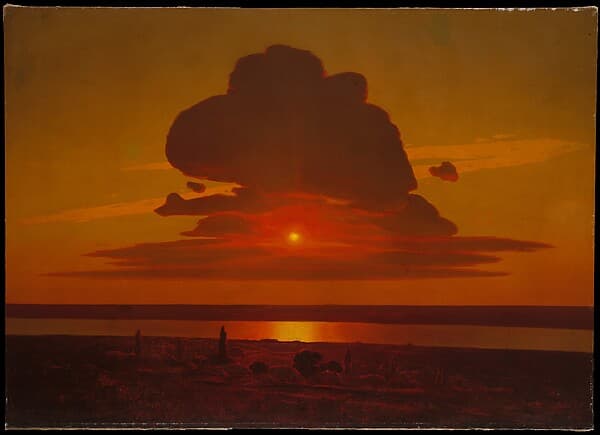
In 1901 the silence was broken: first to his pupils, then to friends, he showed “Evening in Ukraine”, which he had been working on for twenty-three years, “Christ in the Garden of Gethsemane”, a new “Birch Grove” and “The Dnieper in the Morning”. In November came his last public exhibition. After that there were “Rainbow”, “Red Sunset” and “Night Pasture”, but no one saw them in his lifetime.
In the summer of 1910 he fell ill in the Crimea, and his wife brought him back to St Petersburg. Kuindzhi died on 11 (24) July 1910 and was buried in the Smolensky Cemetery; the tombstone with a mosaic Tree of Life was made to a design by Shchusev and a sketch by Roerich. In 1952 his remains and the tombstone were moved to the Tikhvin Cemetery of the Alexander Nevsky Lavra.
Artist works
Works by the artist
Works by Arkhip Kuindzhi available in this edition of NEOARCA.
Related context
Associations
Works connected through artistic movements, cultural context and period. Priced works available in this market appear first.








Profile notes
Profile and sources
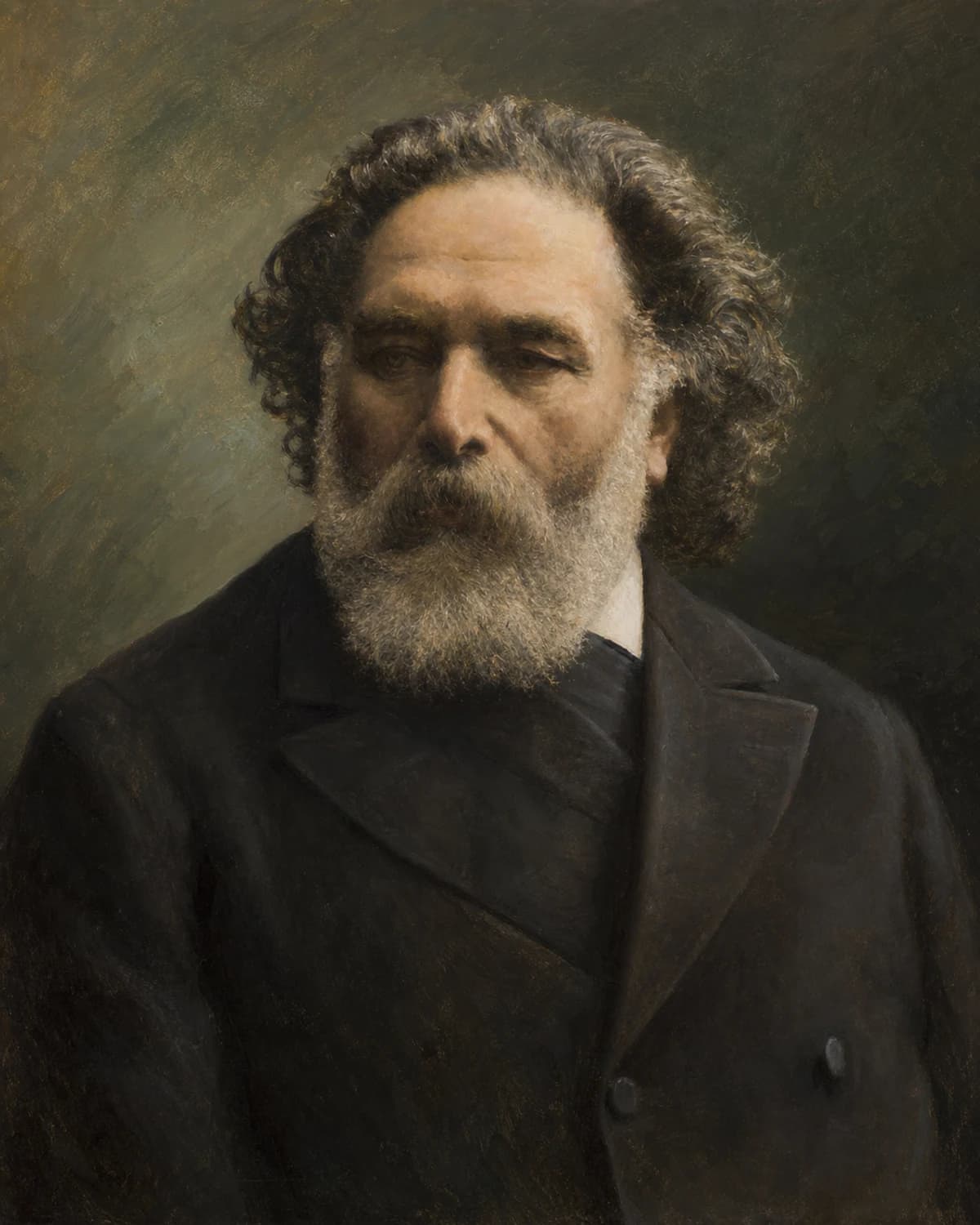
Image
Artist image
На основе открытого изображения: Anonymous photographer from Russian Empire (before 1917) Public domain image (according to PD-Russia-expired ); Wikimedia Commons; Public domain.
