
14.03.1882–15.04.1943
Aristarkh Lentulov
Aristarkh Lentulov (1882–1943), the son of a village priest from Penza Province, was among the founders of the Jack of Diamonds and, after studying in Paris under Le Fauconnier and Metzinger, painted the cathedrals and bell towers of Moscow in a Cubist manner. Later he designed productions for the Kamerny and Bolshoi theatres, taught at VKhUTEMAS and in the 1930s turned to industrial landscapes.
Biography
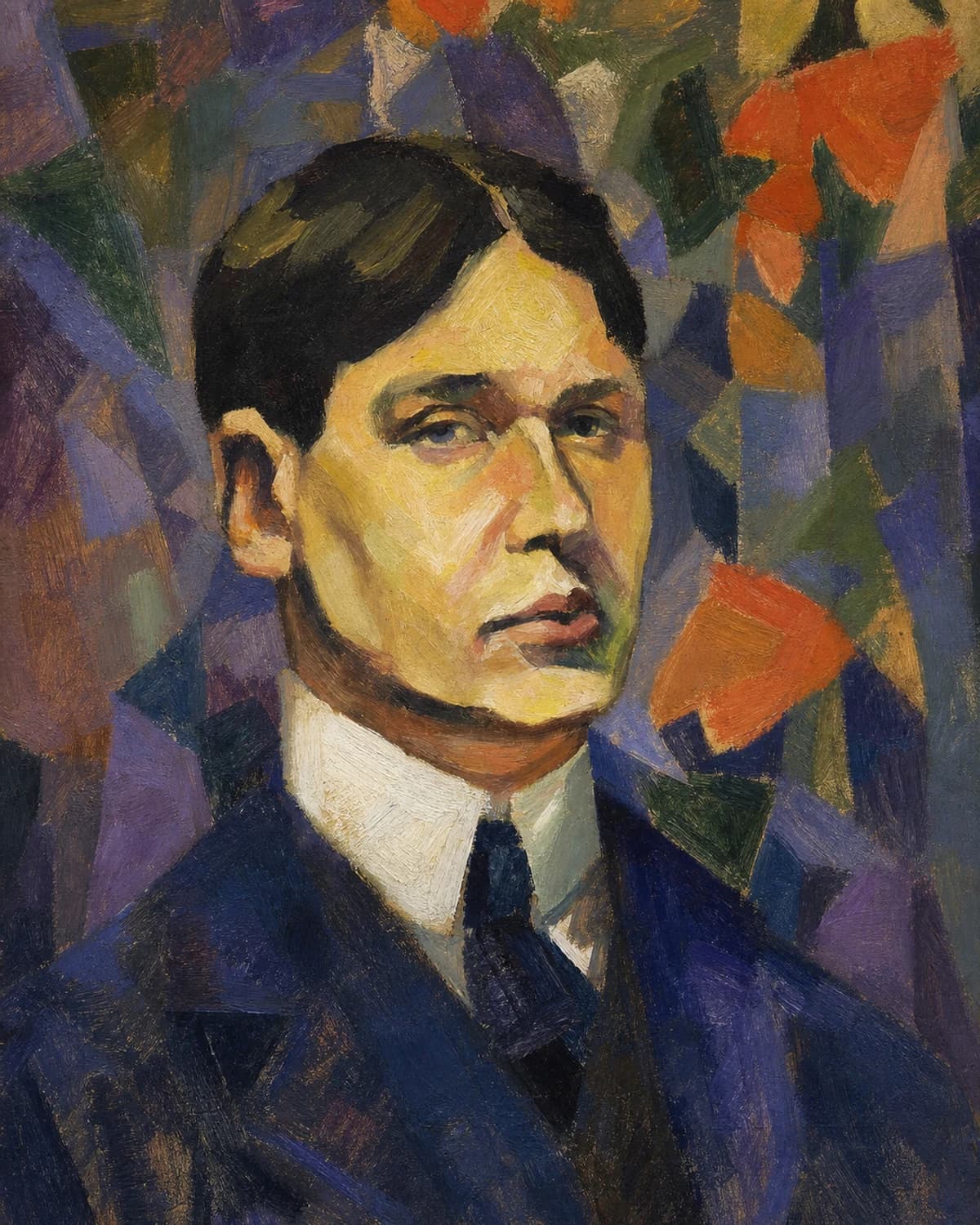
Aristarkh Lentulov called his 1915 self-portrait “The Great Painter”; the picture also has a French version of the title. It is now in the Tretyakov Gallery. To my mind, there is more mockery than vanity in that title.
He was born on 26 March (7 April) 1882 in Penza Province, in the Nizhny Lomov district, the son of a village priest, Vasily Grigoryevich Lentulov. The village is named differently in different sources: Novaya Pyatina, Chernaya Pyatina, Voronye.
Lentulov studied for a long time and in many places. In 1898–1900, and once more in 1905, he attended the Seliverstov Art School in Penza; in between he studied at the Kiev Art School under Mykola Pymonenko, and in 1906–1907 he went to Dmitry Kardovsky’s studio in St Petersburg. From 1909 he lived in Moscow. In 1910 he was among the founders of the Jack of Diamonds and stayed with the group until 1916. Around 1911 he left for Paris, where he studied in the studios of Henri Le Fauconnier, Jean Metzinger and Albert Gleizes and at the private Académie de La Palette, got to know Léger and Delaunay, and also worked in Italy. His interest in Orphism seems to have come from Delaunay. On his return, around 1912, he became one of those who shaped Russian Cubo-Futurism.
His principal Moscow pictures came straight after Paris. “St Basil’s Cathedral”, “Moscow”, “Still Life with a Blue Jug” and “Asters” are dated 1913, “Ringing. The Ivan the Great Bell Tower” and “Nizhny Novgorod” 1915, “At the Iverskaya Chapel” 1916; all of them are now in the Tretyakov Gallery. Their source was old Russian architecture: cathedrals, bell towers, the monastery buildings of New Jerusalem, which he painted in 1917. At the start of the war he joined Mayakovsky and Malevich in the group Today’s Lubok, which issued satirical sheets against Germany and Austria in the manner of the popular print. In 1917–1919 he was one of the leaders of the group Wreath–Stephanos.
The theatre ran alongside painting all his life. In 1916 Lentulov designed Shakespeare’s “The Merry Wives of Windsor” at the Kamerny Theatre, in 1919 Scriabin’s “Prometheus” at the Bolshoi, and he also did Drigo’s ballet “Harlequin’s Millions”. At the International Exhibition of Decorative Arts in Paris in 1925 he received a diploma for his designs for “The Demon”.
From 1919 he was a professor at VKhUTEMAS (later VKhUTEIN) and worked with the Institute of Artistic Culture; Alexander Labas, Eli Belyutin and Klavdia Tutevol are named among his students. In 1926–1927 he belonged to the Association of Artists of Revolutionary Russia, and in 1928–1932 he organised the Society of Moscow Artists, which took in many former members of the Jack of Diamonds, and served as its chairman. By then he was moving away from Cubo-Futurism, muting his colour and calling his new manner “new realism”. “Night at Patriarch’s Ponds” and “Sunset on the Volga” (1928) belong to these years.
In the 1930s he travelled around the Soviet republics and painted factories, constructivist buildings and construction sites on commission: “Cowper Stoves. The Voikov Metallurgical Plant in Kerch” (1930), “Cracking Plant at an Oil Refinery” (1931), “Building the Metro on Lubyanka Square” (1936). In 1933 Moscow saw his solo exhibition marking twenty-five years of work, the first of its kind in the USSR. From 1937 he taught at the Moscow Art Institute.
In 1941–1942 Lentulov lived in evacuation in Ulyanovsk: he painted watercolours and portraits and the picture “On Guard”, and designed Boris Romashov’s play “It Can Happen to Anyone” at the local drama theatre. “The Defence of Leningrad” (1942), now in Samara, dates from the same time.
He died on 15 April 1943 in Moscow and was buried in the Vagankovo Cemetery. His memoirs were published as a separate book in 2014.
Related context
Associations
Works connected through artistic movements, cultural context and period. Priced works available in this market appear first.








Profile notes
Profile and sources
Image
Artist image
На основе открытого изображения: Aristarkh Lentulov; Wikimedia Commons; Public domain.
