
05.09.1912–26.07.1975
Ariadna Efron
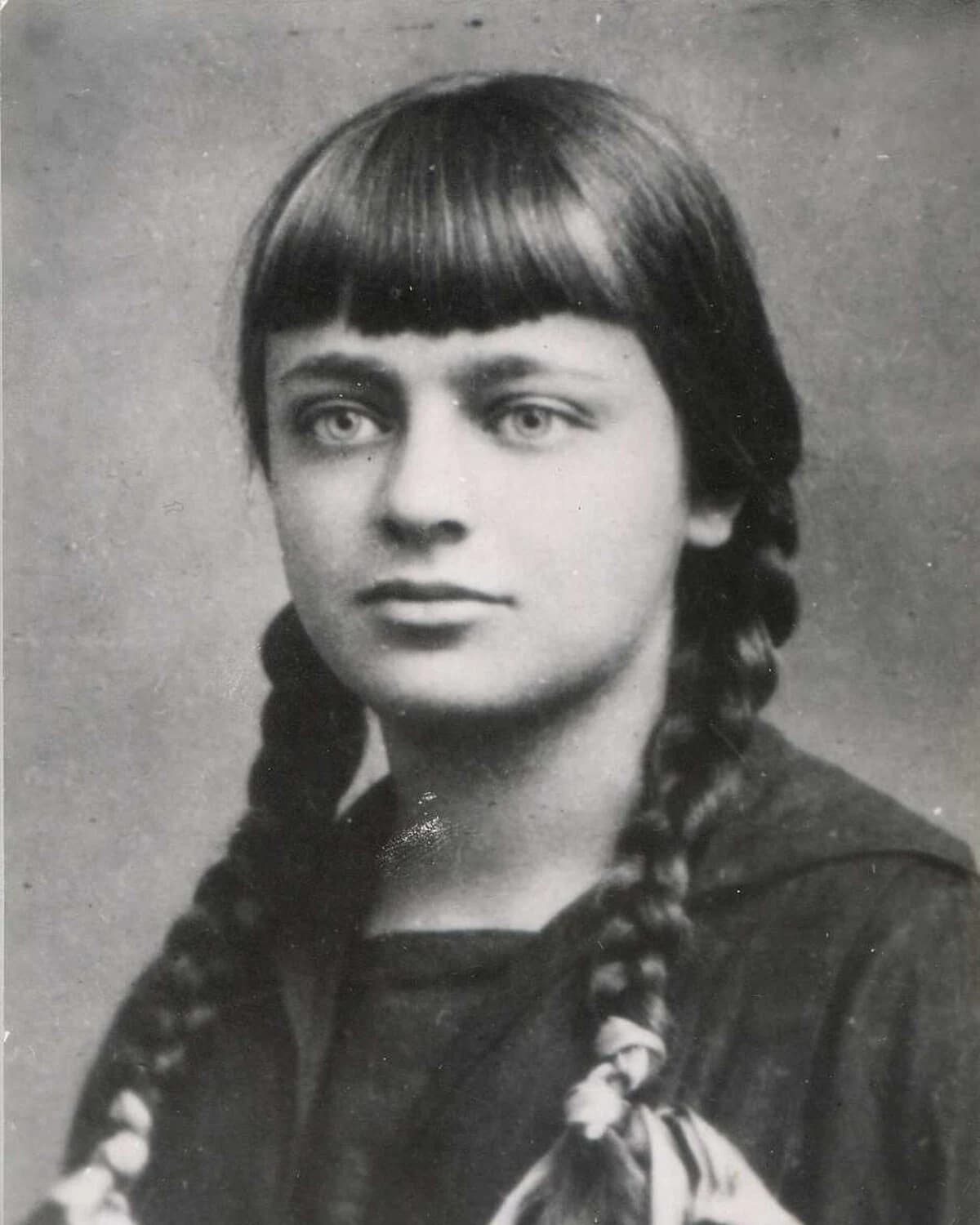
Ariadna Efron (1912–1975), the daughter of Marina Tsvetaeva and Sergei Efron, studied book design and art history in Paris, illustrated magazines and translated. After returning to the USSR she went through the camps and exile from 1939 to 1955; in Turukhansk she decorated the House of Culture and painted watercolours of the exiles’ life. Later she translated French poets, kept her mother’s archive and wrote memoirs of her.
Biography
In Turukhansk, where Ariadna Efron was sent into lifelong exile in 1949, she worked as a designer and decorator at the district House of Culture. For herself she painted watercolours of scenes from life in exile. Some of these sheets were not published until 1989.
She had learned the decorator’s craft in Paris.
She was born on 5 (18) September 1912 in Moscow, to Sergei Efron and Marina Tsvetaeva; at home she was called Alya. Her mother dedicated many poems to her, among them the cycle “Poems to My Daughter”, and included twenty of Alya’s own childhood poems in her book “Psyche”. The girl kept diaries (those of 1919–1921 were published in 2013 as “Book of Childhood”), and at the age of eight she wrote a letter to Anna Akhmatova. In 1922 she went abroad with her mother, lived in Czechoslovakia until 1925 and then in France. In Paris she graduated from a school of applied art, where she was taught book design, engraving and lithography, and from the École du Louvre in art history. She wrote articles and essays and produced translations and illustrations for the French magazines “Russie d’Aujourd’hui”, “France–URSS” and “Pour Vous” and for the Russian-language magazine “Nash Soyuz” (Our Union), and she translated Mayakovsky and other Soviet poets into French. On 18 March 1937 she became the first of her family to return to the USSR and went to work for the French-language magazine “Revue de Moscou”, writing, translating and illustrating.
On 27 August 1939 she was arrested at Bolshevo. The Special Council sentenced her to eight years in the camps under the espionage article. She served her term in the settlement of Rakpas in the Komi ASSR, and it was a long time before she learned of her parents’ deaths in 1941. In the spring of 1943, having refused to cooperate with the camp’s security section, she was sent to fell timber at a penal camp unit of Sevzheldorlag. Tamara Slanskaya, an actress in the camp theatre, got hold of an envelope and wrote to Samuil Gurevich, a man close to Ariadna, that she had to be rescued from the North, and soon he managed to have her transferred to Potma, in Mordovia. Her term ended on 27 August 1947, with restrictions on where she could live. In 1948 she taught graphic art at the Ryazan Art School and kept up a correspondence with friends, above all with Boris Pasternak, who sent her new poems and chapters of “Doctor Zhivago”. On 22 February 1949 she was arrested again and, as a previously convicted person, exiled to the Turukhansk District of the Krasnoyarsk Territory.
To my mind, her Turukhansk watercolours are best looked at together with her letters to Pasternak from exile. In 1982 those letters came out in Paris as a separate book.
In 1955 Ariadna Efron was rehabilitated for lack of evidence of a crime and returned to Moscow. From then on her main work was her mother’s legacy. She kept Tsvetaeva’s archive and prepared her writings for publication, and she wrote memoirs, which appeared in the magazines “Literaturnaya Armeniya” and “Zvezda” and in 1989 as a book, “On Marina Tsvetaeva”. She translated a great deal of poetry, mostly from French: Victor Hugo, Charles Baudelaire, Paul Verlaine, Théophile Gautier. From 1962 she was a member of the Union of Soviet Writers. Her own poems, apart from those of her childhood, were not printed in her lifetime; they came out only in the 1990s. In 2003 her drawings, watercolours and engravings were gathered in an album of their own, and in 2009 her memoirs of her mother came out in English.
Ariadna Efron died on 26 July 1975 in Tarusa, the little town where Tsvetaeva’s parents had once had a dacha, and was buried in the town cemetery. The monument on her grave was made by her friend, the sculptor Pyotr Bondarenko.
Related context
Associations
Works connected through artistic movements, cultural context and period. Priced works available in this market appear first.








Profile notes
Profile and sources
Image
Artist image
Unknown author Unknown author; Wikimedia Commons; Public domain.
