
0500–0460
Apollodorus
Apollodorus of Athens was nicknamed Skiagraphos, “the shadow-painter”: he is credited with being the first to render transitions of light and shade in painting. His pictures have not survived, and we know of them from Greek and Roman authors. Two of them, “Praying Priest” and “Ajax Struck by Lightning”, were still seen at Pergamon in Roman times.
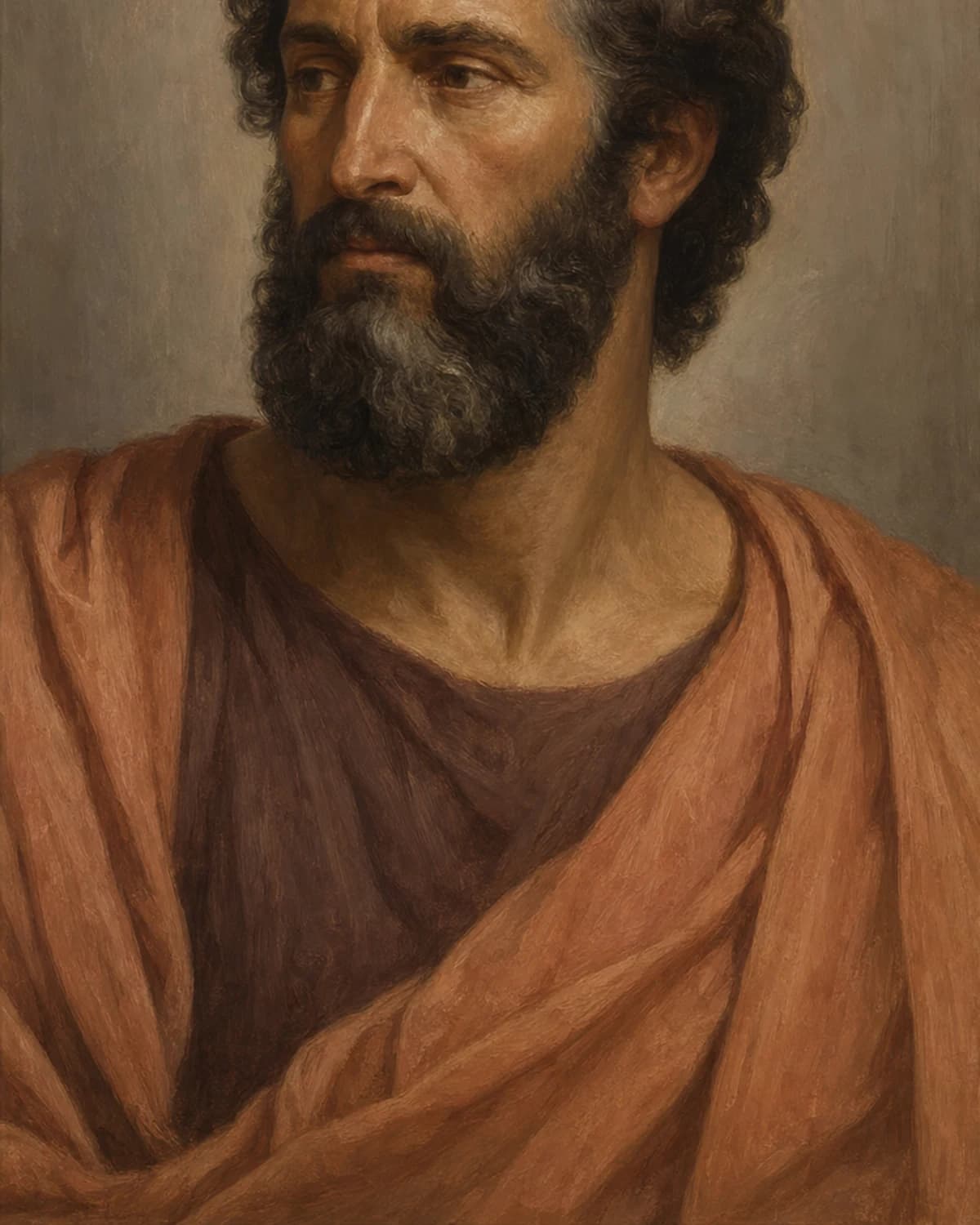
Biography
Above one of his paintings Apollodorus is said to have hung an inscription in verse: it is easy to find fault with me, but try to do better yourself. Plutarch reports the line, and it perhaps contains the whole character of a man about whom we know almost nothing.
The sources give neither a year of birth nor a year of death.
The dates of 500 and 460 BC are confirmed nowhere, and the place of birth (Attica) follows only from the fact that Pliny the Elder calls him an Athenian. Some authors place his activity around 480 BC, others, more often, in the second half of the 5th century BC, in the time of the Peloponnesian War. I would hold to the second: it is also suggested by the fact that Zeuxis is regarded as Apollodorus’ pupil. His life is as obscure as his date. Plutarch and Pliny mention his name, and in Hesychius, a writer of late antiquity, he is already “Skiagraphos”.
The nickname comes from the word skiagraphia. Literally it means “shadow-drawing”, but the Greek word denotes a transition, a gradation of tone, rather than a shadow in our sense. Plutarch understands it simply as a mixing of colours: the same colour is made lighter or darker by adding white. Before Apollodorus, painters such as Polygnotus had made do with a few local tones, chiefly red, yellow, brown and white. Pliny writes that Apollodorus was the first to render shadows and “brought deserved fame to the brush”. Modern scholars describe his method as hatching and the thickening of inner contour lines, combined with an admixture of light and dark tones. The effect was stronger on motionless things: folds of drapery, fruit, faces. A body in motion and a spatial setting were handled less well.
He is also credited with the first steps towards perspective, although the invention of perspective devices is attributed to Agatharchus, who used them, probably, in theatre scenery. There is also a cautious suggestion that Apollodorus was one of the first well-known artists to work on an easel rather than on a wall. The sources do not state this directly.
His paintings have not survived. By title we know “Praying Priest” and “Ajax Struck by Lightning” (in other renderings “Ajax Burned by Lightning”); at Pergamon even the Romans admired them. Other authors name “Odysseus Wearing a Cap” and the “Heracleidae”, including a scene in which Alcmena and the daughters of Hercules supplicate the Athenians for protection. Judging by the titles, the subjects were drawn from myth and epic.
Zeuxis, according to Pliny, was his rival. Apollodorus is even said to have accused him of appropriating other painters’ methods, but this cannot be checked. Zeuxis developed skiagraphia by adding highlights and subtle shades of colour, and Parrhasius of Ephesus, a rival of Zeuxis, carried the search further, into the contour line. Traces of this technique are found in tomb paintings at Vergina, Aineia and Lefkadia in northern Greece, and even at Seuthopolis, a Thracian city in what is now Bulgaria. Later the principle of gradation between light and dark received an Italian name, chiaroscuro.
Other craftsmen are also recorded as “Apollodorus of Athens”, among them a sculptor and bronze-caster, so records of namesakes are easily confused with the painter.
Related context
Associations
Works connected through artistic movements, cultural context and period. Priced works available in this market appear first.
Profile notes
Profile and sources
Image
Artist image
На основе открытого изображения: Johann Georg Hiltensperger; Wikimedia Commons; Public domain.
