
04.02.1833–10.04.1900
Apolinary Horawski
Apolinary Horawski (1833–1900) came from an impoverished noble family of Minsk Governorate, studied at the Imperial Academy of Arts in St. Petersburg and in 1861 became an academician for the painting “An Old Woman Praying”. He painted Belarusian and Russian landscapes and portraits of Glinka, Dargomyzhsky and his teachers; Pavel Tretyakov commissioned many of his works. Most of his paintings are now in Minsk.
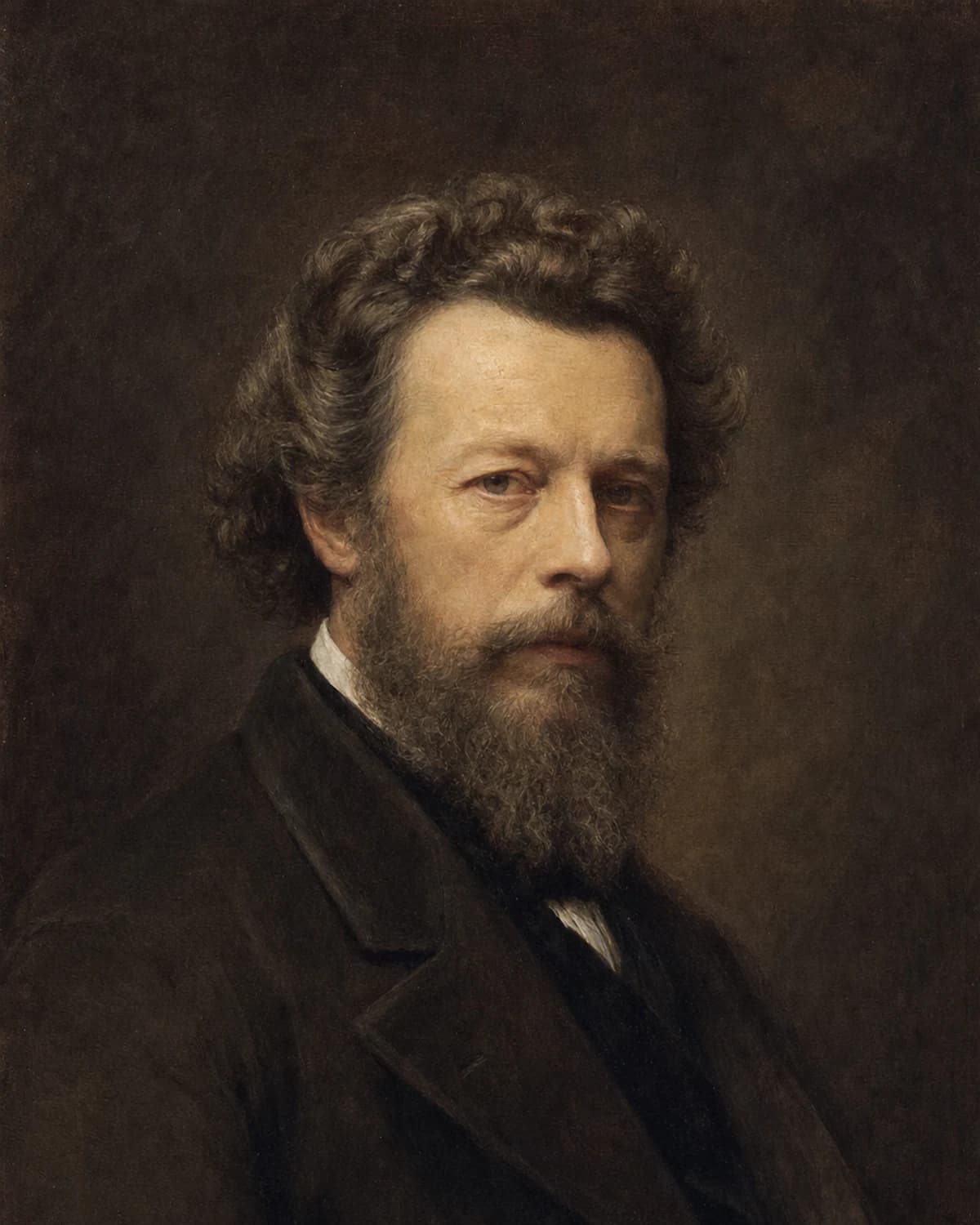
Biography
Where exactly Horawski was born is still disputed. The literature names Uborki in Ihumen District; according to other accounts, the environs of Babruysk and the Berezino district; there is also a version citing a parish register as clarified in 2023, which gives the hamlet of Nabarki (now Novyja Nabarki in the Klichaw district). The date is also given differently: 4 February 1833 (23 January, Old Style) according to some accounts, 30 January (18 January, Old Style) according to others. I would not be sure of the exact date.
The family were gentry of the Korab coat of arms, with about two hundred hectares of land, which his father, Gilyary Frantsevich, had received from his own father and grandfather. Of the children, three became artists (Ipolit, Apolinary and Gilyary), and two became military men.
From the age of ten, in 1842, Apolinary was brought up in the Brest-Litovsk Cadet Corps. He had no inclination for military life, but he liked to draw. A colonel serving at the corps, Mikhail Leontyevich Benois, noticed the boy’s ability and introduced him to his brother, the architect Nicholas Benois. Nicholas helped him enter the Imperial Academy of Arts, where from 1850 to 1854 Horawski studied as an external student under Maxim Vorobiev and Fyodor Bruni. Success came quickly. In 1852 he received a minor silver medal for a landscape and a major silver medal for the painting “The Swamp”, which was bought by the tsarevich, the future Alexander II. In 1853 a minor gold medal was awarded for “View of Lake Rucheisky near the Town of Toropets”, bought by the collector Vasily Kokorev. In 1854 Horawski graduated from the Academy with the rank of class artist and a major gold medal for a landscape showing the estate of Count Kushelev-Bezborodko, Krasnopolitsa, in Pskov Governorate.
In autumn 1855 he came to Svislach and in the same year married Alexandra, daughter of Colonel Mikhail Benois. In 1856 he met Pavel Tretyakov, and the acquaintance grew into friendship. The Horawski brothers, by some accounts, often stayed with Tretyakov for long periods, and he helped them sell paintings and advised them on how to paint. Through Apolinary, works by other artists were also bought for the gallery, among them a portrait of Fyodor Tolstoy by Sergey Zaryanko.
From 1858 to 1860 Horawski lived abroad as a pensioner of the Academy, studying with Alexandre Calame in Geneva and Andreas Achenbach in Düsseldorf; by some accounts he also visited Rome and Paris. After returning to St. Petersburg he received in 1861 the title of academician of painting for “An Old Woman Praying”. From 1860 he often visited his sister’s estate of Brodets, where he painted landscapes. From 1865 and for about twenty years he taught at the drawing school of the Society for the Encouragement of the Arts. For Tretyakov he painted portraits of Kozma Soldatenkov (1857) and Fyodor Bruni (1871), and in 1869 of Glinka and Dargomyzhsky: Glinka from a photograph by Sergey Levitsky, Dargomyzhsky from a photograph by an unknown photographer.
In 1869 the Academy sent him to the south of the empire “to complete his education and to produce pictures of peasant life”. Writing from Babruysk District, he said that he had been gathering studies of Russian nature and figures, cows, calves and sheep, in order to combine landscape with figures and animals. That summer, while working on “The Pinsk Marshes”, he fell ill with fever and rheumatism in his right leg and had to break off the work. In 1872 the painting “An Old Woman Praying” appeared; by some accounts, Ilya Repin rated it highly.
In 1874 Horawski joined the Society for Traveling Art Exhibitions, the association of artists organized under the patronage of the Academy. A year later he lost his eighteen-year-old daughter, a grandson and his father.
In 1880 he bought the estate of Kirillovichi near Pskov and spent summers there. In 1885–1886 he travelled to Siberia and visited Irkutsk. He kept working to the end.
Horawski died in the Mariinsky Hospital in St. Petersburg on 10 April 1900. He was given a funeral service in the Basilica of St. Catherine on Nevsky Prospect and buried in the Vyborg Catholic Cemetery. The grave was lost even before the cemetery itself was destroyed under Soviet rule. His widow Alexandra was left with their daughters Maria and Yulia without means and soon after his death began selling his paintings. The main collection later came together in the National Art Museum of Belarus; there are also works in the Russian Museum, the Tretyakov Gallery and museums in Irkutsk, Penza and Stavropol.
Related context
Associations
Works connected through artistic movements, cultural context and period. Priced works available in this market appear first.








Profile notes
Profile and sources
Image
Artist image
На основе открытого изображения: Ivan Kramskoi; Wikimedia Commons; Public domain.
