
0370–0306
Apelles
Apelles (c. 370 – c. 306 BC), court painter to Philip II and Alexander the Great, was held in antiquity to be the foremost painter of Greece. None of his pictures survives: we know the “Aphrodite Anadyomene”, the “Alexander with a Thunderbolt” and the “Calumny” only from the descriptions of Pliny the Elder and Lucian. His name is linked with the sayings “Not a day without a line” and “Let the cobbler judge no higher than the shoe”.
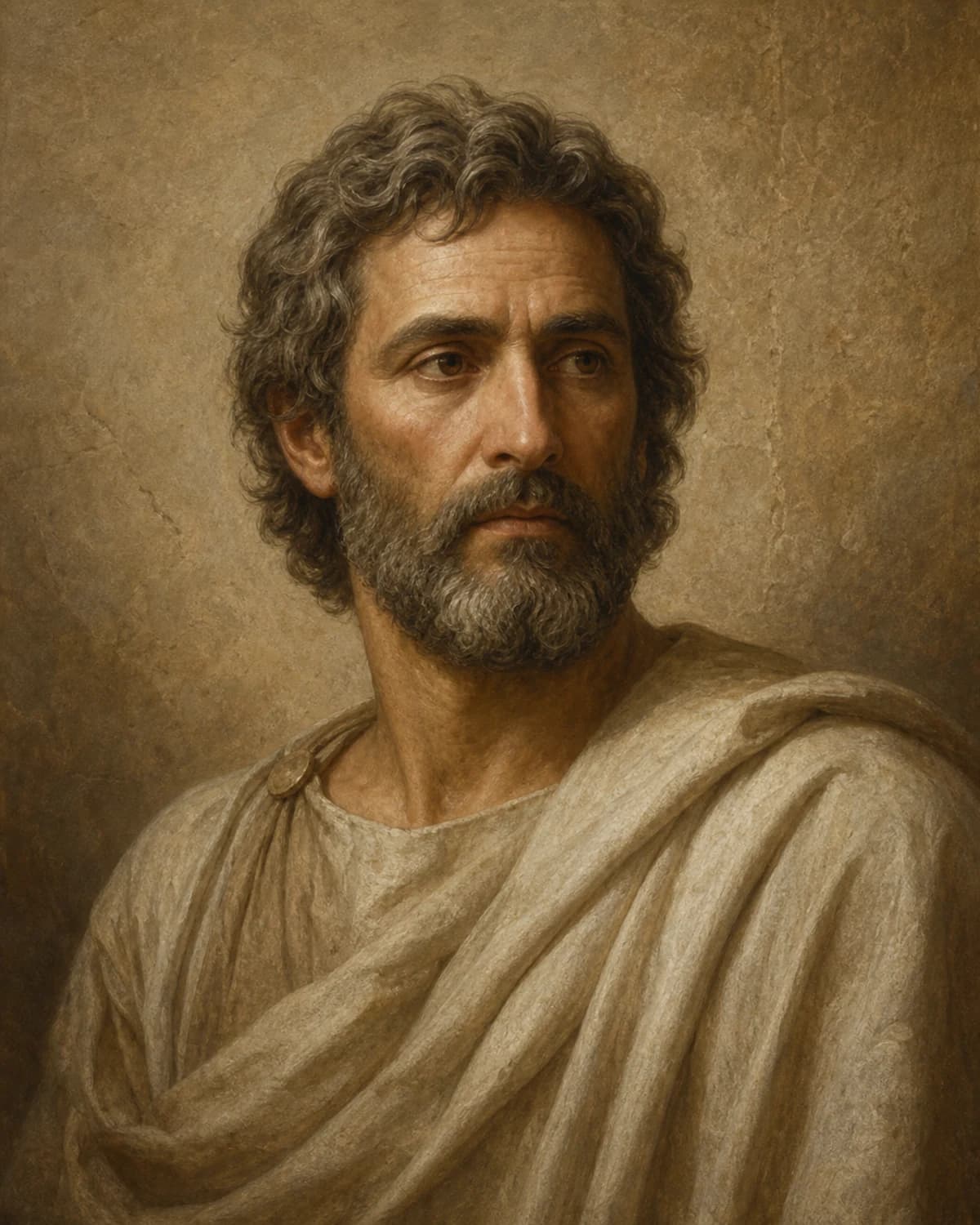
Biography
Apelles came to Rhodes to make the acquaintance of Protogenes and did not find him in his studio. There was only an old woman guarding a large panel prepared for a painting. Asked who was enquiring after the master, the visitor took up a brush and drew an extremely fine line across the panel: that is who. Protogenes, on his return, knew at once whose hand it was and drew over it a still finer line in another colour. Apelles came again and with a third colour split both lines so that no room was left for any further refinement. Protogenes admitted defeat. The panel with its three lines was later taken to Rome, where, Pliny says, it amazed viewers more than any Greek painting, until it burned in the fire of Caesar’s house on the Palatine.
The story was written down by Pliny the Elder almost four centuries after the painter’s death. Nearly everything we know about Apelles is of the same kind, and to my mind it is no longer possible to separate fact from anecdote in these stories.
Ancient writers named his birthplace now as the island of Kos, now as Ephesus, but most likely he was born at Colophon, an Ionian city north of Ephesus. The Byzantine encyclopaedia known as the Suda calls him a Colophonian, “an Ephesian by adoption”, the son of Pytheas and the brother of another painter. He studied first with Ephorus at Ephesus, and when he was already a known master he became a pupil of Pamphilus at Sicyon, thus joining Ionian lightness to Sicyonian thoroughness. Around 340 BC Apelles came to the court of Philip II at Pella and painted the king and the young Alexander so successfully that he became the acknowledged court painter of Macedon. Alexander, tradition has it, allowed no one else to paint his portrait. Pliny places the height of Apelles’s career in the 112th Olympiad, that is, 332–329 BC. His dates are derived from two fixed points: to be an acknowledged master by 340, he must have been born no later than 370; around 306 he is found in Egypt, at the court of Ptolemy I.
He painted Alexander and his generals most often of all. In the Temple of Artemis at Ephesus hung an Alexander holding a thunderbolt, like Zeus; of this picture it was said that there were two Alexanders: the son of Philip was invincible, the son of Apelles inimitable. The fee, so the story goes, was royal, twenty talents in gold, measured out by the weight of the panel. Plutarch, who lived much later, disliked the picture: the fair-skinned Alexander had come out too swarthy. Another anecdote concerns an equestrian portrait. Alexander praised it with reserve, a horse that was led in neighed at the painted horse, and the painter supposedly told the king that the horse was a better judge of painting. Apelles painted the one-eyed general Antigonus in three-quarter view, turning his sound side to the viewer. Two pictures with Alexander, one with Victory and the Dioscuri, the other with a chariot followed by War with bound hands, later ended up in the Forum of Augustus in Rome, and the emperor Claudius had Alexander’s face replaced with that of Augustus. The mosaic of the Battle of Issus at Pompeii may repeat a painting by Apelles or by Philoxenus of Eretria.
His most celebrated work was the “Aphrodite Anadyomene”, painted for the Temple of Asclepius on Kos: the goddess rises from the sea and wrings out her wet hair. Augustus took the picture to Rome, it began to flake, and Nero replaced it with a copy by Dorotheus. According to Pliny, the model was Campaspe, a concubine of Alexander, whom the king gave to the painter on noticing that he was in love. Athenaeus names a different model, the courtesan Phryne, who walked naked into the sea at a festival at Eleusis. The scene of Alexander’s gift was later painted by Tiepolo and Langlois.
Apelles had been on bad terms with Ptolemy, once one of Alexander’s generals, since their days in the royal retinue. A storm drove the painter to Egypt, and a jester bribed by his rivals gave him a false invitation to the royal banquet. The angry Ptolemy demanded to know who had invited him, and Apelles took charcoal from the hearth and sketched on the wall a face that the king recognised from the first strokes. Lucian tells another story: the painter Antiphilus accused Apelles of taking part in a conspiracy against King Ptolemy, and the artist was nearly executed. Once acquitted, he painted the “Calumny”, an allegory in which an innocent youth is accused by Ignorance, Envy, Treachery and Deceit. From Lucian’s description Botticelli painted his own “Calumny of Apelles” around 1495; it is now in the Uffizi.
Pliny writes that Apelles made do with four colours, white, black, red and yellow, and covered his finished pictures with a dark varnish whose recipe he kept secret and took with him to the grave. He considered his strength to be grace, charis, and readily admitted that Melanthius arranged his figures better and Asclepiodorus was more exact in proportion. He let no day pass without practising his line, hence the Latin saying “Not a day without a line”. He would put finished pictures on show outside his studio and hide nearby to listen to passers-by. A cobbler noticed a mistake in a sandal, Apelles corrected it overnight, and when the man set about judging the leg the next morning, the painter came out of hiding and told him to judge no higher than the shoe. Pushkin retold this story in his poem “The Cobbler” (1829). Pliny, it seems, took such sayings from Apelles’s own lost treatise on painting.
Apelles died, apparently, on Kos. He was working there on a new Aphrodite for the islanders and did not live to finish it, and no one undertook to complete the picture.
Related context
Associations
Works connected through artistic movements, cultural context and period. Priced works available in this market appear first.
Profile notes
Profile and sources
Image
Artist image
На основе открытого изображения: sailko; Wikimedia Commons; CC BY 2.5.
