
16.01.1857–26.06.1914
Antonio Herrera Toro
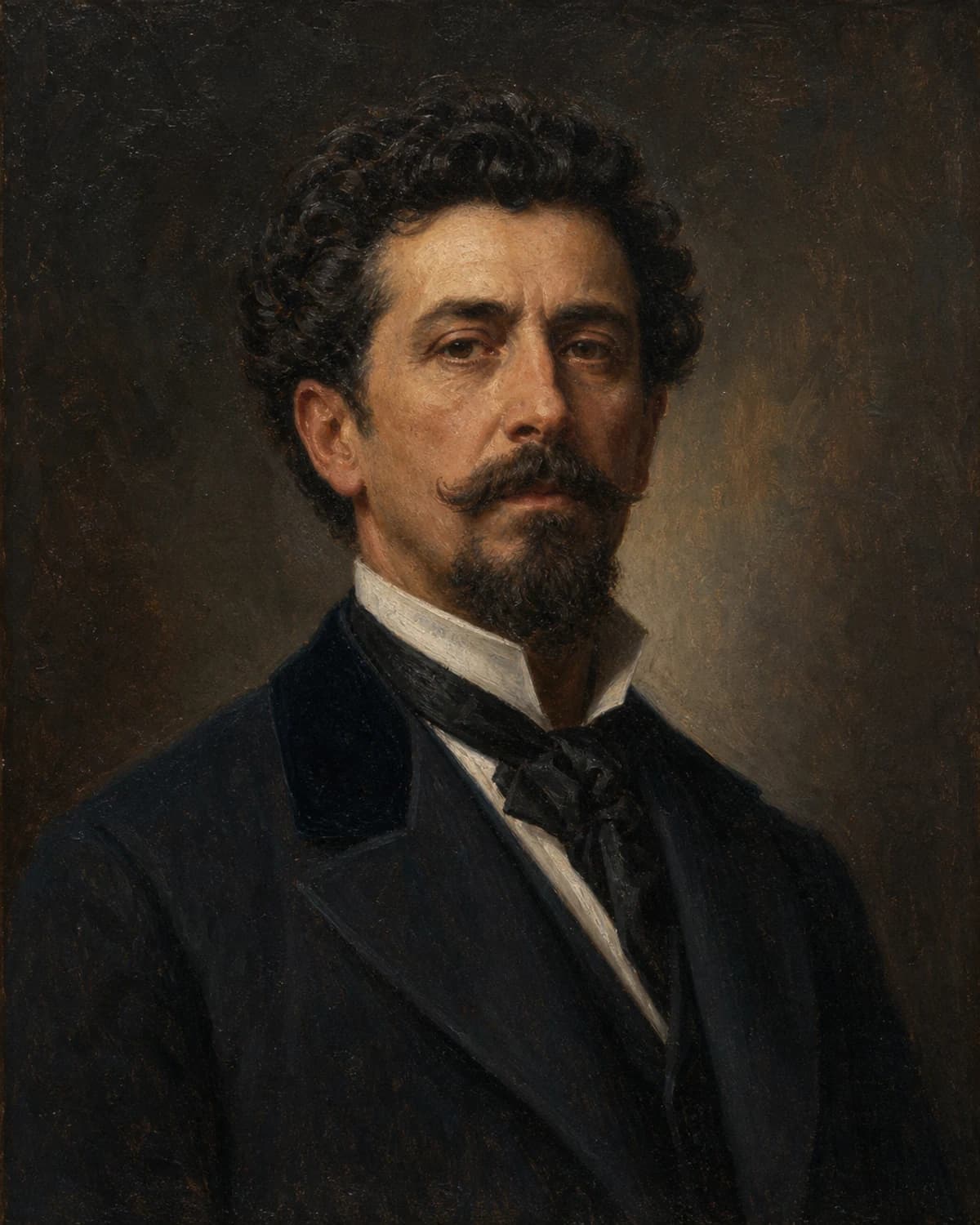
Antonio Herrera Toro (1857–1914) studied under Martín Tovar y Tovar, worked in Paris and Rome on a government scholarship, painted the murals of Caracas Cathedral with Cristóbal Rojas and made “The Death of the Liberator” for the centenary of Bolívar. He painted portraits of Venezuelan presidents, wrote for the magazine El Cojo Ilustrado under the pseudonym Santoro, and from 1908 directed the Academy of Fine Arts.
Biography
In 1883 Caracas was preparing to mark the centenary of the birth of Simón Bolívar, and Antonio Herrera Toro submitted to the national exhibition a painting of the Liberator’s last moments. The painter was twenty-six. Later reference works list this picture first among his works.
He was born on 16 January 1857 in Valencia, in the state of Carabobo. His father, Juan José Herrera, was a lawyer, and his mother was Teresa Rodríguez del Toro. The date of birth also appears in sources as 26 January; the first is adopted here, as it is given in most accounts. He received his early education at the La Viñeta school, where the German scholar Adolf Ernst taught. In 1869, at the age of twelve, he began to study painting under Martín Tovar y Tovar, and five years later he entered the Academy of Fine Arts in Caracas, where his teachers were José Manuel Maucó and Miguel Navarro Cañizares. As early as 1872, according to one publication, he painted “Allegory of the Battle of Araure”, and in 1873 a portrait of President Antonio Guzmán Blanco. In 1875 the government awarded him a scholarship to study in Paris and Rome. He returned in 1881 with sketches for an “Assumption of the Virgin”, commissioned by José Antonio Ponte, Archbishop of Caracas. From these he painted the murals of the cathedral, with Cristóbal Rojas as his assistant.
After “The Death of the Liberator”, Tovar y Tovar, who had received a government commission for paintings for the Federal Legislative Palace, sent Herrera Toro to Peru. In 1884 he made sketches at the sites of the battles of Junín and Ayacucho. Tovar died before finishing the work, and Herrera Toro completed “The Battle of Ayacucho” (1890) himself; “The Battle of Junín” is dated 1904. Between these canvases come portraits and subject pictures: “Charity” (1886), “The Death of Ricaurte at San Mateo” (1889), and portraits of the writer Arístides Rojas, the lawyer Miguel José Sanz and Fermín Toro. Among the portraits are likenesses of heads of state: Raimundo Andueza Palacio (1890) and Cipriano Castro (1902). Several self-portraits also survive, including those of 1880 and 1895.
Alongside painting he took up journalism and signed his texts with the pseudonym Santoro. He wrote often for El Cojo Ilustrado, a biweekly cultural magazine, and took part in founding the newspaper El Granuja.
In 1892 he was appointed director of the government office of buildings and the ornamentation of towns. In 1908, after the death of Emilio Jacinto Mauri, he became head of the Academy of Fine Arts. In early 1909 a large group of students went on strike and demanded changes to the curriculum. Two years later, with Pedro Arismendi Brito, a former general and man of letters, he drew up the regulations of the National Institute of Fine Arts, which included painting and sculpture as well as music and recitation. In the same year, 1911, he submitted his resignation, but the government did not accept it. The students continued to protest, yet he remained director until his death: he died in Caracas on 26 June 1914. It seems to me that we know less about his teaching than we should: the accounts available list posts and conflicts, but do not say what exactly he taught.
Related context
Associations
Works connected through artistic movements, cultural context and period. Priced works available in this market appear first.








Profile notes
Profile and sources
Image
Artist image
На основе открытого изображения: Antonio Herrera Toro; Wikimedia Commons; Public domain.
