
14.05.1905–13.10.1981
Antonio Berni
Antonio Berni (1905–1981), the son of an Italian tailor in Rosario, was a Surrealist and a friend of Aragon in the Paris of the 1920s, returned to Argentina in the 1930s to “New Realism” and large canvases of the unemployed, and from 1958 assembled, out of boards, tin and rags from the dumps, the story of Juanito Laguna, a boy from the shanty towns of Buenos Aires. For his prints of Juanito and Ramona he won the Grand Prix of the 1962 Venice Biennale.
Biography
One cold, cloudy night he was walking through a wretched settlement on the edge of Buenos Aires and looking at the ground: old boards, empty bottles, iron, cardboard boxes, sheets of tin. Out of this, here, people built their shacks. Out of this same stuff, Berni decided, one should build a picture of those who lived in them. So in 1958 began Juanito Laguna, the slum boy whom he put together out of rubbish for almost twenty years; later Ramona Montiel was added to him.
Delesio Antonio Berni was born on 14 May 1905 in Rosario, at 288 Calle España, the son of the tailor Napoleón Berni, an immigrant from Italy, and Margarita Picco, the daughter of Italian settlers from nearby Roldán. In 1914–1915 the father went back to Italy and died during the First World War. At nine the boy was apprenticed to the Buxadera stained-glass workshop, and he studied painting at the Catalan Centre in Rosario. In 1920, at fifteen, he exhibited seventeen canvases, suburban landscapes and flowers, at the Salón Mari, and on 4 November 1923 his Impressionist landscapes were praised by La Nación and La Prensa at once.
In 1925 the Jockey Club of Rosario gave him a scholarship to study in Europe. He went first to Spain, because Sorolla and Zuloaga were in fashion, passed through Madrid, Toledo, Segovia, Granada, Córdoba and Seville, and then settled in Paris, where the Argentines Butler, Badi, Bigatti, Xul Solar, Basaldúa and Spilimbergo were already working. For a few months he attended the courses of André Lhote and Othon Friesz at the Grande Chaumière, painted landscapes of Arcueil, where he settled in 1927, went home briefly and came back to Paris on a grant from the province of Santa Fe. In 1928 Henri Lefebvre, with whom he had become friends, set him reading Marx and introduced him to Louis Aragon; from Max Jacob he learned engraving. A de Chirico retrospective and the paintings of Magritte led him to Surrealism, which he called a new view of art and the world after the war. His Surrealist canvases of around 1930, “The Eiffel Tower in the Pampa”, “The Siesta and Its Dream”, “Death Lurks at Every Corner”, are painted after de Chirico, without Miró’s automatism and without Dalí’s dreams. The correspondence with Aragon went on after he left; the letters were later lost, which Berni regretted all his life.
In the Rosario of 1931 Paris ended at once. After the coup of 1930, with a wife and daughter, he lived for a few months on a farm, then worked for the municipality, organised the Mutual Society of Students and Artists and joined the Communist Party. In 1932 he showed his Parisian Surrealist works in Buenos Aires: it was the first exhibition of Surrealism and the first collage in Latin America, and the critics rejected it wholesale. In the same year he worked as a photographer for a report on the Pichincha district with its mafia and brothels. Unemployment, demonstrations, hunger: Berni later said that this reality “tore at the eyes”. In 1933 Siqueiros, visiting to lecture, called on him, Spilimbergo, Castagnino and Lázaro to paint the mural “Plastic Exercise” together; Berni did his share but did not believe in the mural, holding that in Argentina the wall belonged to the bourgeoisie anyway. His answer was the large canvases of 1934, “The Unemployed” and “Demonstration”, painted from his own photographs; this was “New Realism”. Then came portraits: “Figure” took the first prize of the National Salon in 1940, “Lily”, a portrait of his daughter, the Grand Prix of 1943; in “Paula and Lily” (1941) he painted his wife and daughter.
From December 1941 to May 1942, on a commission from the National Commission for Culture, he travelled through Bolivia, Ecuador, Peru and Colombia studying pre-Columbian art, and from the photographs he brought back he painted “Indian Market”. In the 1940s, with Spilimbergo, Castagnino, Urruchúa and Colmeiro, he painted the dome of the Galerías Pacífico arcade, and he answered the coup of 1943 with “Massacre” and “The Dead Worker”. In 1951–1953 he lived in Santiago del Estero, where the quebracho forests were being felled, and painted there the series “Santiago Motifs” and “Chaco”, later shown in Paris, Berlin, Warsaw, Bucharest and Moscow. In the 1950s came suburban landscapes: “The Tailor’s House”, “The Church”, “The White Tank”, “The Street”.
Juanito Laguna of boards and tin, “Portrait of Juanito Laguna”, “The World Promised to Juanito”, “Juanito Goes to the City”, and Ramona Montiel brought him the Grand Prix for printmaking at the Venice Biennale of 1962. In 1965 the Di Tella Institute showed his retrospective, which travelled through the United States and Latin America; the compositions “Ramona in the Cave”, “Ramona’s World”, “Massacre of the Innocents” (shown in Paris in 1971) grew more complex until, by the late 1970s, they had grown into three-dimensional altarpieces.
After the coup of March 1976 he left for New York and painted there, with a touch of social irony, “Airport”, “The Hippies”, “Streets of New York”, “Chelsea Hotel”. In 1980 he finished “Apocalypse” and “Crucifixion” for the chapel of San Luis Gonzaga in Las Heras; they were installed the following year. He died on 13 October 1981 in Buenos Aires, while working on a monument to Martín Fierro, which was unveiled in San Martín on 17 November.
In 1967 Mercedes Sosa had sung “Juanito Laguna Flies a Kite”. In July 2008 fifteen of his paintings, on their way to the National Museum of Fine Arts, were stolen by robbers dressed as policemen.
Related context
Associations
Works connected through artistic movements, cultural context and period. Priced works available in this market appear first.








Profile notes
Profile and sources
Image
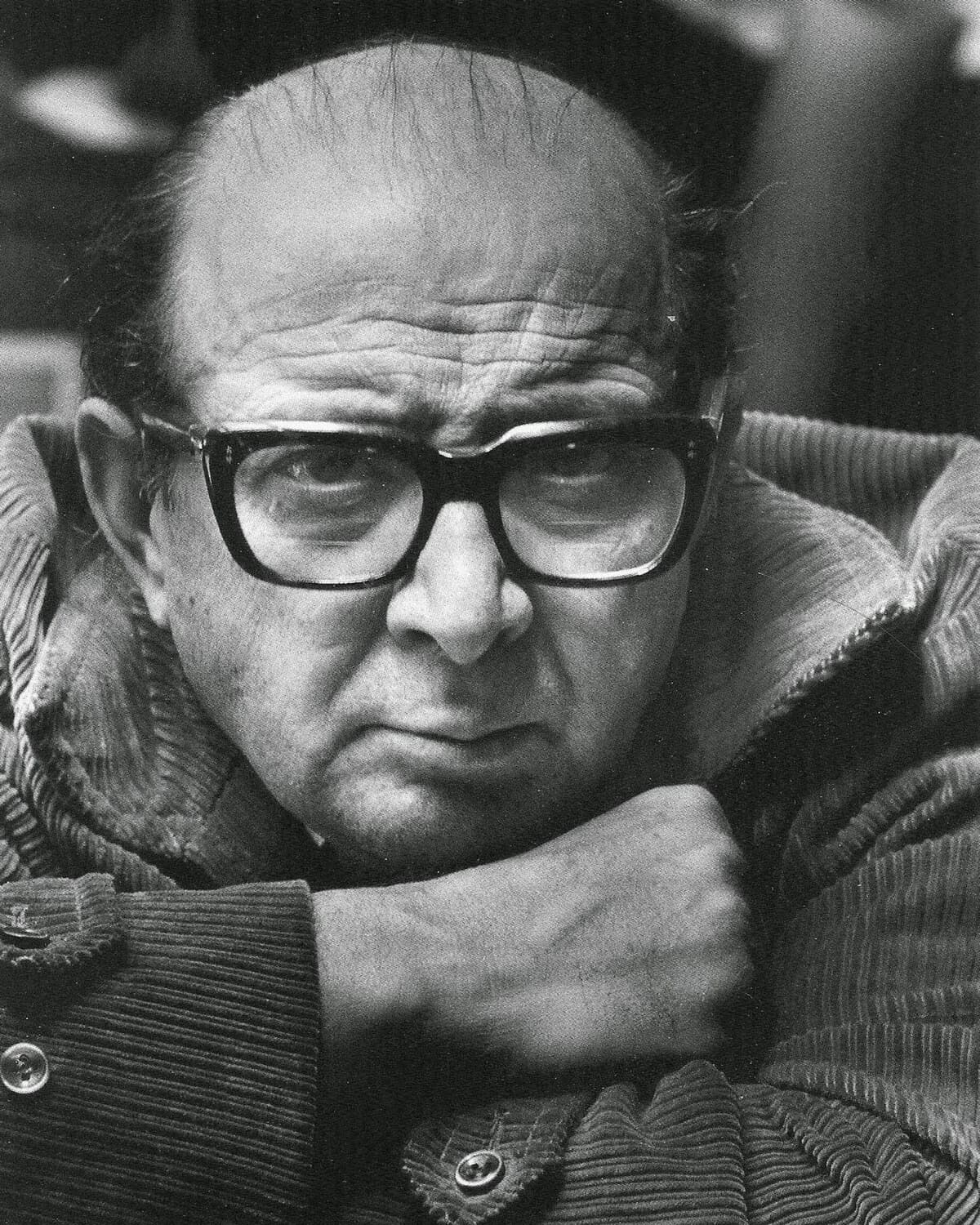
Artist image
Anatole Saderman (1904-1993); Wikimedia Commons; Public domain.
