
13.12.1923–06.02.2012
Antoni Tàpies
Antoni Tàpies (1923–2012) abandoned law studies in Barcelona for painting and became one of the leading Catalan artists of the second half of the twentieth century. He mixed marble dust and clay into his paint, brought rope, rags and scraps of paper into his pictures, and later parts of furniture. He founded the group Dau al Set, won the Rubens Prize, the Wolf Prize and the Velázquez Prize, and established a foundation in Barcelona that bears his name.
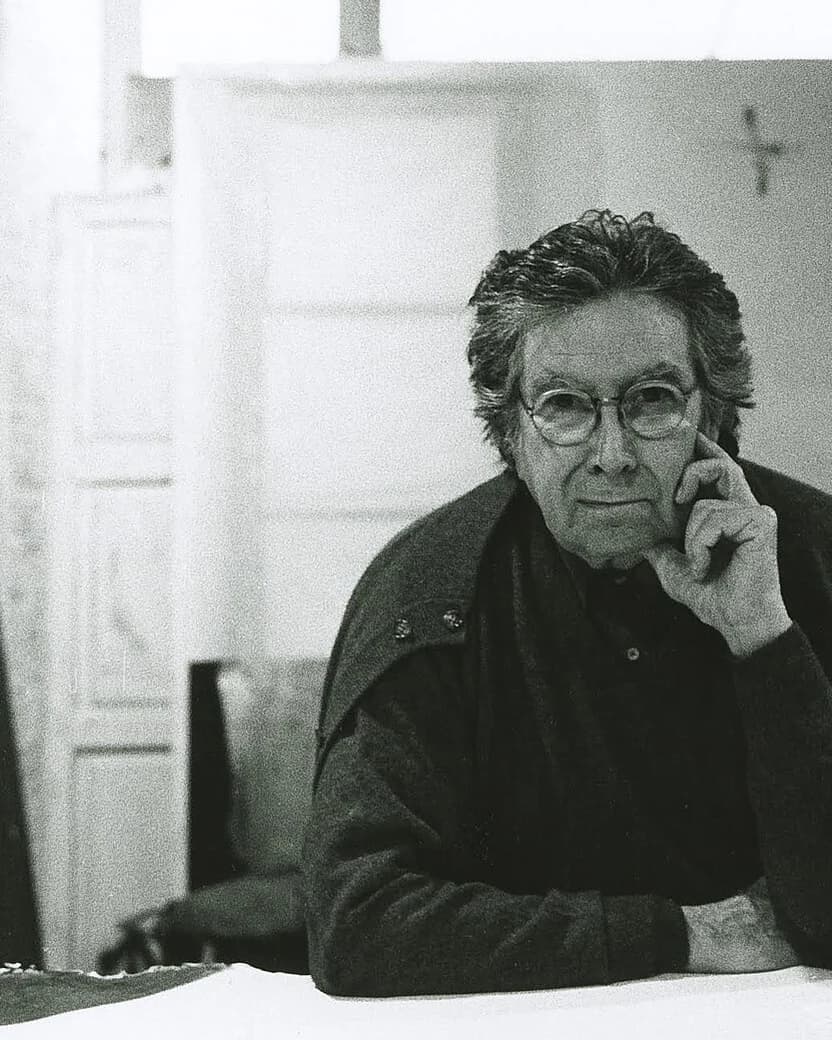
Biography
In 1943 Antoni Tàpies entered the law faculty of the University of Barcelona. Two years later he gave up his studies, apparently without regret: he had been drawn to painting since his teens.
He was born on 13 December 1923 in Barcelona. His father, Josep Tàpies i Mestre, was a lawyer and a Catalan nationalist who served briefly in the Republican government. His mother’s family, Maria Puig i Guerra’s, was connected with publishing and bookselling and took part in Catalan political life. People engaged in Catalan public life and Republican ideas came to the house. He first met modern art in 1934, on entering secondary school: the Christmas issue of the magazine D’ací i d’allà printed reproductions of Duchamp, Braque, Kandinsky and Picasso. During the Spanish Civil War (1936–1939), while still at school, he taught himself to draw and paint. He also attended the German School of Barcelona.
In the early 1940s he fell seriously ill and spent two years in the mountains and in sanatoriums, reading a great deal. After leaving the university, in 1945, he began to experiment with materials and grew increasingly interested in philosophy, including Sartre and Eastern thought. He had been making prints since 1947.
In 1948, together with the poet Joan Brossa, regarded as the main founder, and others, he created Dau al Set, the first post-war art group in Spain, which looked to Surrealism and Dada. The group had a magazine of the same name. Tàpies’s first works derived from Klee and Miró. His first solo show took place in 1950 at the Galeries Laietanes in Barcelona, and in the same year he was included in the Carnegie International in Pittsburgh. In the early 1950s, on a French government scholarship, he lived in Paris and often returned there afterwards. The critic Michel Tapié promoted his work enthusiastically.
From 1953 Tàpies turned to mixed media: he added clay and marble dust to his paint and brought scraps of paper, string and rags into his pictures (“Grey and Green Painting”, 1957, Tate Gallery, London). This is painting of a “matter” texture (pintura matèrica), close to Art Informel. In the same year, 1953, he showed his work in the United States for the first time, in Chicago and New York, and took part in the São Paulo Biennial. In 1958, together with Eduardo Chillida, he represented Spain at the Venice Biennale, where he received the UNESCO Prize and the David Bright Prize, as well as first prize at the Pittsburgh International. By the end of the 1950s his reputation was international. He worked alongside Spanish Informalist artists: Enrique Tábara, Antonio Saura and Manolo Millares.
In 1966 he was arrested at a clandestine assembly at the University of Barcelona. In the early 1970s his work began to carry symbols of Catalan identity, which Franco’s regime did not accept. In 1974 he showed at the Galerie Maeght in Paris a series of lithographs, “Assassins”, dedicated to the memory of the anarchist Salvador Puig Antich. From about 1970, under the influence of Pop Art, he incorporated more substantial objects into his pictures, such as parts of furniture. Later his work includes spray-painted lines reminiscent of Oriental calligraphy. Among his works of 1980 is “Imprint of a Basket on Cloth”.
With poets and writers he made books and portfolios of prints: with Rafael Alberti, Yves Bonnefoy, Joseph Brodsky, Brossa, Octavio Paz, José Saramago and others. He also wrote essays, collected in books such as “La pràctica de l’art” (1970), “L’art contra l’estètica” (1974) and “Memòria personal” (1978); in them he reflects on the social role of art and explains his artistic and political views.
Retrospectives were held at the Guggenheim Museum (1962), at the Musée National d’Art Moderne in Paris (1973), in Buffalo (1977), in Hanover (1998), at the Jeu de Paume in Paris (1994) and at the Museo Reina Sofía in Madrid (2000). He received the Rubens Prize (1972), the Wolf Prize (1981), the Prince of Asturias Award (1990) and the Velázquez Prize (2003). On 9 April 2010 King Juan Carlos I granted him the title of Marquess of Tàpies. The Fundació Antoni Tàpies in Barcelona, on Carrer d’Aragó, he founded himself; by one account in 1984, by another the foundation opened in 1990.
Tàpies died in Barcelona on 6 February 2012.
Profile notes
Profile and sources
Image
Artist image
Teresa Tàpies Domènech; Wikimedia Commons; CC BY-SA 4.0.
