
10.08.1737–04.12.1773
Anton Losenko
Anton Losenko (1737–1773), the orphaned son of a merchant from Glukhov and a singer in the court choir, studied under Ivan Argunov and then, as one of the Academy of Arts’ first pensioners, went to Paris and Rome. His “Vladimir and Rogneda” (1770) put early Russian history on canvas. From 1772 he directed the Academy, wrote a textbook on human proportions and died leaving “The Farewell of Hector and Andromache” unfinished.
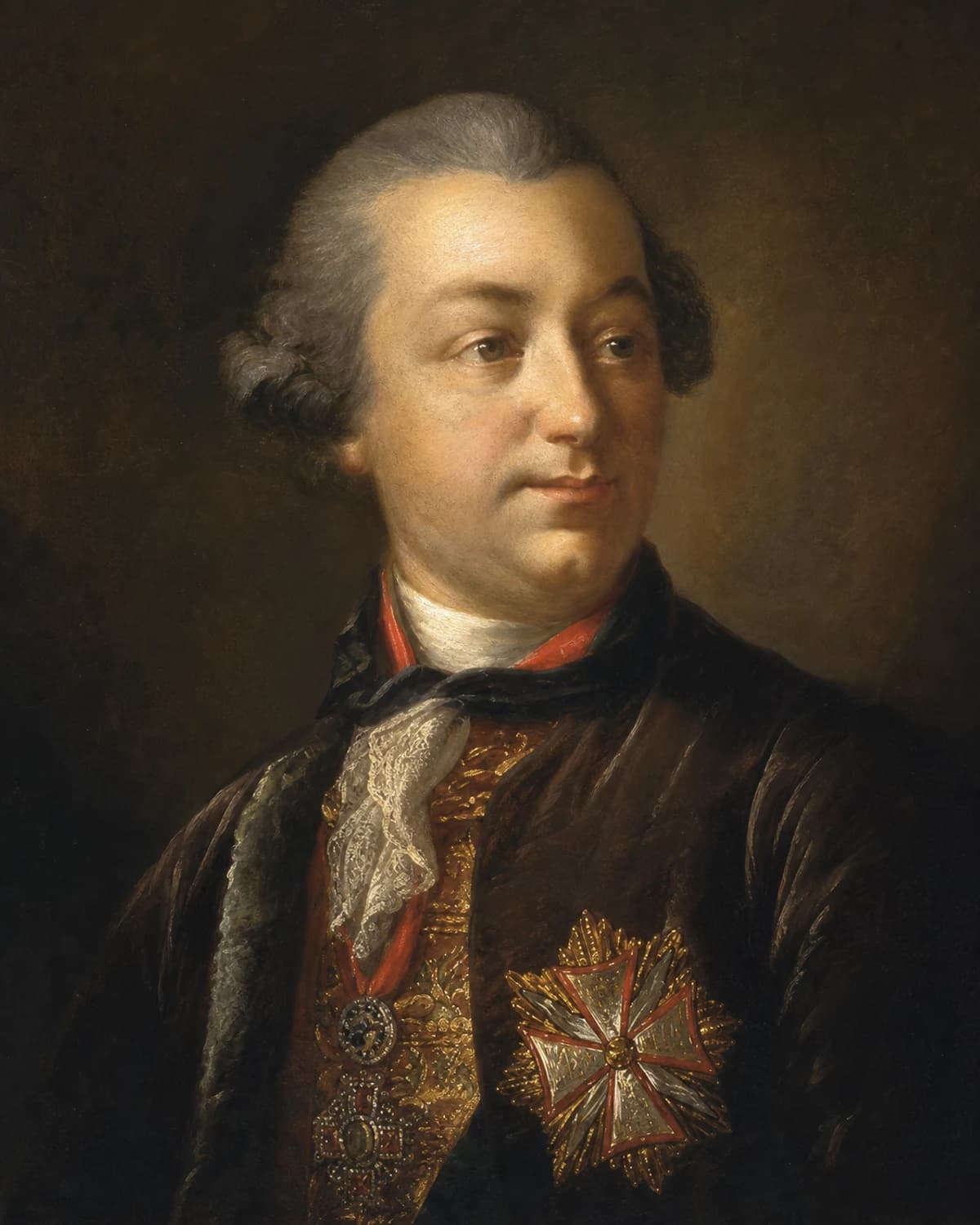
Biography
In 1753 the voice of Anton Losenko, a chorister in the court choir, broke. He could no longer sing, but he drew well, and the boy was apprenticed to Ivan Argunov, a serf artist belonging to Count Sheremetev. He spent five years and five months with Argunov.
Nineteen years later he would be director of the Academy of Arts.
He was born on 30 July (10 August) 1737 in Glukhov. His father, the merchant Pavel Yakovlevich Losev, often travelled on business to Ukraine and Poland and in time settled in Glukhov. The artist’s own surname was also written as Losenkov. His mother died when he was four, then his father died too, and the seven-year-old orphan was sent to St Petersburg, to the court choir.
After Argunov, Losenko was placed at the newly founded Academy of Arts, with the portraitist Pietro Rotari. To this time belong “Tobias and the Angel” (1759) and the portraits of Ivan Shuvalov and Alexander Sumarokov (1760). Half a year after his admission he was sent abroad as a pensioner; together with Vasily Bazhenov he is considered the Academy’s first pensioner. In Paris he studied under Jean Restout, then under Joseph-Marie Vien, and Prince D. M. Golitsyn was his patron. There he painted “The Miraculous Catch” (1762), “The Death of Adonis” (1764) and the programme picture “The Sacrifice of Isaac” (1765), for which the Royal Academy of Painting and Sculpture awarded him a large gold medal. In 1766–1769 he continued his training in Rome, at the French Academy, studied Raphael and painted two pictures of Cain and Abel; “Abel” is dated 1768, and “Zeus and Thetis” 1769.
On his return to St Petersburg he had to submit a history painting for the title of Academician, and he chose an episode from the history of Kievan Rus’. “Vladimir and Rogneda” (1770) is often called naive and melodramatic, yet in it early Russian history was shown visually for the first time, in the artistic language accepted at the time. To my mind, it should be seen as the beginning of the tradition of history painting whose founder Losenko is considered to be.
For this painting he received the title of Academician and the post of adjunct professor, soon became a professor, and in 1772 director of the Academy, sharing the post with N. Gillet. He wrote a textbook on the proportions of the human body from which artists in Russia learned until the mid-nineteenth century. He painted few portraits: besides Shuvalov and Sumarokov, there are Fyodor Volkov (1763) and Grand Duke Paul as a child; they are expressive and consistently classicist. Among his pupils who made names of their own were the painters Ivan Akimov, Pyotr Sokolov and Grigory Ugryumov, the sculptor Mikhail Kozlovsky and the engraver Gavriil Skorodumov.
Losenko died in St Petersburg on 23 November (4 December) 1773, at the age of thirty-six. The large canvas “The Farewell of Hector and Andromache”, a commission from Catherine II, remained unfinished. He was buried in the cemetery of the Church of the Annunciation on Vasilyevsky Island; the grave has been lost. In 1972 his portrait of Fyodor Volkov appeared on a Soviet postage stamp.
Related context
Associations
Works connected through artistic movements, cultural context and period. Priced works available in this market appear first.








Profile notes
Profile and sources
Image
Artist image
На основе открытого изображения: Anton Losenko; Wikimedia Commons; Public domain.
