
1933–present
Anna Bella Geiger
Anna Bella Geiger (born 1933) began in the 1950s as an abstract painter in Fayga Ostrower’s studio in Rio de Janeiro, and since the 1970s has worked with maps, photo-etching, video and metal objects, asking where the borders of “Brazilian culture” run. Her 1978 photographic postcard “Our Daily Bread” is held by museums in the United States. She teaches at the Escola de Artes Visuais do Parque Lage.
Biography
In 1950 the seventeen-year-old Anna Bella Geiger exhibited for the first time at the Salão Nacional de Belas Artes in Rio de Janeiro. Three years later she took part in the exhibition of abstract art in Petrópolis, one of the first in Brazil.
She was born on 4 April 1933 in Rio de Janeiro. Her parents had grown up in Ostrowiec Świętokrzyski in Poland and moved to Brazil ten years before her birth; her father was a craftsman. She first studied language and literature, Anglo-Germanic letters, at the Federal University of Rio de Janeiro, and took up painting in the 1950s with Fayga Ostrower. In 1954 she went to New York, where she attended art history classes at the Metropolitan Museum with Hannah Levy and sat in on courses at New York University; a year later she returned.
She took up printmaking in the metal engraving workshop of the Museu de Arte Moderna in Rio de Janeiro, which she attended from 1960 to 1965 and where three years later she began teaching herself. The period 1965–1968 she calls her “visceral phase”: the etchings show fragments of the body, scattered organs resembling a map of a microcosm. That, I think, is where her interest in maps began. In 1969 she taught at Columbia University in New York; in 1970 she came back to Rio once more. In the 1970s, an abstract artist by training, she brought representational elements into her work and moved to photo-etching, photomontage, xerox, assemblage, video and Super-8 film. In her hands the maps of Brazil and South America are turned upside down, erased, laid over the body; the question whether there is a single Brazilian culture shared by all Brazilians she raised in the years of the military regime, when it sounded different from the way it does today. “Our Daily Bread” of 1978 is a photographic postcard in five copies; it is held by the Blanton Museum in Austin, the Fogg Museum at Harvard and the Tepper Takayama gallery in Boston. In the 1980s she concentrated on painting, and in the early 1990s began casting maps in metal and setting them in iron boxes and archive drawers filled with encaustic, hot wax with pigment. In 1987, with the critic Fernando Cocchiarale, she published a book on geometric and informal abstraction in the Brazilian avant-garde of the 1950s. In 2006 in Rio she built the installation “Circe”, with a scale model of ancient Egyptian ruins and a performance video; in 2009 it was reassembled.
She received a Guggenheim Foundation fellowship in the early 1980s: in 1982 by one account, in 1983 by another.
Her work is in the Museum of Modern Art in New York, the Victoria and Albert Museum, the Centre Pompidou, the Fogg Museum, the Getty Foundation, the Museu Serralves in Porto, the Museo Reina Sofía, the Museum of Contemporary Art in Chicago, the National Museum of Women in the Arts in Washington and the Pérez Art Museum Miami; her prints are in the Museu Nacional de Belas Artes in Rio and the Museum of Contemporary Art in Niterói. Exhibitions have been held in London, Tokyo, Warsaw, Ottawa, Portugal and Puerto Rico. Among her awards: the gold medal of the Salão Paranaense in 1963, an honourable mention at the Cuenca Biennial in 1998, the Order of Rio Branco in the rank of officer in 2006. In 2023 she took part in two BIENALSUR exhibitions, at the Casa de América in Madrid and in Buenos Aires. She lives in Rio de Janeiro and teaches at the Escola de Artes Visuais do Parque Lage.
Profile notes
Profile and sources
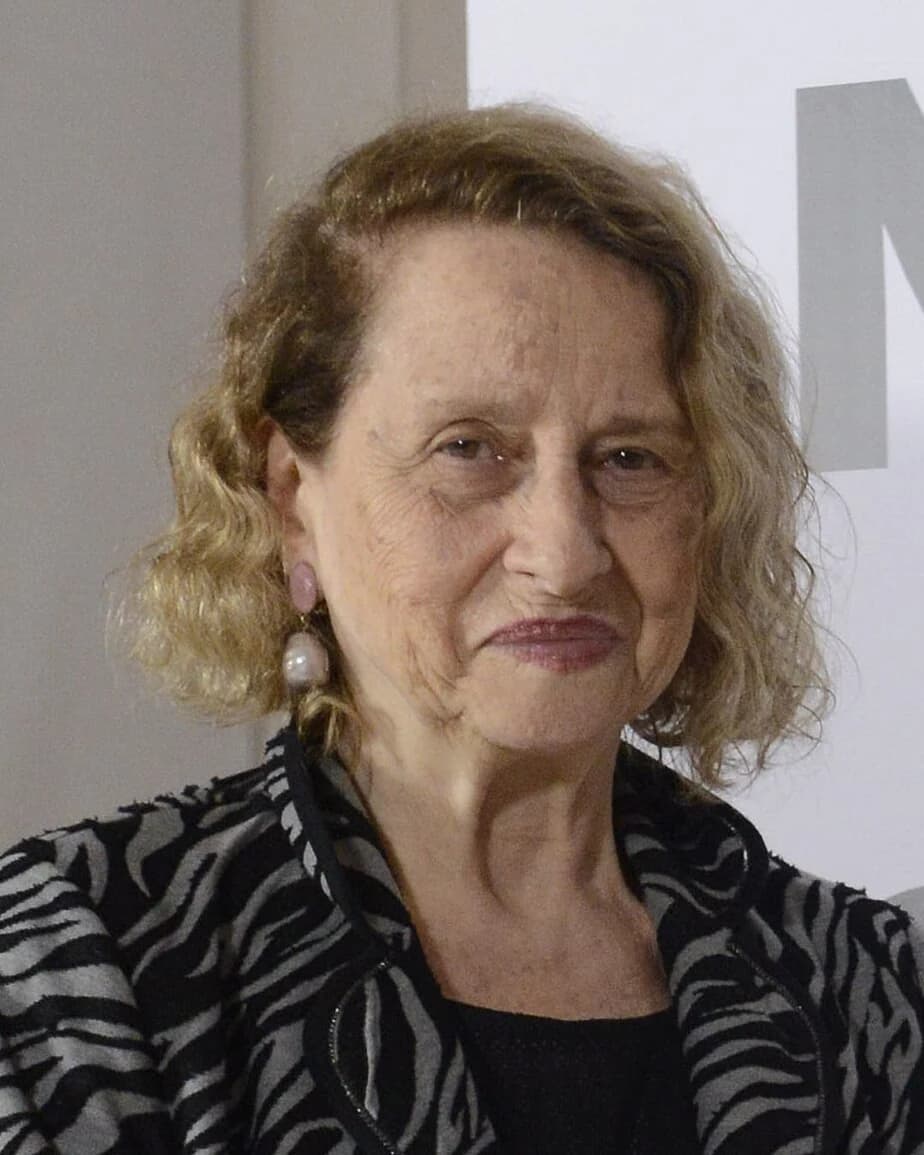
Image
Artist image
Universidad Nacional de Tres de Febrero; Wikimedia Commons; CC BY-SA 4.0.
