
16 марта 1799–9 июня 1871
Anna Atkins
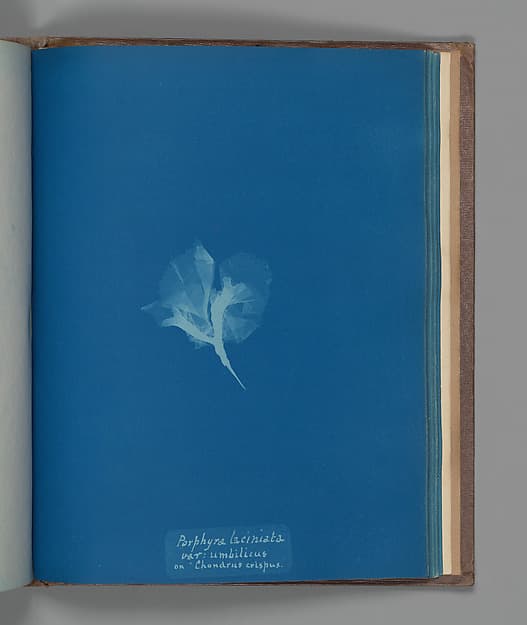
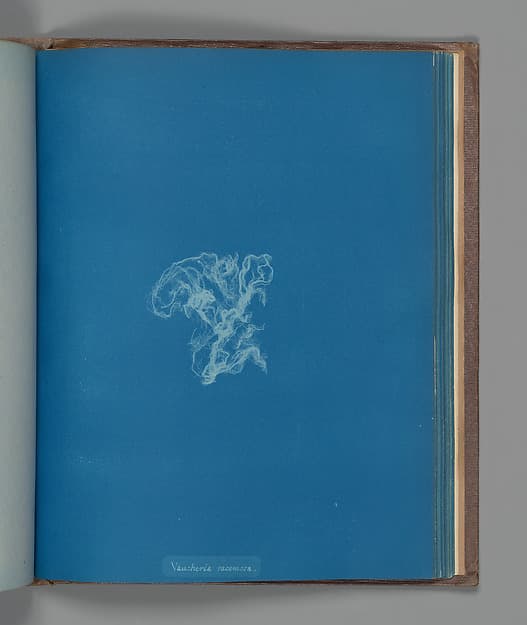
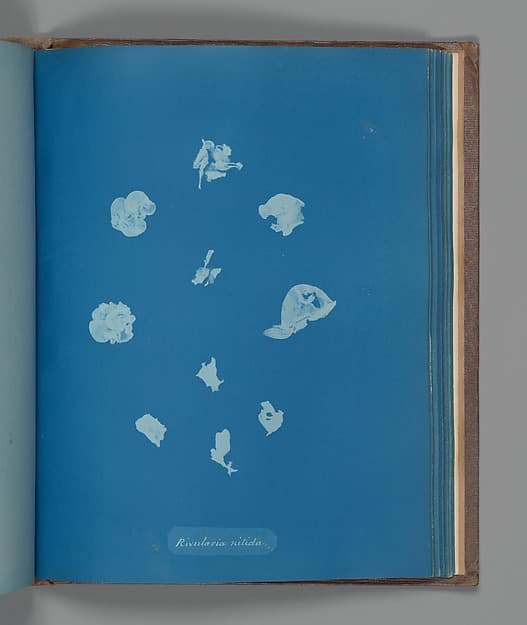
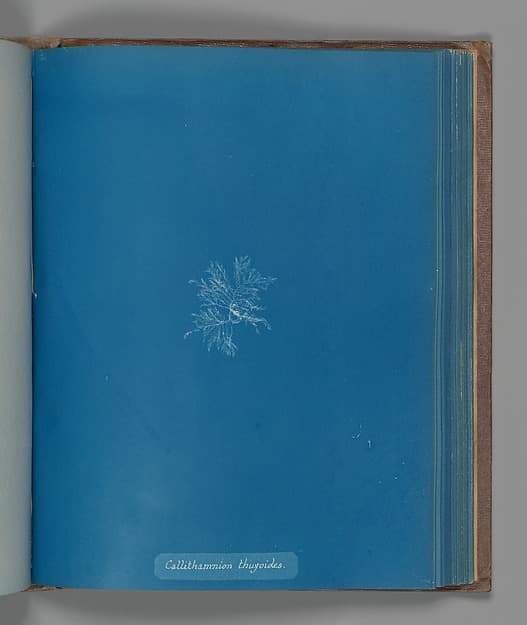
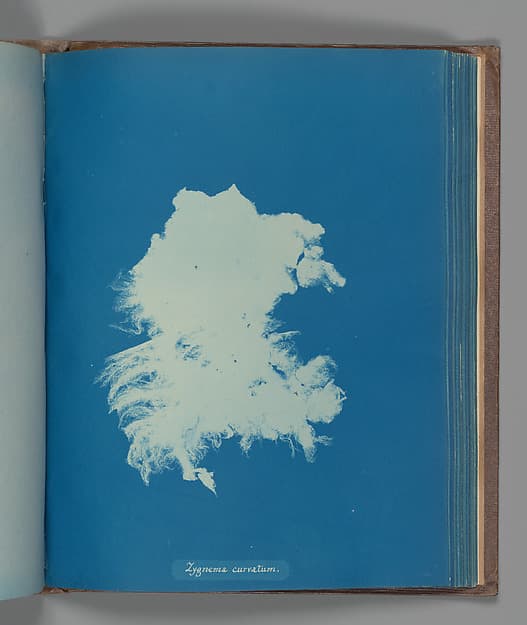
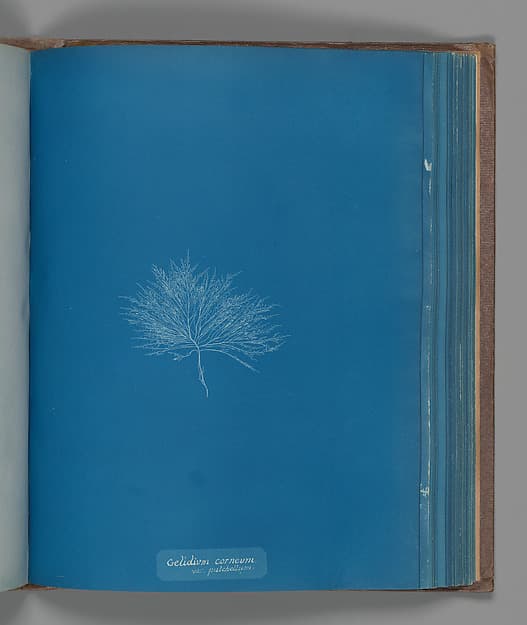
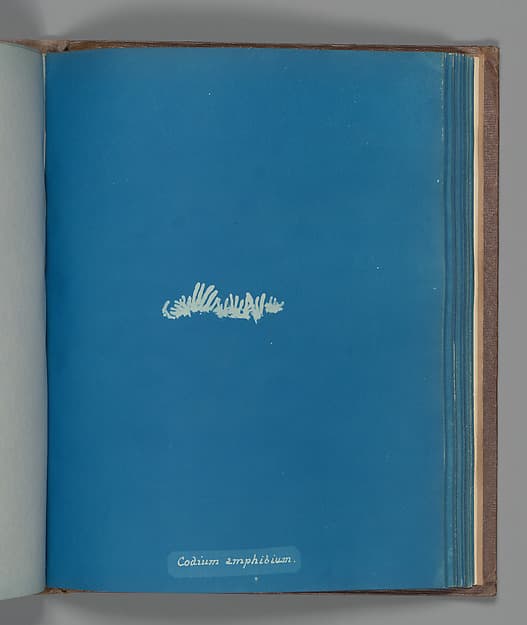
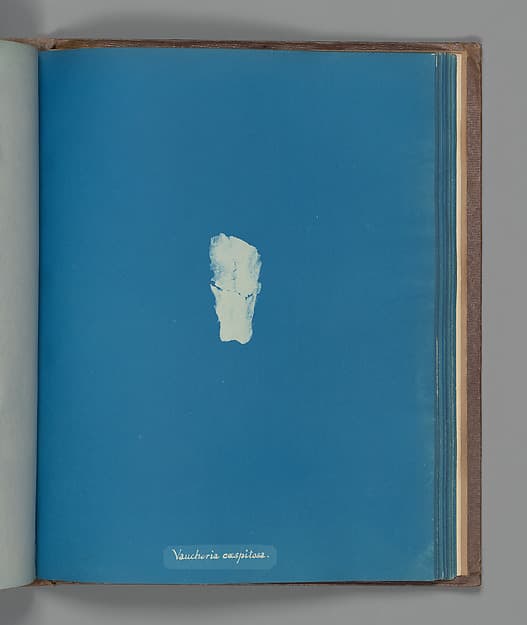
In 1843 Anna Atkins began issuing in parts a book on British algae in which cyanotypes stood in place of engravings: a dried plant was laid directly on light-sensitive paper and left a white silhouette on a blue ground. The book is regarded as the first illustrated with photographic images. Later she made several albums of ferns and flowering plants with a friend.
Biography
Only seventeen copies of “Photographs of British Algae: Cyanotype Impressions” are known today, and nearly all of them differ in what they contain. The print run was tiny and the text was written out by hand. Atkins did not mean to sell the book: she gave the volumes away and sent them to acquaintances and libraries.
She was born on 16 March 1799 in Tonbridge, Kent, and her maiden name was Children. Her mother, Hester Anne, died after the birth, in 1800. Anna grew up with her father, John George Children, a chemist, mineralogist and zoologist who worked at the British Museum. Her education was unusually scientific for a woman of her time. Even before her marriage she drew for her father: her engravings of shells were used in his translation of Lamarck’s work on the genera of shells. How many drawings she made, the sources give differently, from 200 to 256.
In 1825 she married John Pelly Atkins, a London merchant in the West India trade and later Sheriff of Kent, and moved to the family home, Halstead Place, near Sevenoaks. They had no children. In 1839 she was admitted to the Botanical Society of London. She collected and preserved dried plants, and this herbarium, it seems, came in useful to her later.
She learned photography from the circle her father belonged to. He and John Pelly Atkins were friends of William Henry Fox Talbot, and from him Anna learned about the “photogenic drawing” (an object is placed on sensitised paper and exposed to the sun) and about the calotype. She had access to a camera by 1841. She is sometimes called the first woman photographer, but the title is contested in favour of Constance Fox Talbot; no camera photographs survive by either of them, so the dispute will probably never be settled.
Another family friend, the astronomer and physicist John Herschel, invented the cyanotype in 1842. In less than a year Atkins applied it to algae. She laid an unmounted dried specimen on paper treated with a light-sensitive solution, exposed it in the sun and obtained a negative: a pale outline on a blue ground. The printing is by contact, without camera or lens, so the finest filaments and branchings show. She conceived the work as illustrations for William Henry Harvey’s “A Manual of British Algae” (1841). The first part appeared in October 1843. By 1853 there were three volumes in all. The most complete copy is held by the Royal Society: 403 pages and 389 plates, and, to all appearances, it is the only one assembled as Atkins herself intended. At times she added extra plates of the same species if she found a better specimen, and such duplicates survive in the copy at the Horniman Museum.
The first part of Talbot’s “The Pencil of Nature” appeared in June 1844, eight months later. It is regarded as the first commercially published book illustrated with photographs, while Atkins’s book remains the first of any kind, even if privately issued.
After her father’s death in 1852 she published his biography, “Memoir of John George Children”. In the 1850s, together with Anne Dixon (1799–1864), whom she called almost a sister, she made at least three presentation albums of cyanotypes. “Cyanotypes of British and Foreign Ferns” (1853) is in the Getty Museum. “Cyanotypes of British and Foreign Flowering Plants and Ferns” (1854) has been taken apart, and its pages have passed to museums and collections. The album of 1861, inscribed to Captain Henry Dixon, Anne’s nephew, contains 74 cyanotypes: algae, ferns, flowers, feathers of the peacock, emu, partridge and duck, and also lace and needlework. Its captions too are printed in cyanotype, with the Latin names of the plants.
In 1865 Atkins gave the British Museum the algae, ferns and other plants she had used in her work. She died on 9 June 1871 at Halstead Place, aged seventy-two.
Artist works
Works by the artist
Works by Anna Atkins available in this edition of NEOARCA.
Related context
Associations
Works connected through artistic movements, cultural context and period. Priced works available in this market appear first.
Profile notes