
30.10.1741–05.11.1807
Angelica Kauffman
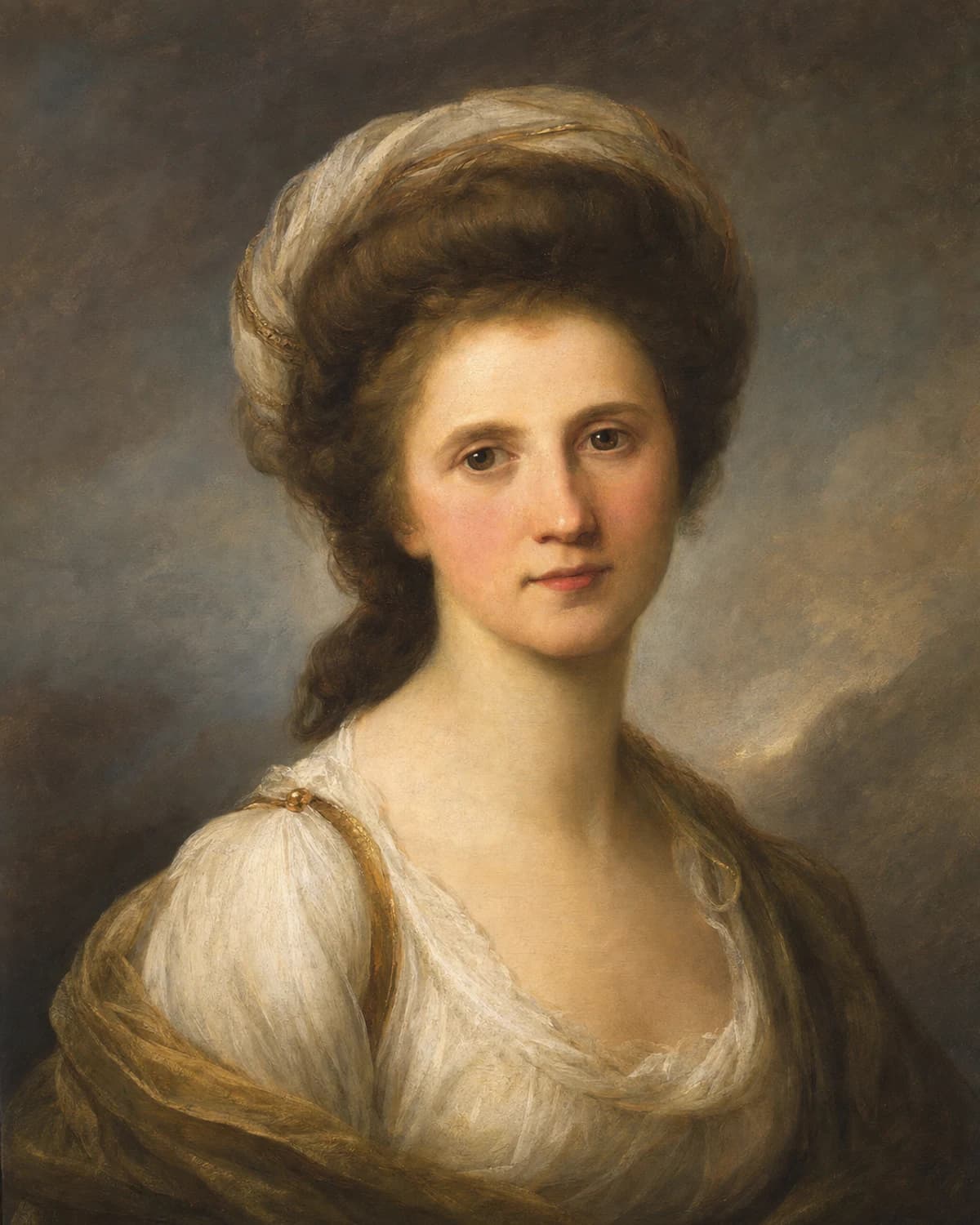
Angelica Kauffman (1741–1807) learned to paint from her father, an itinerant fresco painter, and by the age of twenty-three already belonged to three Italian academies. For fifteen years she worked in London, where in 1768 she was among the founders of the Royal Academy of Arts, and she spent her last twenty-five years in Rome. She thought of herself above all as a history painter.
Biography
In August 1764 Johann Joachim Winckelmann wrote from Rome to a friend about a young woman painter who was just finishing a half-length portrait of him. Her Italian, he said, was as good as her German, she expressed herself freely in French and English, she “may be styled beautiful”, and in singing she could vie with the best virtuosi. The portrait is now in the Kunsthaus Zürich; she also made an etching of it.
Angelica Kauffman was twenty-two. English soon proved more useful to her than her other languages: British travellers in Rome were glad to commission portraits from a painter they could talk to without an interpreter.
She was born on 30 October 1741 in Chur, then part of the League of God’s House (now the Swiss canton of Graubünden). Her father, Joseph Johann Kauffmann (1707–1782), who came from Schwarzenberg in the Vorarlberg, was a mural painter of modest means who moved from one commission to the next; he taught his daughter himself and made her his assistant early on. Her mother, Cleophea Lutz, taught her languages and music. The family lived in Morbegno, from 1752 in Como and then in Milan, where the girl painted the Duchess of Modena and the Archbishop of Milan, Cardinal Pozzobonelli. Her first self-portrait, of 1753, shows a young singer holding a sheet of music. After her mother’s death in 1757 the choice between music and painting was made. In the same year father and daughter worked in Schwarzenberg on the village church, rebuilt after a fire, and Angelica painted figures of the apostles there after models by Piazzetta.
From 1758 came long journeys through Italy: Parma, Modena, Bologna, Florence, Rome, Naples. She studied Correggio, Guido Reni, Domenichino and Raphael. In Florence, where they arrived in June 1762, she was given a studio of her own, since it was thought improper for a young woman to work in the same room as men. In October she was admitted to the Florentine Accademia delle Arti del Disegno, and the Accademia Clementina in Bologna made her an honorary member. From January 1763 she lived in Rome, then in Naples, and at this time her first history paintings appeared, “Bacchus and Ariadne” and “Penelope at Her Loom” (1764). Women were not allowed to draw from the nude, so she learned the male figure from drawings, engravings and plaster casts; some scholars explain the unusually soft male bodies in her pictures in this way. In May 1765 she was elected to the Accademia di San Luca in Rome, with an “Allegory of Hope” as her reception piece. In the same month her portrait of the actor David Garrick was shown in London, at the exhibition of the Free Society of Artists.
In Venice Lady Wentworth, the wife of the British ambassador, persuaded her to travel to England, and in June 1766 Kauffman was in London. In the spring of 1767 she set up her own household in Golden Square, where her father joined her. Her closest friend was Joshua Reynolds: “Miss Angelica” or “Miss Angel” turns up again and again in his pocketbook, and they painted each other’s portraits. It was probably through his efforts that her signature appeared on the petition to the King for the founding of the Royal Academy of Arts. In the Academy’s first catalogue, of 1769, her name is followed by the letters R.A.; the only other woman among the founders was Mary Moser. To the first exhibition Kauffman sent “Hector Taking Leave of Andromache” and three more classical subjects, and after that she exhibited every year until 1782, sometimes as many as seven pictures at once.
London wanted portraits from her. She painted them, and in 1771 spent several months in Ireland as a guest of the Lord Lieutenant, Viscount Townshend, but she regarded herself above all as a history painter, even though academic theory reserved this highest genre for men. In 1773 the Academy named her to the group of artists who were to decorate St Paul’s Cathedral; the scheme was never carried out. There followed subjects from English history, “Vortigern and Rowena” (1770) and “Eleanor Sucking the Poison from the Wound of Her Husband, King Edward I” (1776), and in 1778 “Leonardo Expiring in the Arms of Francis I”. Engravings after her pictures by Francesco Bartolozzi sold in large editions, and her compositions passed onto porcelain, fans and furniture. In 1778–1780, together with Biagio Rebecca, she painted the ceiling of the Academy’s Council Room at Somerset House with four allegories: “Invention”, “Design”, “Composition” and “Colour”. All the same, the indifference of the English to history painting disappointed her, and in Rome, where the genre was valued and commissioned, there was more work for her.
In 1775 the Academician Nathaniel Hone exhibited a satire, “The Conjurer”, aimed at Reynolds, with a nude caricature of Kauffman in one corner. After she complained to the Academy, Hone painted out the caricature, but the picture was rejected anyway.
In 1781 she married the Venetian painter Antonio Zucchi (1726–1795) and soon left with him for Rome. She lived there for another twenty-five years, having lost little of her former fame. Her sitters included Goethe, who became her friend (the 1787 portrait is in Weimar), King Ferdinand IV of Naples with his family, and Countess A. S. Protasova with her nieces. The Hermitage now holds “Virgil Reading the Aeneid to Augustus and Octavia” (1788) and “Venus Persuading Helen to Love Paris” (1790), and in 1798 Derzhavin dedicated an ode to her. In 1794 she painted a self-portrait in which she stands between Music and Painting, as if choosing once again. To my mind, it is her most personal picture. The last work she sent to the Academy exhibition in London was a picture of 1797; after that she painted little.
Angelica Kauffman died in Rome on 5 November 1807. Her funeral was directed by Antonio Canova, who modelled it on the burial of Raphael: the whole Accademia di San Luca followed the coffin to the church of Sant’Andrea delle Fratte, and two of her best pictures were carried in the procession.
Artist works
Works by the artist
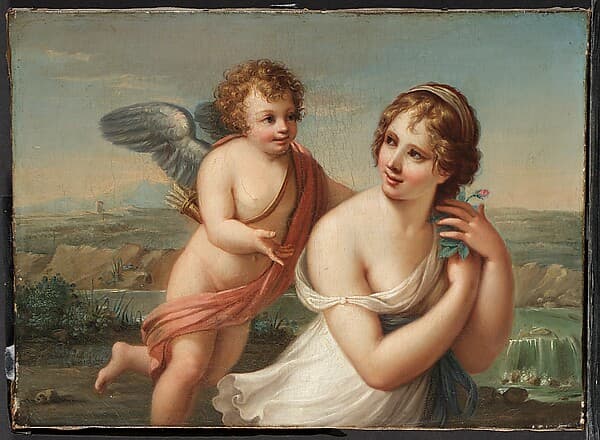
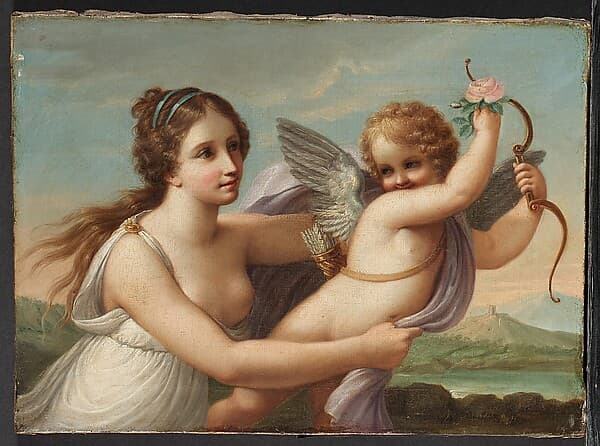
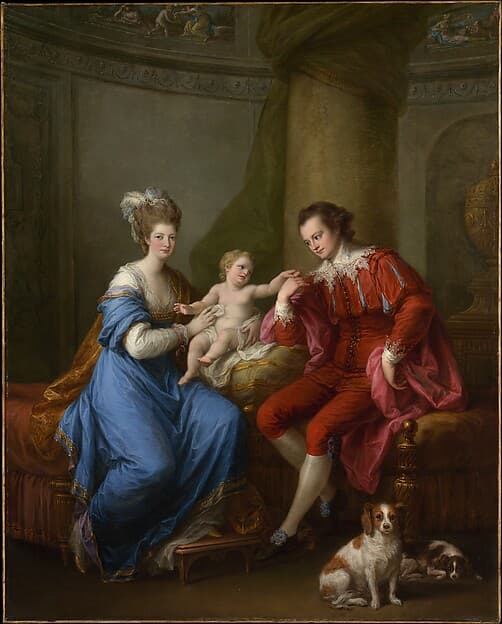
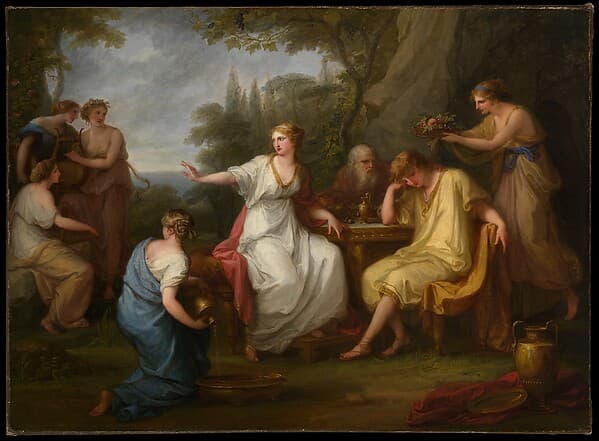
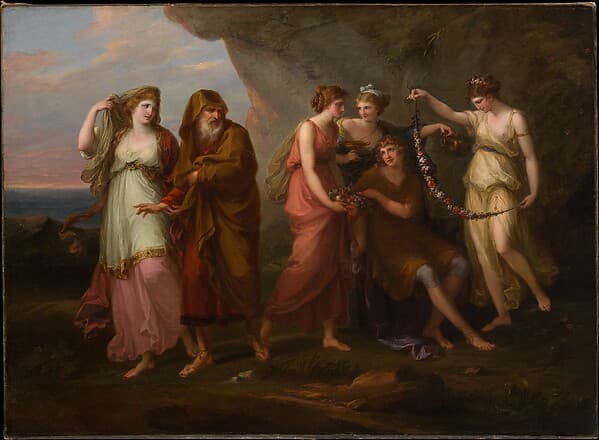
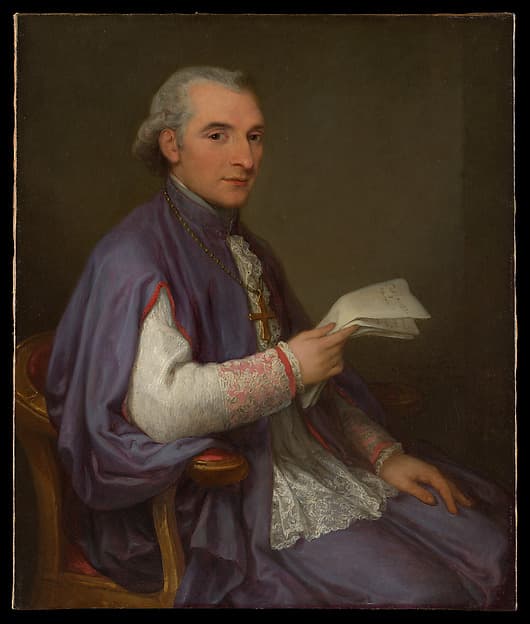
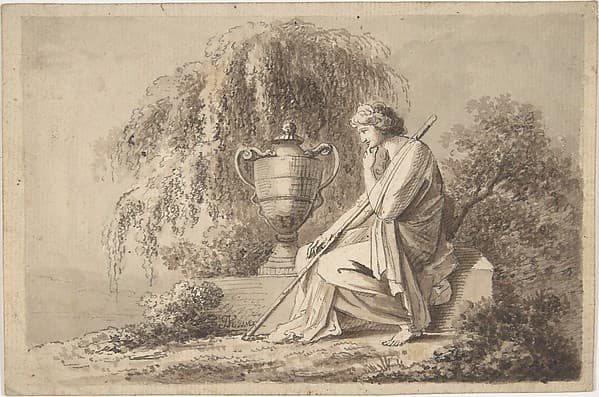
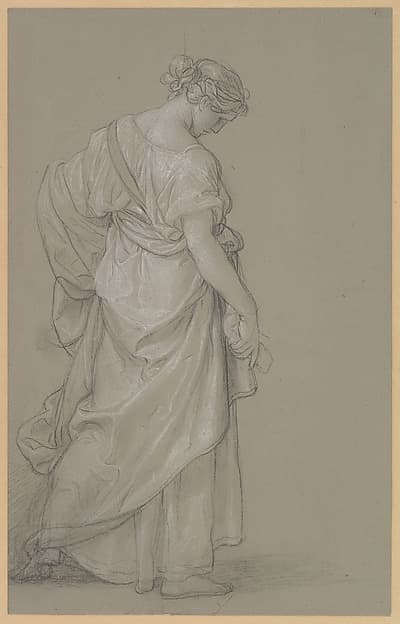
Works by Angelica Kauffman available in this edition of NEOARCA.
Related context
Associations
Works connected through artistic movements, cultural context and period. Priced works available in this market appear first.








Profile notes
Profile and sources
Image
Artist image
На основе открытого изображения: Angelica Kauffmann; Wikimedia Commons; Public domain.
