
10.10.1855–16.07.1903
Ángel Della Valle
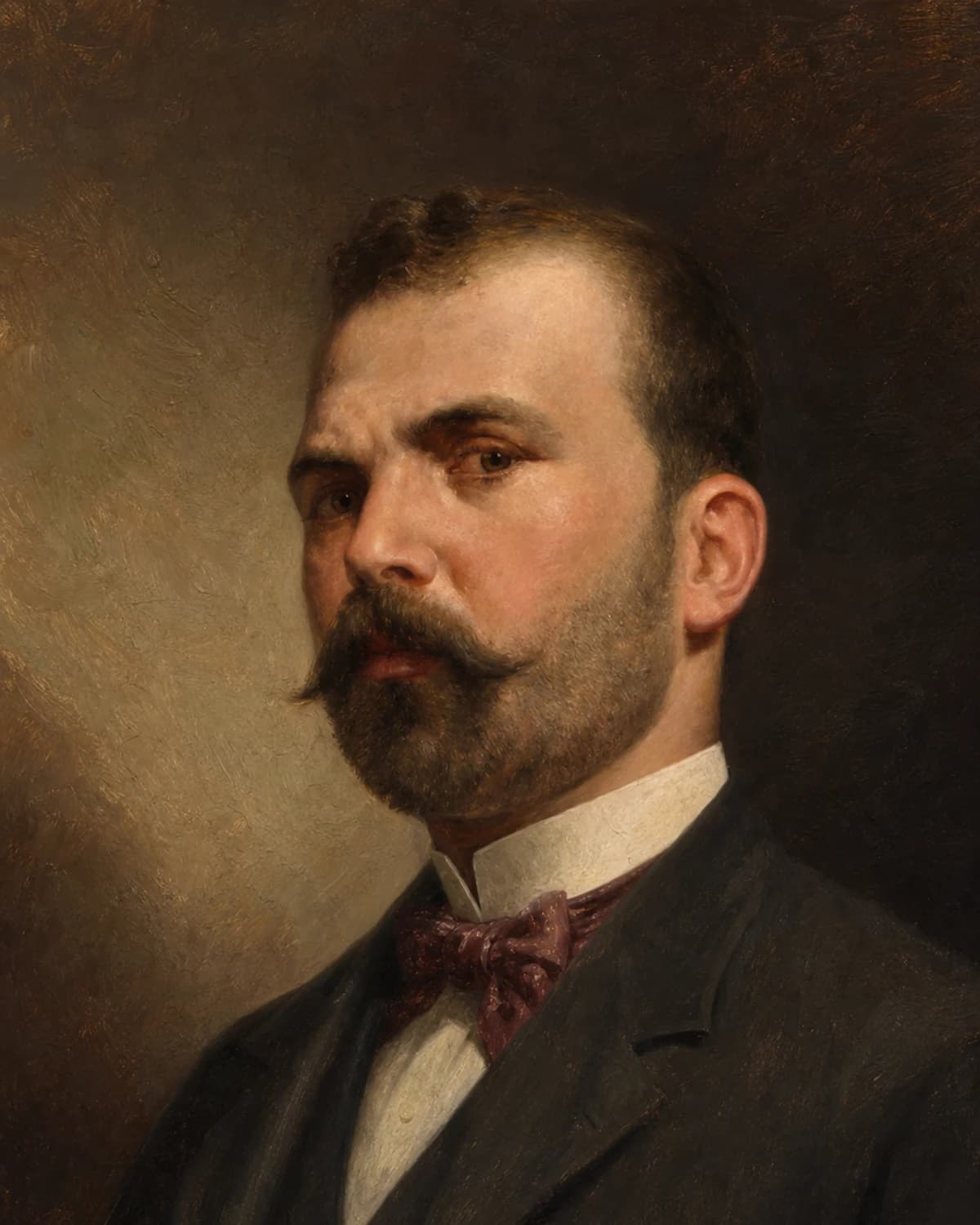
Ángel Della Valle studied in Florence under Antonio Ciseri and became one of the painters of the “Generation of ’80” in Buenos Aires. His best-known picture is “The Return of the Malón” (1892), shown at the World’s Columbian Exposition in Chicago. For eighteen years he taught drawing at the Society for the Encouragement of Fine Arts and died in the middle of a lesson.
Biography
In July 1903 Ángel Della Valle was teaching a class in his classroom, and death found him there. His student Thibon de Libian managed to sketch the moment; the drawing survives as a mark of respect for his teacher.
He was born in Buenos Aires to a family of Italian immigrants. His father put up buildings and worked on several large commissions; that income paid for the boy’s place at the Colegio San José, a private school and one of the best in the city. His aptitude for drawing showed early. His father died, and soon afterwards, with his mother’s consent, the young man left for Italy. His birth year is uncertain: it is given as 1852 in some accounts and as 1855 in others; I have no documents to settle it, so only the date, 10 October, is given here, without a firm year. In Florence he became a pupil of Antonio Ciseri. The reason for the journey is clear: Buenos Aires then had no art academies, only individual masters who took pupils privately, and oil painting had to be learned seriously. Della Valle returned to Argentina in 1883 and set up a studio in his parents’ house. He soon found himself among the young artists who later founded the salon “El Ateneo”, which writers and musicians also attended. Friends and colleagues included the painters Augusto Ballerini, Eduardo Sívori, Ernesto de la Cárcova and Reinaldo Giudici, and the sculptors Lucio Correa Morales and Francisco Cafferata. From 1893 the members of this circle began holding regular art exhibitions in Argentina.
At first he painted portraits. Among his well-known sitters were his childhood friend Pedro Lagleyze, a prominent ophthalmologist, and President Julio Argentino Roca, who was Lagleyze’s patient. According to some accounts, it was through the doctor’s mediation that the artist was able to paint the president, and Lagleyze also helped him in his professional career.
His best works are generally considered to be of another kind: rural landscapes, gauchos, scenes from the daily life of ordinary people. Pictures of this sort include “Horses of San Marcos” (1881), “Train on the Pampa” (1888), “Dusk on the Lagoon” (1889), “Lomas de Zamora Station” (1893), “At the Edge of the Woods” (1895), “Fire on the Pampa” and “The Studio” (both 1900). In 1892 he showed “The Return of the Malón”. It had to be exhibited in a commercial space, the Nocetti y Repetto bazaar, because the city still had neither salons nor galleries. The painting shows Indigenous people returning home after a raid, a malón. The following year it was sent to the Argentine pavilion at the World’s Columbian Exposition in Chicago; it is now in the National Museum of Fine Arts in Buenos Aires.
He also taught. The Sociedad de Estímulo de Bellas Artes (SEBA), founded in 1876, was then the country’s only centre of art education, and for eighteen years Della Valle held its chair of drawing, taking the class three times a week. Lessons were held on the upper floors of the Bon Marché department store, in the building that is now the Galerías Pacífico. His students are said to have included Boggio, Daneri and Victorica.
In time his pupils took up more of his attention than his own painting. I think this shows even in the list of his works: after 1900 there is nothing in it.
Della Valle died in Buenos Aires on 16 July 1903.
Related context
Associations
Works connected through artistic movements, cultural context and period. Priced works available in this market appear first.








Profile notes
Profile and sources
Image
Artist image
На основе открытого изображения: Ángel della Valle; Wikimedia Commons; Public domain.
