
06.08.1928–22.02.1987
Andy Warhol
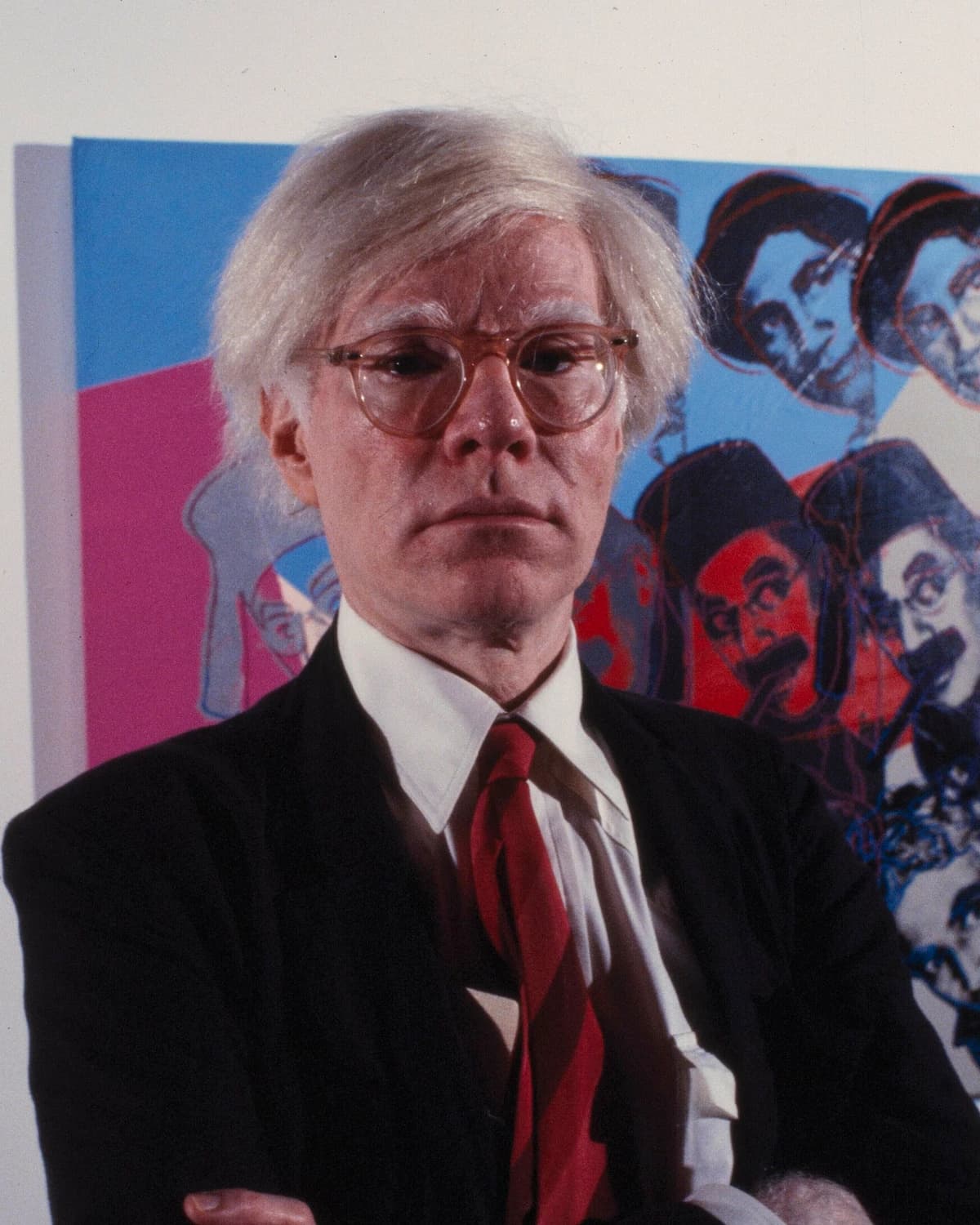
Andy Warhol (1928–1987), the son of Rusyn immigrants in Pittsburgh, spent ten years drawing shoes for fashion magazines, and in 1962 he showed thirty-two Campbell’s Soup cans and the “Marilyn Diptych”. His New York Factory printed silkscreens, made films, produced the Velvet Underground and published “Interview” magazine. His last large series was “The Last Supper” (1986).
Biography
In April 1961 Warhol’s first pop paintings hung in the window of the Bonwit Teller department store on Fifth Avenue. “Popeye”, “Superman” and “Before and After” served as a backdrop for mannequins in spring dresses. Their author was at the time a well-known New York illustrator of shoes and a window dresser, and no serious gallery wanted to take him on: Leo Castelli turned him down, deciding that the paintings were too close to the work of Roy Lichtenstein.
A year later everything had changed.
He was born Andrew Warhola Jr. on 6 August 1928 in Pittsburgh, the fourth child of the family. His parents, Andrej Warhola and Julia Zavacká, were Rusyns from the village of Mikó in what was then Austria-Hungary (now Miková in Slovakia). His father worked in a coal mine; his mother spoke almost no English and made flowers out of tin cans and crêpe paper to sell. As a boy of eight he was ill for long stretches and lay at home, drawing and making scrapbooks out of Hollywood magazines, and when his father and brothers noticed his interest in photography they set up a darkroom for him in the basement. His father died in May 1942. After Schenley High School Warhol entered the Carnegie Institute of Technology; in the summer of 1946, while selling vegetables from a truck, he drew his customers, and the series won him a student prize. In 1949 he graduated in pictorial design.
In June of that year he moved to New York with a fellow student, Philip Pearlstein. His first commission was shoes for the September issue of “Glamour”. Then came “Vogue”, “Harper’s Bazaar” and “Mademoiselle”, from 1955 advertisements for Israel Miller’s shoe company, which won him an Art Directors Club award, and then record covers. By then he had dropped the final “a” from his surname. For himself he made shoes of a different kind, in gold leaf, each standing for a celebrity, from Truman Capote to Elvis Presley. In 1956 the Museum of Modern Art declined one of his drawings as a gift, but that same year it showed another of his shoes in a group exhibition. The captions in Warhol’s privately printed little books were often lettered in a calligraphic hand by his mother.
In December 1961, after seeing Claes Oldenburg’s installation “The Store”, he came home feeling that his comic-strip paintings were not original enough. A friend advised him to paint what he loved most, namely money. He began painting dollar bills, and the printer Floriano Vecchi taught him the basics of silkscreen. On 9 July 1962 his exhibition opened at the Ferus Gallery in Los Angeles: thirty-two canvases, each with its own variety of Campbell’s soup. He had eaten that soup for lunch for twenty years, he said. In November the Stable Gallery in New York showed “Marilyn”, “Red Elvis”, “129 Die in Jet!” and “100 Coke Bottles”. The “Marilyn Diptych” also dates from 1962. The new method went like this: a photograph was enlarged and transferred to a silk screen, the paint was pushed through onto the canvas with a squeegee, and a single image could be repeated as many times as one liked.
From 1964 the studio on East 47th Street was called the Factory. Billy Name lined it with foil and painted it silver, assistants printed silkscreens under Warhol’s eye, and poets, musicians, bohemians and rich patrons came by. The wooden “Brillo Boxes” were made here too, and Warhol shot films: “Sleep” (1963), five hours of the poet John Giorno asleep; “Empire”, eight hours of a skyscraper filmed on a summer night in 1964; later “Chelsea Girls” (1966). In Paris in 1965 he announced that he was giving up painting for film. He became manager of the Velvet Underground, staged multimedia shows with the band called “Exploding Plastic Inevitable” and paid for their first album. The line about everyone being famous for fifteen minutes first appeared in “Time” magazine in 1967.
On 3 June 1968 the writer Valerie Solanas, who had acted in one of his films, shot Warhol in the Factory itself. He spent almost two months in hospital and wore a surgical corset for the rest of his life.
After that the Factory turned into an office. In 1969, with the journalist John Wilcock, he founded “Interview” magazine and began carrying a Polaroid camera everywhere; the snapshots became the basis of the commissioned portraits of the 1970s: Mick Jagger, Liza Minnelli, Yves Saint Laurent. He designed the cover of the Rolling Stones album “Sticky Fingers”, with a real zip on the jeans, and produced the “Mao” series (1972–1973), “The Philosophy of Andy Warhol” (1975) and “Athletes” (1977); from 1974 he packed letters, photographs and all sorts of odds and ends from his life into cardboard boxes. There were 610 of these “time capsules” in the end. The last portrait he painted in the old Factory, in 1974, was of his mother, who had died two years before.
In the 1980s he supported young downtown artists, Keith Haring and Jean-Michel Basquiat; in September 1985 he and Basquiat had a joint exhibition. At the same time he went to church two or three times a week and sat in the back pews so as not to be recognised. Religious subjects had appeared in his work for a long time, but in 1986 he made the “Last Supper” series after Leonardo; it is the largest body of religious work by an American artist. In January 1987 the series was shown in Milan, at the Palazzo delle Stelline. I think Warhol cannot be understood without this side of him, though he himself took pains to hide it behind jokes.
Warhol died in New York on 22 February 1987. His funeral service was held on 26 February in Pittsburgh, in English and Church Slavonic, at the Holy Ghost Byzantine Catholic Church, and he was buried beside his parents in a cemetery in Bethel Park. Before the coffin was lowered, his friend Paige Powell dropped the February and March issues of “Interview” into the grave.
Profile notes
Profile and sources
Image
Artist image
Bernard Gotfryd; Wikimedia Commons; Public domain.
