
12.07.1917–16.01.2009
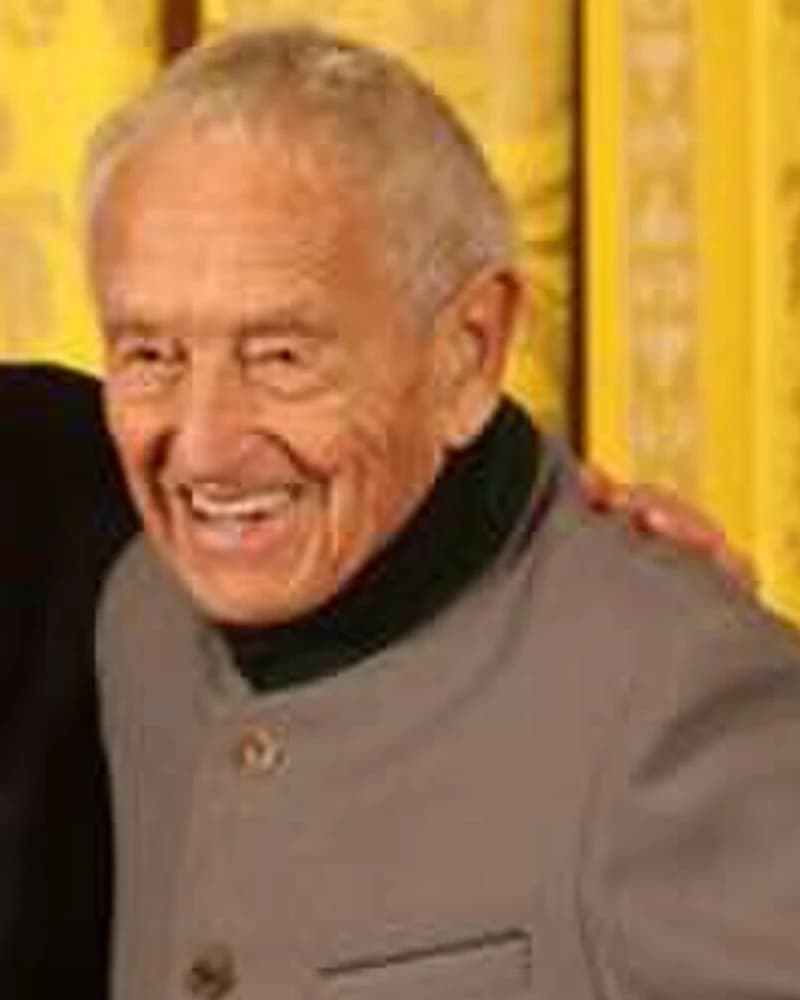
Andrew Wyeth
For almost his whole life Andrew Wyeth painted two places: his native Chadds Ford in Pennsylvania and his summer home of Cushing in Maine, with their neighbours, farms and windows. He worked in tempera, watercolour and drybrush and avoided oil. His “Christina’s World” (1948) is in the Museum of Modern Art in New York; Wyeth was the first painter to receive the Presidential Medal of Freedom and was an honorary member of the USSR Academy of Arts.
Biography
In the hot summer of 1947 Andrew Wyeth was working in an attic room of the Olson farmhouse in Cushing, Maine. It was so stifling that he prised a window open. The west wind filled the dusty, frayed lace curtains, and the birds crocheted into them seemed to flutter and fly. Wyeth managed a quick sketch and then waited several weeks for the west wind to blow again so that he could go on with his studies. That is how the tempera “Wind from the Sea” came about, a favourite painting of Robert Frost.
There are no people in it.
Wyeth was born on 12 July 1917 in Chadds Ford, exactly a hundred years after Henry David Thoreau, and his father, an admirer of Thoreau, took this as a good sign. Andrew was the youngest of the five children of the illustrator Newell Convers Wyeth and Carolyn Bockius; his eldest sister Henriette became a portrait painter, his sister Carolyn also a painter, his brother Nathaniel an inventor, his sister Ann a composer. Because of his frail health the boy was taught at home and lived a secluded life: his father, he recalled later, kept him almost locked up, in a world of his own. He drew before he could read. King Vidor’s film “The Big Parade” (1925) he claimed to have seen a hundred and eighty times, and he believed that nothing had influenced him more.
His father was his only teacher. As a teenager Andrew made illustrations that were published under his father’s name, mastered figure drawing and watercolour, and learned egg tempera from his brother-in-law, the painter Peter Hurd. He studied art history on his own and valued Winslow Homer above all. In 1937, at twenty, he showed watercolours at the Macbeth Gallery in New York, and the exhibition sold out entirely. His manner turned out drier and sparer in colour than his father’s, and he soon gave up illustration.
On 15 May 1940 he married Betsy James, whom he had met in Maine. She managed all his affairs and, by general agreement, influenced him no less than his father had. Their son Nicholas was born in 1943, and in 1946 Jamie, who became a painter of the third generation.
In October 1945 N. C. Wyeth was killed, together with his three-year-old grandson, at a railway crossing near their home. Andrew himself regarded this loss as a turning point in his art, and his mature manner soon took shape. In “Winter 1946” a neighbour’s boy, Allan Lynch, runs down a bare slope with his hand stretched out; on the other side of the hill his father had died.
Through Betsy he met their neighbour Christina Olson, and it was at the Olson farm, in 1948, that “Christina’s World” was painted. Christina, who could not walk, half lies in the dry grass, turned towards the distant house on the hill. The house has since been restored to look as it does in the painting and is part of the Farnsworth Art Museum. A second farm of this kind was that of Karl and Anna Kuerner in Chadds Ford, which he painted for almost thirty years. He said it was not picturesque at all, and that it excited him purely abstractly and purely emotionally. The painting “Brown Swiss” (1957) is named after the breed of Kuerner’s cows, but there are no cows in it, only their tracks in the grass and the reflection of the house in the pond. In “Life” magazine in 1965 he said that people thought of him as a realist, while he thought of himself as an abstractionist. To my mind, “Brown Swiss” explains this better than any of his words.
He worked slowly: dozens of studies in pencil or loose watercolour, then the picture itself in watercolour, drybrush or tempera. He avoided oil paint. In 1958 the Wyeths bought and restored “The Mill”, a group of eighteenth-century buildings on the Brandywine River, and from then on he lived in Pennsylvania in winter and in Maine in summer. He painted windows constantly, about three hundred works; his son Jamie said his father was obsessed with them.
In 1986 it became known that there was a series of 247 studies of Helga Testorf, which he had painted between 1971 and 1985 in secret even from those close to him. In 1987 the National Gallery of Art in Washington showed the series, and the exhibition drew harsh criticism.
Critics in general were sharply divided in their view of Wyeth. The art historian Robert Rosenblum, asked in 1977 to name the most overrated and the most underrated artist of the twentieth century, named Wyeth both times. Yet official recognition was not lacking: in 1963 he became the first painter to receive the Presidential Medal of Freedom; he was elected to the French Académie des Beaux-Arts; in 1978 he became an honorary member of the USSR Academy of Arts; in 1980 he was the first living American artist elected to Britain’s Royal Academy; in 1988 he received the Congressional Gold Medal, and in 2007 the National Medal of Arts. His work is also in the Hermitage.
Andrew Wyeth died on 16 January 2009 in Chadds Ford, at the age of ninety-one.
Profile notes
Profile and sources
Image
Artist image
derivative work: RandomOrca2 from enwiki Andrew_Wyeth-George_W_Bush.jpg : NEA photographer Michael Stewart; Wikimedia Commons; Public domain.
