
16.12.1860–29.04.1945
Andrés de Santa Maria
Andrés de Santa Maria was born in Bogotá but from the age of two grew up in London, Brussels and Paris, and studied under Henri Gervex. In 1887 his “Launderers of the Seine” was accepted at the Paris Salon. He then spent a decade and a half in Colombia, where he directed the art academy, and worked in Brussels until his death.
Biography
In 1887 a large canvas, “Launderers of the Seine”, was shown at the Paris Salon. Its author, Andrés de Santa Maria, was twenty-six, and he won a first prize for it. The painting was later bought by the National Museum of Colombia, where it remains.
He was born on 16 December 1860 in Bogotá, into a well-off family with political connections: his grandfather and father held high posts in the Colombian government. He was the third son of Andrés de Santa María Rovira and Manuela Hurtado. In 1862 his parents took him to Europe. The family lived in London, moved to Brussels in 1869, and when his father obtained a position at the Colombian embassy in France in 1878, settled in Paris.
He had wanted to paint from his youth, but his parents opposed it and made him follow a career in finance. For a time he worked in a bank. Only after his father’s death in 1882 could he study painting: he entered the School of Art in Paris and worked with Ferdinand Jacques Humbert and Henri Gervex. Prince Eugen of Sweden and Ignacio Zuloaga are named among his fellow students. At that time impressionism attracted him, and through Alfred Roll he became interested in social subjects and in the realism of Jean-François Millet and Gustave Courbet. “Launderers of the Seine” already shows both interests: reflections of light on water and a subject from the lives of working people. He took part in the Salons of 1888, 1889 and 1890. His early works include “The Shooters” (1885), “The Reading” (1886) and the portrait of Salomón Koppel (1889), painted closer to Courbet and showing a firm command of academic rules. In 1891 he showed “The Tea Party” at an exhibition of the Artistic Union of Paris.
On 25 January 1893, at Saint-Jean-de-Luz, he married Amalia Bidwell Hurtado; they had eight children. In 1894 the family returned to Colombia and lived there for about seventeen years. In Bogotá Santa Maria became professor of landscape at the Academy of Fine Arts and brought French experience to it. His manner, which broke with academic tradition, provoked controversy. During the Thousand Days War, a Colombian civil war, the academy was closed and he went to Europe for a long stay. At the Paris Salon he showed a painting of English guards, and the jury sent him a letter of congratulation. After the war he came back and in 1904, at the invitation of President Rafael Reyes, became director of the academy. An exhibition held then set off the country’s first debate about modern art; Baldomero Sanín Cano, Ricardo Hinestroza Daza and Max Grillo took part in it. According to other accounts, life classes with a nude model were introduced under him, but that is worth checking separately.
At the academy he founded a school of decorative and industrial arts, where pottery, wood and stone carving and metal casting were taught. In 1910, for the centenary of independence, he showed forty-six of his own works and oversaw the art section of the jubilee exhibition. Fídolo González Camargo and Roberto Páramo are named as his pupils; both later painted in the spirit of his work. In 1906, by one account, or in 1926, by another, he painted a triptych for the National Capitol showing Simón Bolívar leading the campaign of liberation.
Criticism in Colombia was harsh. In 1911 he gave up his post and left for Europe, never to return.
With his family he travelled to England, the Netherlands and France and settled in Brussels. When the First World War began he moved to Paris, where he became friends with the sculptor Antoine Bourdelle, then went to London and lived in San Sebastián until 1918. After the war he returned to Brussels. In 1936 his work was shown in Brussels, and in 1937 the Burlington Gallery in London exhibited 125 paintings made since 1907. In his late pictures he used palette knives and spatulas to lay on thick layers of paint, and besides contemporary trends he drew inspiration from old masters such as El Greco. He kept exhibiting almost to the end of his life.
Santa Maria died on 29 April 1945 in Brussels, aged eighty-four. In 1949 he was exhibited at the National Museum of Colombia, and in 1971 the Museum of Modern Art in Bogotá showed 126 of his paintings. The largest holding of his work, about thirty canvases, is in the National Museum of Colombia, among them “On the Beach at Macuto” (about 1907).
Related context
Associations
Works connected through artistic movements, cultural context and period. Priced works available in this market appear first.








Profile notes
Profile and sources
Image
Artist image
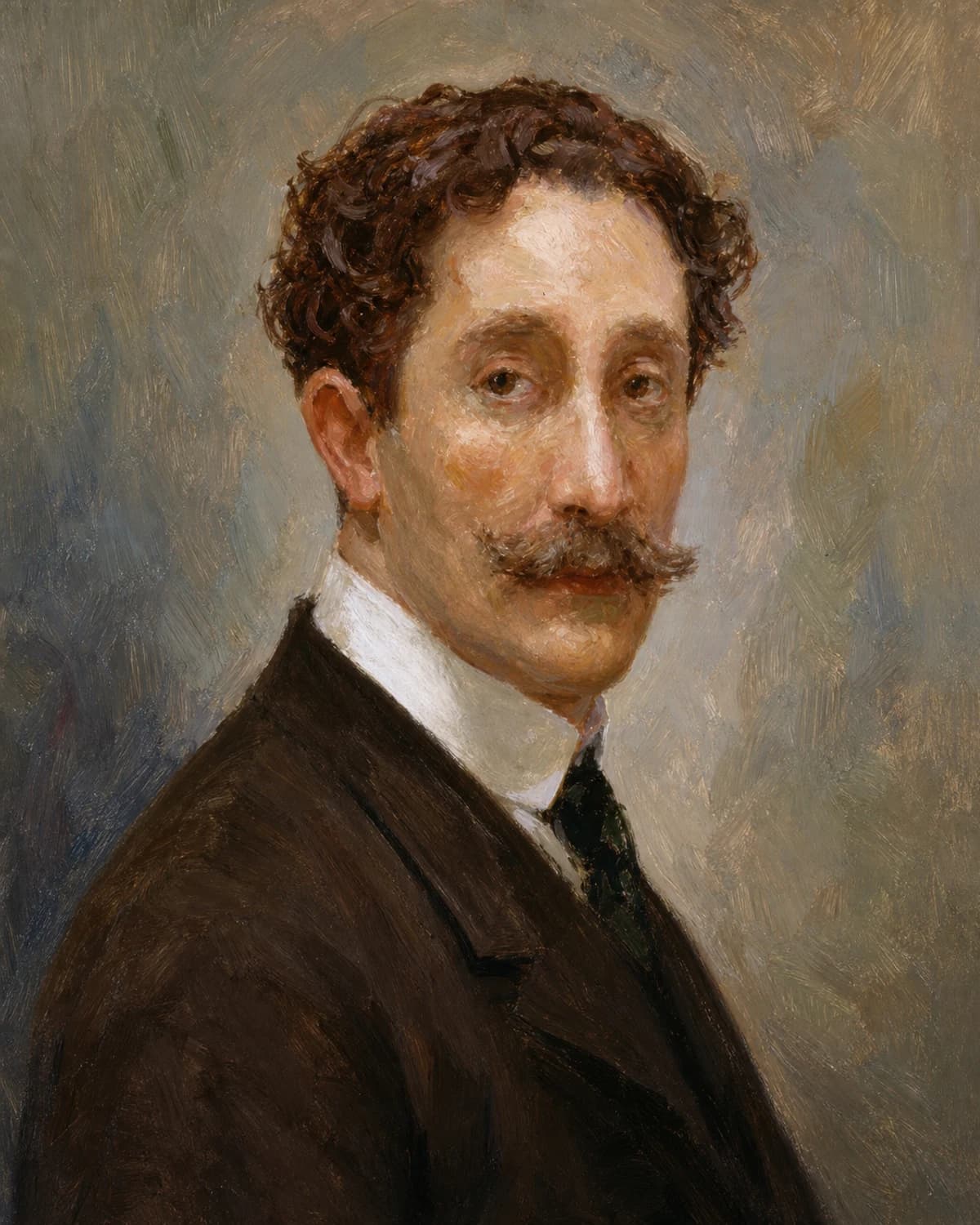
На основе открытого изображения: Self portrait; Wikimedia Commons; Public domain.
