
1360–17.10.1428
Andrei Rublev
Andrei Rublev (c. 1360 – c. 1430), a monk and icon painter, is known from four mentions in the chronicles: mural paintings in cathedrals in the Moscow Kremlin, in Vladimir, and in the Trinity-Sergius and Andronikov monasteries. Only the icon of the Trinity is indisputably by his hand. In 1551 the Stoglav Council made his manner the model for church painting, and in 1988 the Russian Orthodox Church canonised him as a venerable saint.
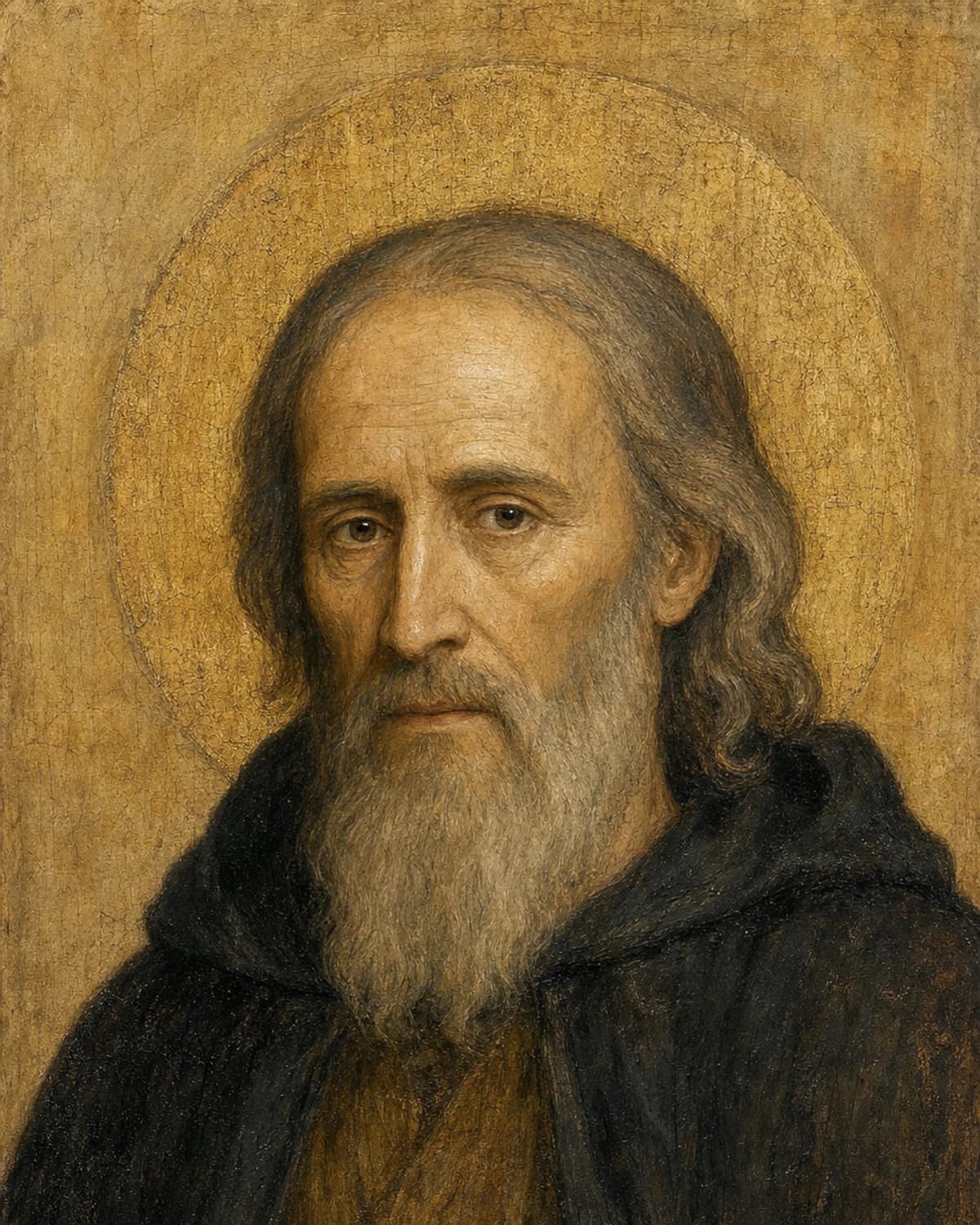
Biography
On 22 June 2024 the icon of the Trinity was returned to the Trinity-Sergius Lavra and put back in its original place in the iconostasis of the Trinity Cathedral. It is the only icon that scholars accept without reservation as the work of Andrei Rublev.
Very little is known about the master himself.
Even his birthplace has not been established: most likely the Principality of Moscow, though Novgorod the Great is also named. His year of birth is reckoned only approximately, around 1360. His surname is linked to the word “rubel”, the name of a tool for rolling leather, and so it is supposed that he came from a family of craftsmen. We do not know his secular name; he was called Andrei when he took monastic vows, probably shortly before 1405, at the Andronikov Monastery in Moscow under its abbot Andronik. There is a late icon with the inscription “Andrei, son of Ivan, Rublev”. The signature is clearly forged, but it may indirectly preserve his father’s name. According to another account, he lived for a time at the Trinity-Sergius Monastery under the abbot Nikon, the successor of Sergius of Radonezh.
The first record in the chronicles dates from 1405. The Cathedral of the Annunciation in the Moscow Kremlin was then being painted by Theophanes the Greek, the elder Prokhor of Gorodets and “the monk Andrei Rublev”, and he comes last in the list, the junior both in rank and in age. Theophanes, a Byzantine master who had moved to Rus, is generally considered his teacher.
The second record is dated 1408: together with Daniil Chorny, Andrei was painting the Dormition Cathedral in Vladimir. These murals survive in part, and they are the only work of his that has both a precise date and surviving paint. The largest composition there is the Last Judgement. Scholars have long remarked that the scene, traditionally a fearsome one, is almost free of menace in Rublev’s hands. I find it hard to say, though, how far this impression depends on the state of preservation: the murals have not come down to us whole. By 1408 he apparently already had assistants and pupils. The Vladimir icon of the Mother of God from this cathedral is assigned to the same years, and earlier still, around 1395, he may have worked on the miniatures of the Khitrovo Gospels, now in the Russian State Library. Most scholars accept both attributions, but with caution.
The third mention takes us to the 1420s. In 1425–1427 Rublev and Daniil Chorny led the work in the Trinity Cathedral of the Trinity-Sergius Monastery. The murals have not survived. The icons of the iconostasis did survive, but they are painted in different manners and are uneven in quality, so they are regarded mainly as the work of the team. The Trinity was probably intended for this iconostasis, although it is dated variously: to 1411, to 1425–1427, and sometimes to around 1410. The subject derives from the “Hospitality of Abraham”, the Old Testament story of the three travellers whom Abraham received. Rublev removed Abraham and Sarah themselves from the scene, leaving the three angels at the table, and through composition and symbolism turned the theme towards the mystery of the Trinity.
The fourth work, the last one known, is the painting of the Saviour Cathedral of the Andronikov Monastery, carried out, according to the chronicle, in the spring of 1428. It was there, in the Andronikov Monastery, that Andrei Rublev died; according to some sources on 17 October 1428, according to others on 29 January 1430. He was buried near the bell tower.
The other icons and frescoes attributed to Rublev over the course of the twentieth century are now more often linked to his workshop or to his contemporaries. His manner, meanwhile, became a model long before any scholarly attributions: the Stoglav Council of 1551 prescribed that icons be painted as Rublev had painted them, and among those who followed him was Dionisy. In 1947 a reserve was established at the Spaso-Andronikov Monastery, and later a museum of early Russian culture and art bearing his name opened there. In 1966 Andrei Tarkovsky made the film “Andrei Rublev”, which tells the painter’s life freely. In 1988 the Local Council of the Russian Orthodox Church canonised him as a venerable saint.
In 2003, during excavations beneath the altar of the Saviour Cathedral, remains were found which the scientists involved consider, with a high degree of probability, to be those of Andrei Rublev and Daniil Chorny. After study they were placed in reliquaries and moved into the altar of the same cathedral.
Related context
Associations
Works connected through artistic movements, cultural context and period. Priced works available in this market appear first.
Profile notes
Profile and sources
Image
Artist image
На основе открытого изображения: anonimous; Wikimedia Commons; Public domain.
