
1431–13.09.1506
Andrea Mantegna
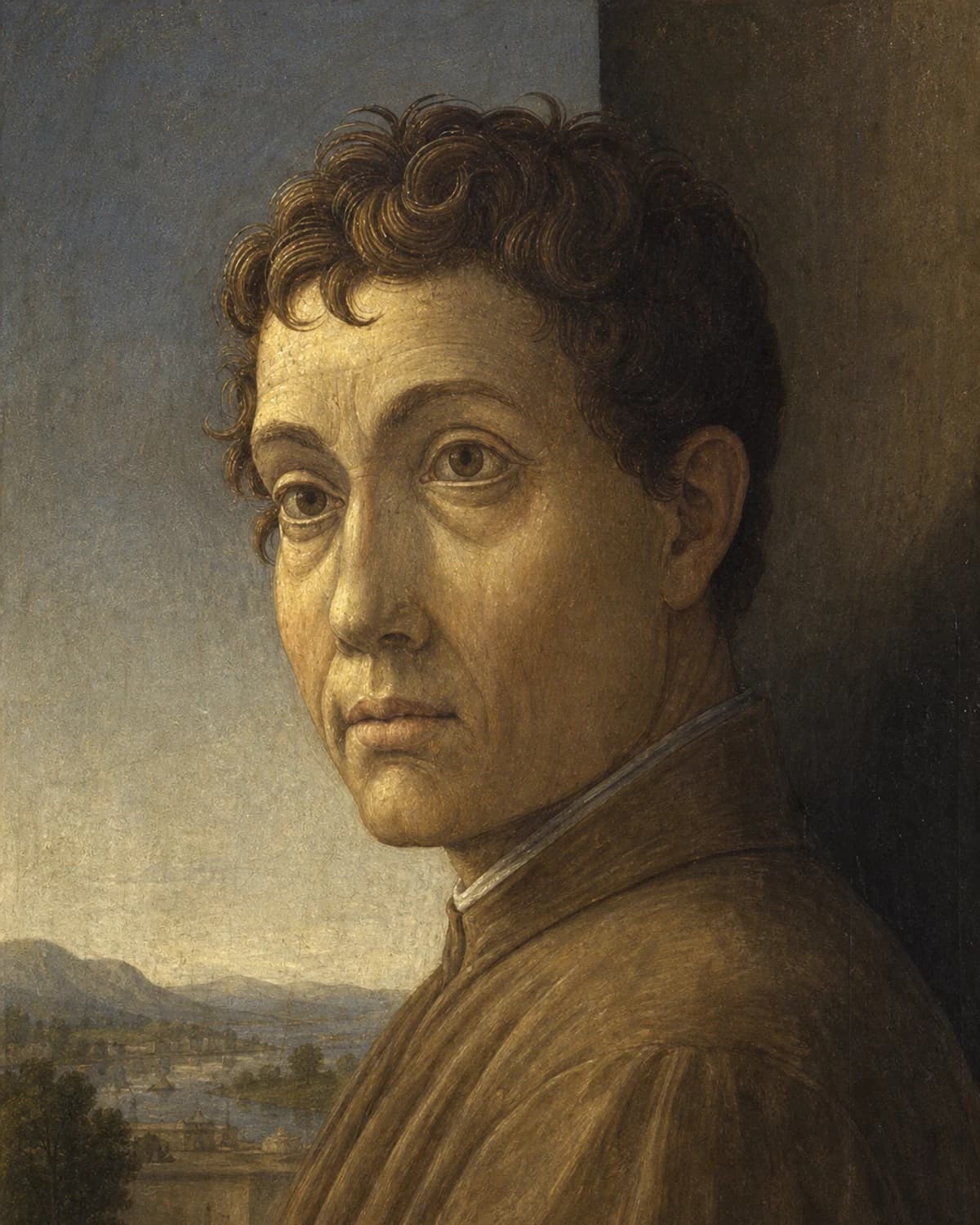
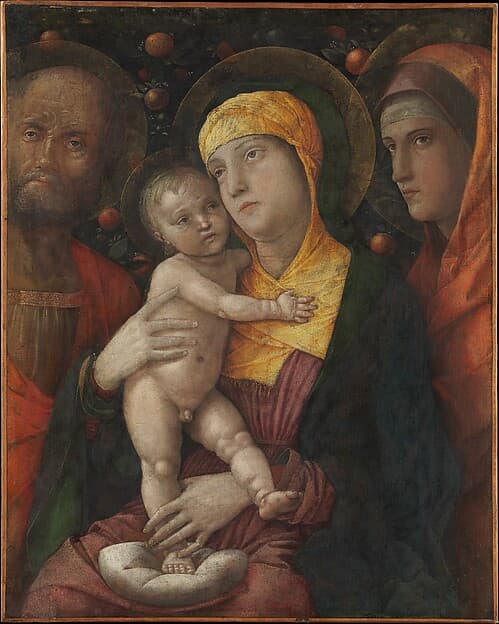
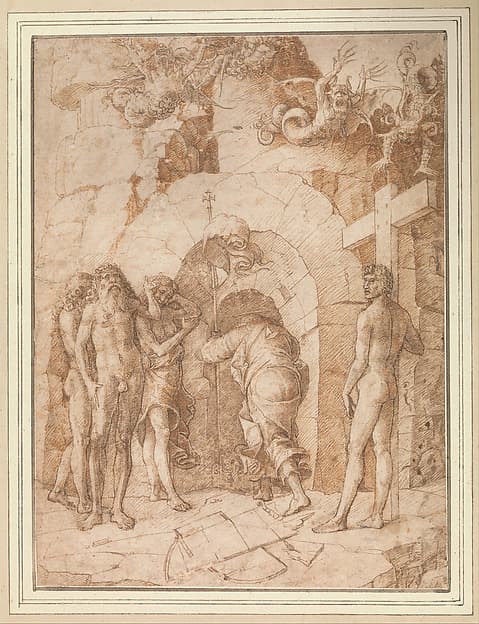
Andrea Mantegna (c. 1431–1506) trained in Padua under Francesco Squarcione, a collector of antique fragments, and all his life built his figures as if carving them from stone. From 1460 until his death he was court artist to the Gonzaga in Mantua, where he painted the Camera degli Sposi, with a round opening onto the sky in the middle of the vault, and the nine canvases of the “Triumphs of Caesar”.
Biography
“Andrea would have done much better with those figures if he had given them the colour of marble”: so, as Vasari tells it, Francesco Squarcione spoke of his former pupil’s frescoes in the Ovetari Chapel of the Eremitani church in Padua. Mantegna’s people looked to him like stone statues, and in his view they should have been painted in the colour of stone.
Almost all of these frescoes were destroyed in 1944, when Allied aircraft bombed Padua.
Mantegna was born around 1431 in the village of Isola di Carturo near Padua, on the territory of the Venetian Republic, the second son of a carpenter, Biagio. Vasari made him a shepherd boy, but historians do not believe this version. As a boy he moved to Padua, where his elder brother Tommaso worked as a tailor, and came to Squarcione, also a former tailor, who kept a workshop and collected ancient statues, reliefs, vases and coins. The pupils there were made to draw from plaster casts; Andrea learned Latin as well and was said to be his master’s favourite. Squarcione adopted him, hence the nickname “Squarcione” in the chronicles, alongside “Andrea da Padova”. At seventeen the pupil left, having won the right to work independently through the courts, and later claimed that his master had profited from his labour while paying him almost nothing. His first commission of his own, an altarpiece for the church of Santa Sofia in Padua (1448), has not survived. That same year he and Niccolò Pizzolo were called to join a large team decorating the Ovetari Chapel, and after a series of chance events he painted most of it alone. The boldest scene of the cycle of Saint James, the procession to his execution, is seen from a very low viewpoint, almost from the ground.
Around 1453 he married Nicolosia, daughter of the Venetian painter Jacopo Bellini; her brothers Giovanni and Gentile became his brothers-in-law, and in his early work Giovanni Bellini openly followed Mantegna. In 1456–1459 he painted a large altarpiece for the church of San Zeno Maggiore in Verona: the Madonna with angels and four saints on each side. For Verona it was probably the first example of Renaissance painting.
Ludovico III Gonzaga, Marquis of Mantua, had been inviting him for several years, and in 1460 Mantegna became court artist on a salary of 75 lire a month, an enormous sum for the time. At first he stayed at Goito from time to time, but from December 1466 he settled with his family in Mantua itself and lived there to the end, serving three Gonzaga in succession. His principal Mantuan work, a room in the castle now known as the Camera degli Sposi, the “Bridal Chamber”, was painted in 1465–1474. On the walls are portraits of the Gonzaga family, and in the centre of the vault he painted a round opening, an oculus, as if open to the sky. Correggio took it up, and ceiling illusions of this kind persisted in Italian painting for almost three centuries.
The following decade was a hard one. The painter’s son Bernardino died, as did Ludovico himself, his wife Barbara and his heir Federico, who had knighted Mantegna; commissions began again only under Francesco II.
For Francesco, around 1486, he began the “Triumphs of Caesar”, nine canvases in tempera, each about three metres long, which together form a procession of almost thirty metres: soldiers, captives, elephants, standards and the spoils of the Gallic War, the figures almost life-size and seen from a low horizon. The work was apparently interrupted by Rome. In 1488–1490, at the invitation of Innocent VIII, he painted a chapel in the Vatican Belvedere, destroyed in 1780, met the Turkish hostage prince Jem and studied the ancient monuments, though the city itself rather disappointed him. The “Triumphs” were finished back in Mantua, around 1492. In the late 1620s the canvases, together with most of the Gonzaga collection, were bought by King Charles I of England, and they are now at Hampton Court.
With the new marchioness, Isabella d’Este, things did not go smoothly. She was displeased with his portrait of her in 1493: the painter, she wrote, had done it so badly that there was no likeness at all. Even so, after 1497 Mantegna painted for her study, the studiolo, the “Parnassus” and “Minerva Expelling the Vices from the Garden of Virtue” (both now in the Louvre); a third picture, on the god Comus, was completed by Lorenzo Costa, his successor at court. Around 1495 came the “Madonna della Vittoria”, commemorating the Battle of Fornovo, whose outcome Francesco Gonzaga wished to present as a victory: the Virgin’s cloak is spread over the kneeling marquis, and the church for the picture was built to the painter’s own design. The “Dead Christ” in the Brera in Milan is dated variously, around 1490 or around 1500; he seems to have painted it for his own funerary chapel.
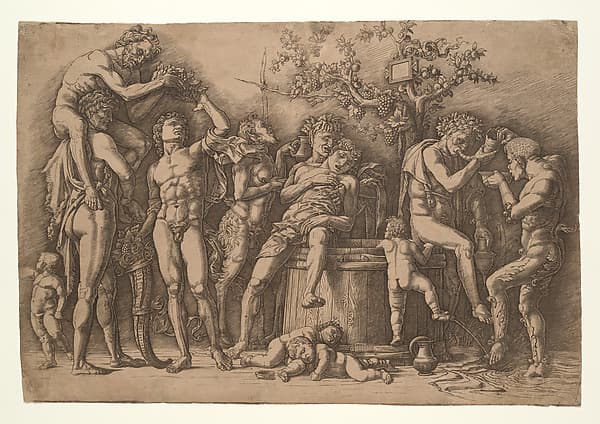
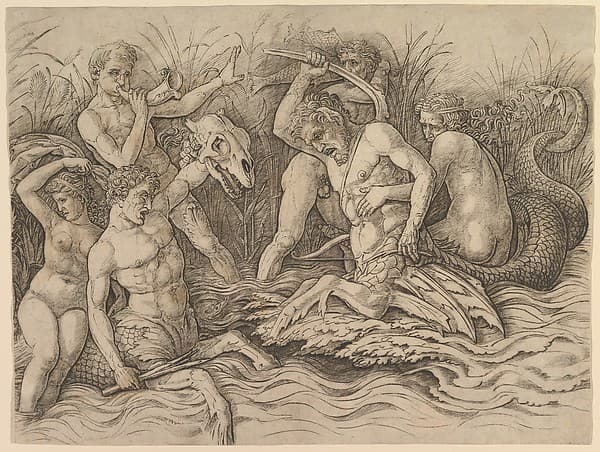
The engravings hold the most uncertainty. Mantegna signed and dated not a single plate. Some thirty large prints crowded with figures, among them the “Battle of the Sea Gods”, used to be associated with him and his workshop, but it is now thought that he engraved seven plates himself, or none. Vasari asserted that Mantegna took up engraving in Rome, but then all this work would have been crammed into the last fifteen years or so of his life, and to me that seems too short a time. The so-called “Mantegna Tarocchi” cards, despite the name, are not his. His only known sculpture, a Saint Euphemia, is in the cathedral at Irsina.
In old age he still embarked on costly ventures, the marquis banished his son Francesco from Mantua, and he had to sell a beloved antique bust of Faustina. Soon after the sale, on 13 September 1506, Mantegna died in Mantua. He was buried in the church of Sant’Andrea, where he had himself painted the altarpiece for his funerary chapel; in 1516 his sons set up a monument to him there.
Artist works
Works by the artist
Works by Andrea Mantegna available in this edition of NEOARCA.
Related context
Associations
Works connected through artistic movements, cultural context and period. Priced works available in this market appear first.
Profile notes
Profile and sources
Image
Artist image
На основе открытого изображения: Andrea Mantegna; Wikimedia Commons; Public domain.
