
1500–1500
An Kyŏn
An Kyŏn served in the Dohwaseo, the court painting bureau of the early Joseon dynasty, and rose to the fourth official rank. In 1447, for Grand Prince Anpyeong, he painted the scroll “Dream Journey to the Peach Blossom Land”, the oldest surviving Korean landscape. The scroll is now in Japan, at Tenri University; it is the only work securely from his brush.
Biography
In 1447, the twenty-ninth year of King Sejong’s reign, the king’s third son, Grand Prince Anpyeong, saw in a dream a garden of peach trees in blossom and asked the court painter An Kyŏn to paint the dream. The work, it is said, took three days.
The result was a small scroll on silk, 38.7 by 106.5 centimetres. Unlike the usual arrangement of a handscroll, the movement here runs from the lower left corner upwards and to the right. On the left lies the waking world: earthen mountains seen straight on, from the front. On the right the dream begins, and it is painted in rocks, waterfalls and a river, as if from above, from a bird’s-eye view. The landscape is assembled from several separate groups of mountains, linked to one another but not merged into one. In the brushwork and the fall of light people see traces of the Song court master Guo Xi, though the scroll already shows a manner of its own. There are no people or animals in it at all. Human presence is suggested only by a half-hidden boat and two small pavilions among the peach trees. The subject goes back to a story by the Chinese poet Tao Yuanming about a fisherman who followed a stream lined with peach trees and found, inside a cave, a hidden land where refugees from war lived.
The prince was pleased. He wrote the title himself, along with an account of how the picture came about, and asked twenty-one scholars to compose poems and texts in its praise. Together with Anpyeong’s inscription and a poem of his added three years later, 23 texts by twenty men of letters and one Buddhist monk, in semi-cursive and regular script, are mounted with the scroll; the whole length runs to about twenty metres. Six years later this circle fell apart. In 1453 Anpyeong’s older brother, Grand Prince Suyang, seized power, and Anpyeong was accused of treason, exiled to Ganghwa Island and executed. Of the authors of the inscriptions, Bak Paengnyeon, Yi Kae and Seong Sammun later became three of the “six martyred ministers”, while Sin Sukchu and Choe Hang took Suyang’s side.
Suyang later destroyed much of what Anpyeong had left. The scroll survived.
It was most probably carried off to Japan by the general Shimazu Yoshihiro during the Imjin War. In 1893 the scroll turned up in Kagoshima; in 1953 it was given to Tenri University, and it is now listed as a National Treasure of Japan. In 2009 it was brought to Seoul for a short time, to the National Museum of Korea.
Of An Kyŏn himself much less is known than of his patron. He was born in Jigok near Seosan, in what is now South Chungcheong Province; the years of his life are unknown, and by a cautious estimate he was born around 1400 and worked under Sejong and Munjong. His art name was Hyŏndongja. The Dohwaseo painted portraits of kings, crown princes and high officials and depicted state ceremonies; An Kyŏn rose there to the post of hogun, that is, to the fourth rank. In 1448, the year after the landscape for Anpyeong, he painted a ceremonial picture, “Uijangdo”. Landscapes, portraits and the “Four Gentlemen” (plum, orchid, chrysanthemum and bamboo) are attributed to him. A great deal is attributed to him, but only one scroll is securely confirmed as his; the rest, to be honest, are attributions of varying persuasiveness.
His influence lasted a long time. An Kyŏn and his followers formed the most prominent landscape school of the early Joseon: an asymmetrical three-part composition, objects placed in empty space, a sharp contrast of black and white. The manner was known in Japan as well, in the Muromachi period, notably to Tenshō Shūbun. It is said that the painter Shin Saimdang learned to draw as a child by looking at An Kyŏn’s works.
In Seosan, where he came from, a festival is held in his name.
Related context
Associations
Works connected through artistic movements, cultural context and period. Priced works available in this market appear first.
Profile notes
Profile and sources
Image
Artist image
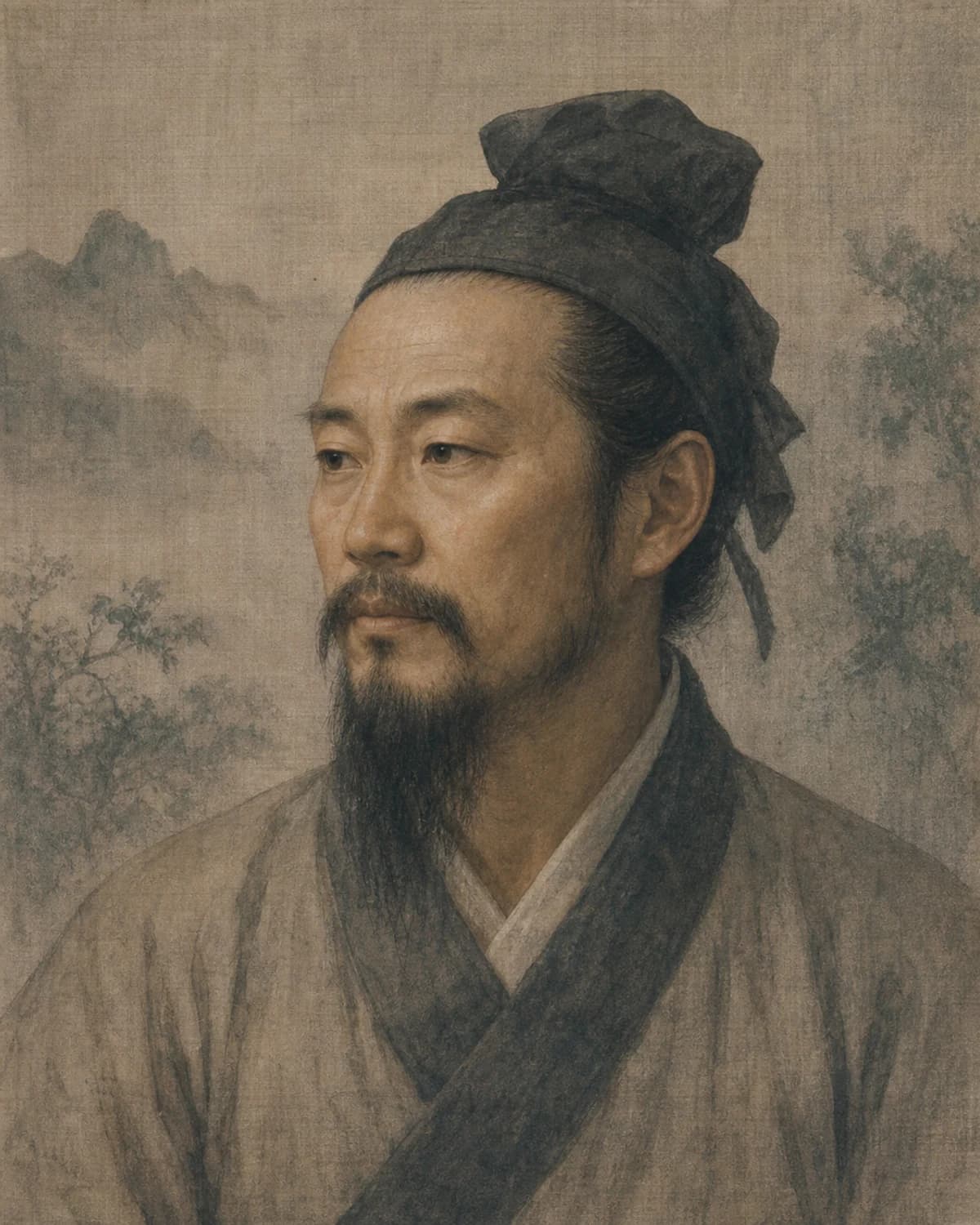
На основе открытого изображения: Ahn_Gyeon; Wikimedia Commons; Public domain.
