
30.01.1913–05.12.1941
Amrita Sher-Gil
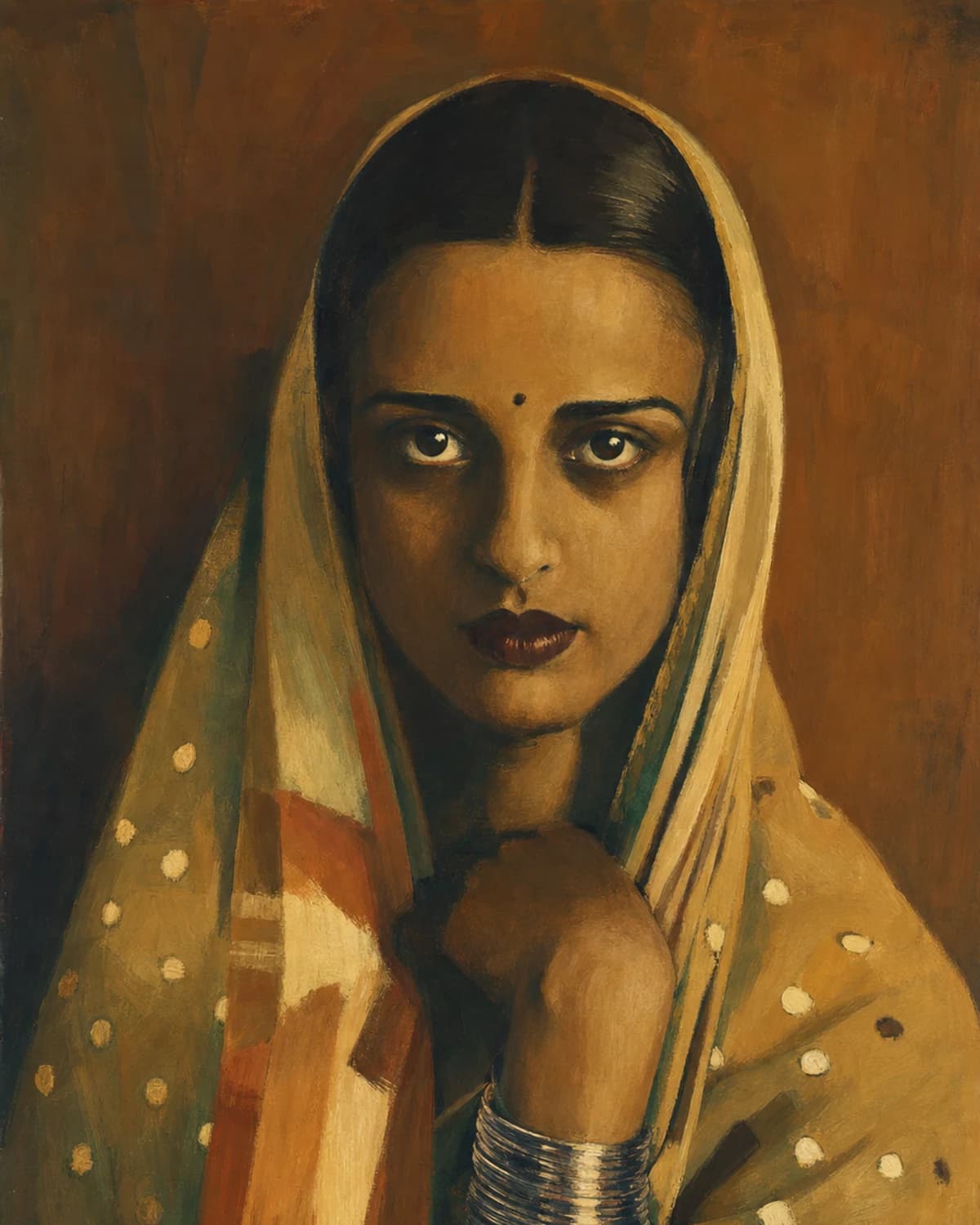
Amrita Sher-Gil was born in Budapest to a Sikh aristocrat from the Punjab and a Hungarian singer, studied in Paris, and at twenty became the youngest, and the only Asian, Associate of the Paris Salon. After returning to India in 1934 she painted village life, joining what she had learned from Gauguin and Cézanne with Mughal miniatures and the Ajanta murals.
Biography
One of her Paris professors, looking at her palette, told Amrita Sher-Gil that she was not in her element in the West and that her artistic nature would find its true surroundings in the East. She later recalled how, from 1933, she was haunted by a longing for India and a strange feeling that her destiny as a painter lay there.
At the end of 1934 she went back.
By then Paris had already recognised her. For the painting Young Girls (1932) she won a gold medal, and in 1933 she was elected an Associate of the Salon, the youngest in its history and the only one from Asia. One of the models for Young Girls was the Parisian critic Denise Proutaux. Her Paris years produced many self-portraits, nudes, still lifes, and portraits of friends and fellow students; the National Gallery of Modern Art in New Delhi finds these self-portraits by turns sombre, pensive and joyful.
She was born on 30 January 1913 in Budapest and at birth was given the double name Dalma-Amrita. Her father, Umrao Singh Sher-Gil, came from the Sikh aristocracy of the Punjab, knew Sanskrit and Persian, and practised photography. Her mother, Marie Antoinette Gottesmann, an opera singer from a well-to-do Hungarian Jewish family, had come to Lahore in 1912 as companion to Princess Bamba Sutherland, granddaughter of Maharaja Ranjit Singh, and met her future husband there. The family remained in Budapest until the end of the First World War. The girl began drawing at about five. In 1921, because of money troubles, the Sher-Gils moved to India, to Shimla, where Amrita learned the piano and the violin and by the age of nine was already performing at the local theatre with her younger sister Indira. From the age of eight she was taught painting by private tutors, and the household servants sat as her models. She was expelled from her convent school when she declared herself an atheist.
In 1924 her mother took her to Florence, to the Santa Annunziata art school. She did not stay there long, but she saw the Italian masters for the first time. Her uncle, the Indologist Ervin Baktay, who came to Shimla in 1926, saw the painter in his niece, went through her work with her and insisted on serious training. At sixteen she sailed for Europe with her mother. In Paris Amrita studied at the Académie de la Grande Chaumière under Pierre Vaillant and Lucien Simon, then, from 1930 to 1934, at the École des Beaux-Arts. She looked to Cézanne, Gauguin and Modigliani.
Once back, she set out to discover India afresh. In 1935 came Hill Women and Hill Men, and Mother India: poor hill people who had not lost their dignity. In 1936, on the advice of the collector and critic Karl Khandalavala, she set off to travel around the country and discovered Mughal and Pahari miniatures and the cave paintings of Ajanta. In February 1937 Jawaharlal Nehru visited her exhibition in New Delhi. A journey through South India that same year produced three paintings known as the South Indian trilogy: Bride's Toilet, Brahmacharis and South Indian Villagers Going to Market. Their colour is hot, and she treats the people, shown in poverty and despair, with evident sympathy. She now saw her task as telling the life of the Indian people on canvas. In one letter she put it bluntly: “Europe belongs to Picasso, Matisse, Braque… India belongs only to me.” I think there is more defiance than boasting in that line: she was in her early twenties and deciding who to be.
In 1938, in Hungary, she married her cousin, the doctor Viktor Egan; her interest in the Nagybánya school of painting is also dated to the Hungarian period. Then the young couple moved to Saraya near Gorakhpur, to her father's family estate. There she painted Village Scene, In the Ladies' Enclosure and Siesta, slow scenes of village life in which the miniature tradition can be seen. The critics Karl Khandalavala in Bombay and Charles Fabri in Lahore called her the finest painter of the century, yet there were almost no buyers. The Nawab Salar Jung of Hyderabad sent her paintings back, and the Maharaja of Mysore preferred Raja Ravi Varma.
Her family was closely tied to the British administration, but Amrita herself sympathised with the Indian National Congress and admired Gandhi. In October 1940 Nehru, on a visit to Gorakhpur, called on her at Saraya. She never painted his portrait, reportedly because she thought him “too good-looking”.
In September 1941 the couple moved to Lahore, then one of the main cultural centres of undivided India, and Amrita set up a studio on the top floor of the house. There she was preparing her first large solo exhibition. A few days before the opening she fell seriously ill, and around midnight on 5 December 1941 she died; she was twenty-eight. Her last painting remained unfinished. Her body was cremated in Lahore on 7 December.
Related context
Associations
Works connected through artistic movements, cultural context and period. Priced works available in this market appear first.








Profile notes
Profile and sources
Image
Artist image
На основе открытого изображения: Unknown author Unknown author probably Umrao Singh Sher-Gil (1870–1954); Wikimedia Commons; Public domain.
