
12.07.1884–24.01.1920
Amedeo Modigliani
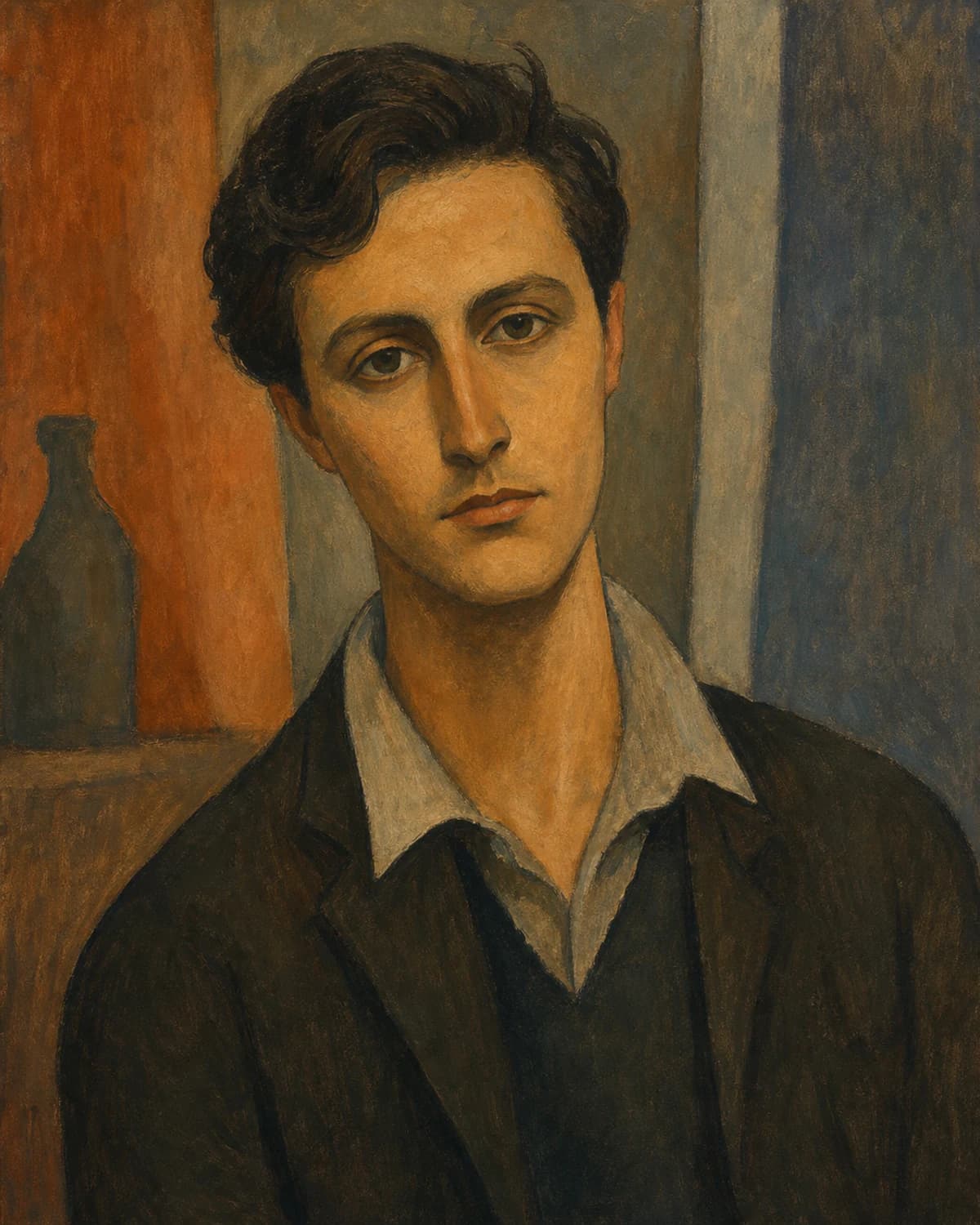
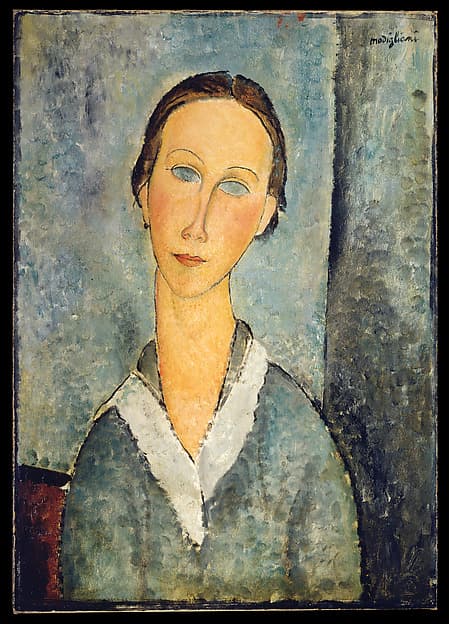
Amedeo Modigliani grew up in Livorno, studied in Florence and Venice, and from 1906 lived in Paris. For five years he gave himself almost entirely to sculpture, then returned to painting, making portraits of friends and nudes with elongated necks and mask-like faces. His only solo exhibition in his lifetime, in 1917, was closed by the police; fame came to him after his death.
Biography
The story goes that the bailiffs entered the Modigliani house in Livorno just as the mistress of the house went into labour. Under an old law, creditors could not take the bed of a woman in childbirth or a mother with a newborn, and the family piled their most valuable belongings onto her bed. So, on 12 July 1884, Amedeo was born, the fourth and youngest child. His father, the mining engineer Flaminio Modigliani, had by then been ruined, and his mother, Eugénie Garsin from Marseille, earned a living from lessons and translations.
At home he was called Dedo.
The family was Sephardic, and the boy spoke French from childhood: from 1886 until his death in 1894 his grandfather Isaco Garsin lived with them and got his grandson used to books of philosophy. When her son was eleven, his mother wrote in her diary that she could not yet make out his character, and added: “Perhaps an artist?” After pleurisy, in 1898 he went through a severe bout of typhoid and, by his mother’s account, dreamed in his delirium of seeing the paintings in the Palazzo Pitti and the Uffizi. She promised to take him to Florence and sent him to Guglielmo Micheli’s studio in Livorno, where at fourteen Modigliani was the youngest pupil. The open-air landscape that Micheli taught did not appeal to him; he was best at the nude. His teacher nicknamed him Superman, because he was forever quoting Nietzsche’s “Thus Spoke Zarathustra”.
At sixteen he was found to have tuberculosis, and his mother spent the winter of 1900–1901 with him in the south, in Naples, Rome and on Capri. In the spring of 1902 he enrolled in the Free School of the Nude in Florence; a year later he left for Venice and its Institute of Fine Arts, and at the Venice Biennales of 1903 and 1905 he saw the French Impressionists and Rodin’s sculpture for the first time.
Early in 1906, with a small sum his mother had scraped together, he arrived in Paris. At first he lived in a respectable hotel, then rented a studio in Montmartre, went to draw from the model at the Académie Colarossi, made friends with Maurice Utrillo and the poet Max Jacob, and grew close to Picasso, who lived nearby at the Bateau-Lavoir. In less than a year the reserved dandy was unrecognisable. He destroyed almost all his early work, calling it childish baubles made when he was a dirty bourgeois. Ludwig Meidner, one of his first Paris friends, called him the last true bohemian. He drew without pause, sometimes as many as a hundred drawings a day, and lost a great deal in his frequent moves.
In the spring of 1907 he settled in a house that the doctor Paul Alexandre let to young artists. Alexandre became Modigliani’s first patron, bought his work (his collection came to hold 25 paintings and about 450 drawings) and found him portrait commissions. In 1907 his works were shown at the Salon d’Automne, in 1908 at the Salon des Indépendants, but the public took no notice.
From April 1909 he lived in Montparnasse, met Constantin Brâncuși and for five years all but abandoned painting for stone. In 1911, in the studio of the Portuguese painter Amadeo de Souza-Cardoso, he showed stone heads that he called “pillars of tenderness”, and conceived a “temple of Beauty”, for which he drew caryatids. In 1912 his heads stood at the Salon d’Automne; in the spring of 1913, in Livorno, he worked in marble and sent sculptures to Paris, but not one marble piece survives. Twenty-seven of his sculptures are known in all. By 1914 he had returned to painting: once the war began, stone became hard to obtain, and he no longer had the strength for it. To my mind, without those five years with the chisel there would have been none of the elongated, mask-like faces of his late portraits.
In the spring of 1910 he met the young Anna Akhmatova. Their affair lasted until August 1911; they never saw each other again, and she took sixteen of his portraits of her back to Russia.
In 1914 the army would not take him on health grounds. Paul Alexandre went to the front, and the dealer Paul Guillaume became his new patron. The English artist Nina Hamnett recalled how, on her very first evening in Montparnasse, a smiling man at the next table in the café introduced himself: “Modigliani, painter and Jew.” For almost two years the English poet and journalist Beatrice Hastings lived with him, and he painted her fourteen times. The portraits of his friends date from the same years: Picasso, Soutine, Kisling, Rivera, Lipchitz, Cocteau.
From 1916 the Polish poet Léopold Zborowski looked after him: he gave him a room in his flat, paid him fifteen to twenty francs a day, hired models and bought his paints. Most of the famous nudes were painted on his commission. On 3 December 1917 Modigliani’s first and only solo exhibition in his lifetime opened at Berthe Weill’s gallery. The gallery stood opposite a police station, and the nudes in the window outraged the police: the show was closed on its opening day.
In the spring of 1917 the sculptor Chana Orloff introduced him to the nineteen-year-old Jeanne Hébuterne, a student at the Académie Colarossi. Soon they were living together, and Jeanne became his principal model: he painted her at least twenty-five times. In 1918, together with the Zborowskis and Soutine, they left the war behind for the south, for Cagnes-sur-Mer and Nice, where on 29 November a daughter was born, also named Jeanne. In May 1919 Modigliani returned to Paris, took part in the Salon d’Automne and became engaged to Jeanne, but the wedding never took place.
Modigliani died on 24 January 1920 at the Hôpital de la Charité in Paris, at the age of thirty-five. He was buried in the Père Lachaise cemetery. The next day Jeanne Hébuterne, who was expecting their second child, was also dead. Only in 1930 did her family allow her remains to be moved beside his; on their shared stone his inscription says that death struck him down on the threshold of glory. Their daughter was brought up by the painter’s sister in Florence, and as an adult Jeanne Modigliani wrote a book about her father, “Modigliani: Man and Myth”.
Artist works
Works by the artist
Works by Amedeo Modigliani available in this edition of NEOARCA.
Related context
Associations
Works connected through artistic movements, cultural context and period. Priced works available in this market appear first.








Profile notes
Profile and sources
Image
Artist image
На основе открытого изображения: Unknown author Unknown author; Wikimedia Commons; Public domain.
