
08.05.1850–13.11.1899
Almeida Júnior
Almeida Júnior (1850–1899) started out as a bell-ringer in the church of his native Itu, studied at the Imperial Academy of Fine Arts in Rio de Janeiro and then, with money from Emperor Pedro II, under Cabanel in Paris. He made his name with scenes from the life of the caipiras, the country people of São Paulo, and was one of the first in Brazil to paint in the Realist tradition of Courbet and Millet.
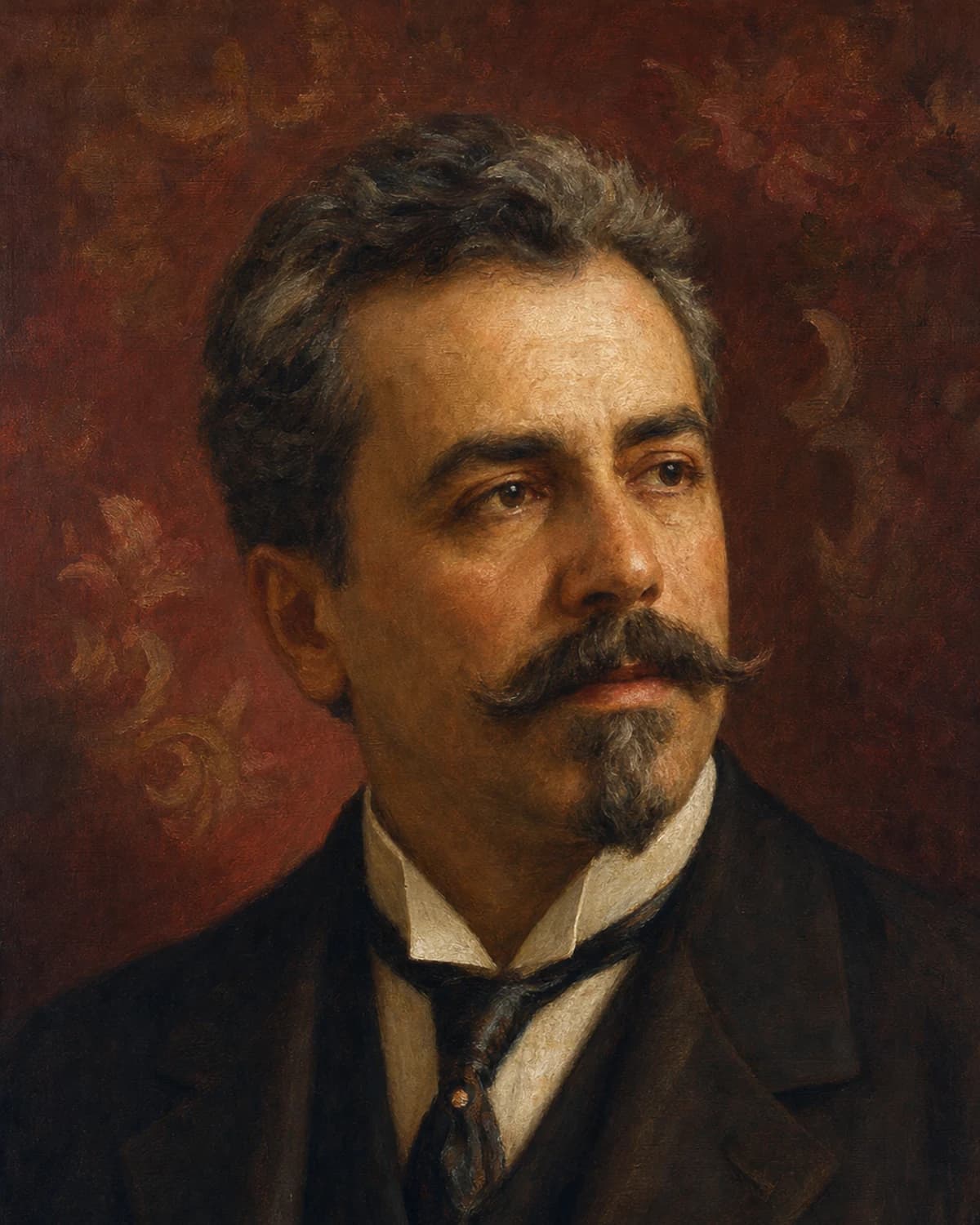
Biography
Almeida Júnior’s career began in a bell tower. He served as bell-ringer at the main church of Itu, the Church of Our Lady of Candelária, and painted small pictures on religious subjects. The head priest was so impressed by them that he raised money so the young man could go to Rio de Janeiro to study painting.
José Ferraz de Almeida Júnior was born on 8 May 1850 (according to other accounts, in 1851) in Itu, in the province of São Paulo. In 1869 he entered the Imperial Academy of Fine Arts, where he studied under Victor Meirelles and Pedro Américo. Among his fellow students, all of them city-bred, he stood out for his country speech and manners.
After the academy he had the right to compete for a state-funded trip to Europe, but he did not take it up: he returned to Itu and opened a studio there. Europe found him anyway. In 1876 Emperor Pedro II, touring the São Paulo region, saw his paintings and offered his support, and that same year an imperial decree granted the artist 300 francs a month to study in Paris. He settled in Montmartre, entered the École des Beaux-Arts as a student of Alexandre Cabanel, and exhibited at the Salon four times. He lived in Paris until 1882, made a short trip to Italy and returned to Brazil, where he showed everything he had painted while away. In 1883 he opened a studio in São Paulo, gave private lessons, held his own exhibitions and painted portraits on commission, from coffee barons to Republican politicians. In 1884 he exhibited at the General Exhibition of Fine Arts and was made a knight of the Order of the Rose. A year later Meirelles, preparing to retire, offered him his chair of history painting at the academy, but Almeida Júnior declined: staying in São Paulo mattered more to him.
Between 1887 and 1896 he travelled to Europe three more times. Biblical and historical subjects gradually gave way in his work to local ones: the everyday life of the caipiras, the country people of São Paulo. His manner changed along with his subjects, from academic to naturalist. Among his best-known paintings are “Caipira Cutting Tobacco”, “Interrupted Whetting”, “The Model’s Rest” and “The Conversion of Saint Paul on the Road to Damascus”. It seems to me that turning down the chair in Rio and these late country scenes say the same thing: a career in the capital interested him less than his home province. The academy nonetheless went on valuing him and in 1898 awarded him its gold medal.
Almeida Júnior died on 13 November 1899 in Piracicaba.
In Brazil his birthday, 8 May, is celebrated as the Day of the Visual Artist. At the Brazilian Academy of Fine Arts he is the patron of the twenty-sixth chair.
Related context
Associations
Works connected through artistic movements, cultural context and period. Priced works available in this market appear first.








Profile notes
Profile and sources
Image
Artist image
На основе открытого изображения: Sailko; Wikimedia Commons; Public domain.
