
28.01.1900–13.10.1984
Alice Neel
For half a century Alice Neel (1900–1984) painted portraits of her neighbours in Spanish Harlem, poets, communists, critics and pregnant friends while abstraction ruled American painting, and recognition came only when she was nearing seventy: a retrospective at the Whitney in 1974, a portrait of Kate Millett for the cover of “Time”, a nude self-portrait at eighty. In 1981, 85 of her works were shown in Moscow.
Biography
In the self-portrait of 1980 Alice Neel is eighty years old. She sits naked on a chair in her studio, in her glasses, a brush in her right hand and a rag in her left; her body is turned away from the viewer, her head turned towards him. She began the canvas in 1975, abandoned it, and finished it at the urging of her son Richard when the Harold Reed Gallery invited her to an exhibition of self-portraits. It is one of her last paintings.
She was born on 28 January 1900 in Merion Square, Pennsylvania (now Gladwyne), the fourth of five children of George Washington Neel, an accountant for the Pennsylvania Railroad, and Alice Concross Hartley; that same year the family moved to the small town of Colwyn. Her mother, as she recalled, used to tell her: I don’t know what you expect to do in the world, you’re only a girl. After finishing high school, in 1918 Neel passed the civil service examination and worked for three years in an office to help her parents, going to art classes in Philadelphia in the evenings. In 1921 she entered the Philadelphia School of Design for Women (now Moore College of Art), where she preferred the realism of the Ashcan School to fashionable Impressionism; Robert Henri taught there. Twice she received an honourable mention in her painting class, in 1925 the Kern Dodge Prize for the best painting in the life class, and that same year she graduated.
In 1924, at the Pennsylvania Academy’s summer school in Chester Springs, she met the Cuban painter Carlos Enríquez. On 1 June 1925 they married, and Neel left for Havana, into the circle of young writers, artists and musicians of the Cuban avant-garde; in March 1927 she exhibited with her husband at the twelfth Salón de Bellas Artes alongside Eduardo Abela, Marcelo Pogolotti and Amelia Peláez. It was there, it seems, that her political views took shape. In 1927 the couple returned to New York; the birth of a daughter in 1928 produced “Well Baby Clinic”, in which mothers with infants look more like patients in an asylum than inhabitants of a nursery. In 1930 Enríquez went back to Cuba. Neel called that summer one of her most productive: it was then that she painted her first female nudes, among them the portrait of her schoolfriend Ethel Ashton, a figure hunched on a chair with her eyes straight on the viewer. It seems to me that everything she did afterwards is already there: no flattery, no mercy, no detachment. Shown only in 1943, at an alumnae exhibition, the canvas caused outrage; Ashton herself, on seeing it, stormed out in a fury. In 1931, after staying with her parents in Pennsylvania and with her friend Nadya Olyanova, Neel settled in New York again.
There she painted the local characters, among them Joe Gould (1933), one of the few early works to survive, later shown at Tate Modern. At the end of 1933, at an interview at the Whitney Museum, she was offered thirty dollars a week under the Public Works of Art Project; she had been living in poverty, and she became one of the first artists to work for the federal art programmes. She painted, in a realist manner, Depression street scenes and people of the left: Mother Bloor, the poet Kenneth Fearing, the union activist Pat Whalen. In 1934 about 350 of her watercolours, paintings and drawings were lost to fire; that is partly why so few early works exist. She never joined the Communist Party, but did not hide her sympathies then or later. In the late 1930s she moved to Spanish Harlem and began painting her neighbours, above all women and children.
Then came twenty years of near-total silence from the galleries. In the 1940s she made illustrations for the magazine “Masses & Mainstream” and went on painting portraits at her home in upper Manhattan; in 1943 the federal programme parted with her, and with two sons to raise she had a hard time of it. Between 1940 and 1950 she had one solo show, in 1944. In the 1950s, through her friendship with the writer Mike Gold, she was shown at the New Playwrights Theatre, and in 1959 Robert Frank filmed her in his beatnik film “Pull My Daisy”, written by Jack Kerouac, alongside a young Allen Ginsberg.
Recognition came in the 1960s. In 1965 an exhibition of portraits at the Graham Gallery in New York was a success. By the middle of the decade many of her women friends were expecting children, and she painted a series of pregnant nudes; asked why, she answered that it was simply a fact of life, one that people out of false modesty never show, and that a pregnant woman has a claim staked out: she is not for sale. The women’s movement claimed her as its own. In 1970 “Time” commissioned a portrait of Kate Millett from her for its cover; Millett refused to sit, and the portrait was painted from photographs. Neel called herself “a collector of souls”. The Andy Warhol was painted in those same years, naked to the waist, eyes closed; many consider that canvas the summit of her work. In 1971 her own Moore College gave her a solo exhibition, in 1974 the Whitney Museum showed a retrospective, in 1976 she was elected to the American Academy and Institute of Arts and Letters, and in 1979 President Carter presented her with the award of the National Women’s Caucus for Art. “Margaret Evans Pregnant” (1978) is now in the Institute of Contemporary Art in Boston: the woman sits upright on a chair, and in the mirror behind her is a reflection that does not resemble her. In 1981, 85 of her works were shown in Moscow. In the last year of her life Robert Mapplethorpe took her photographic portrait, also with eyes closed.
Neel died on 13 October 1984 in her New York apartment. The retrospectives went on without her: the Whitney in 2000, the Philadelphia Museum of Art in 2001, the first European exhibition at the Victoria Miro Gallery in London in 2004, “Painted Truths” in Houston, London and Malmö in 2010, “Painter of Modern Life” from Helsinki to Hamburg in 2016–2018, “People Come First” at the Metropolitan Museum in 2021, more than a hundred works, and then in Bilbao and San Francisco, “Hot Off the Griddle” at the Barbican in London in 2023. In 2007 her grandson Andrew Neel made a documentary film about her.
Related context
Associations
Works connected through artistic movements, cultural context and period. Priced works available in this market appear first.








Profile notes
Profile and sources
Image
Artist image
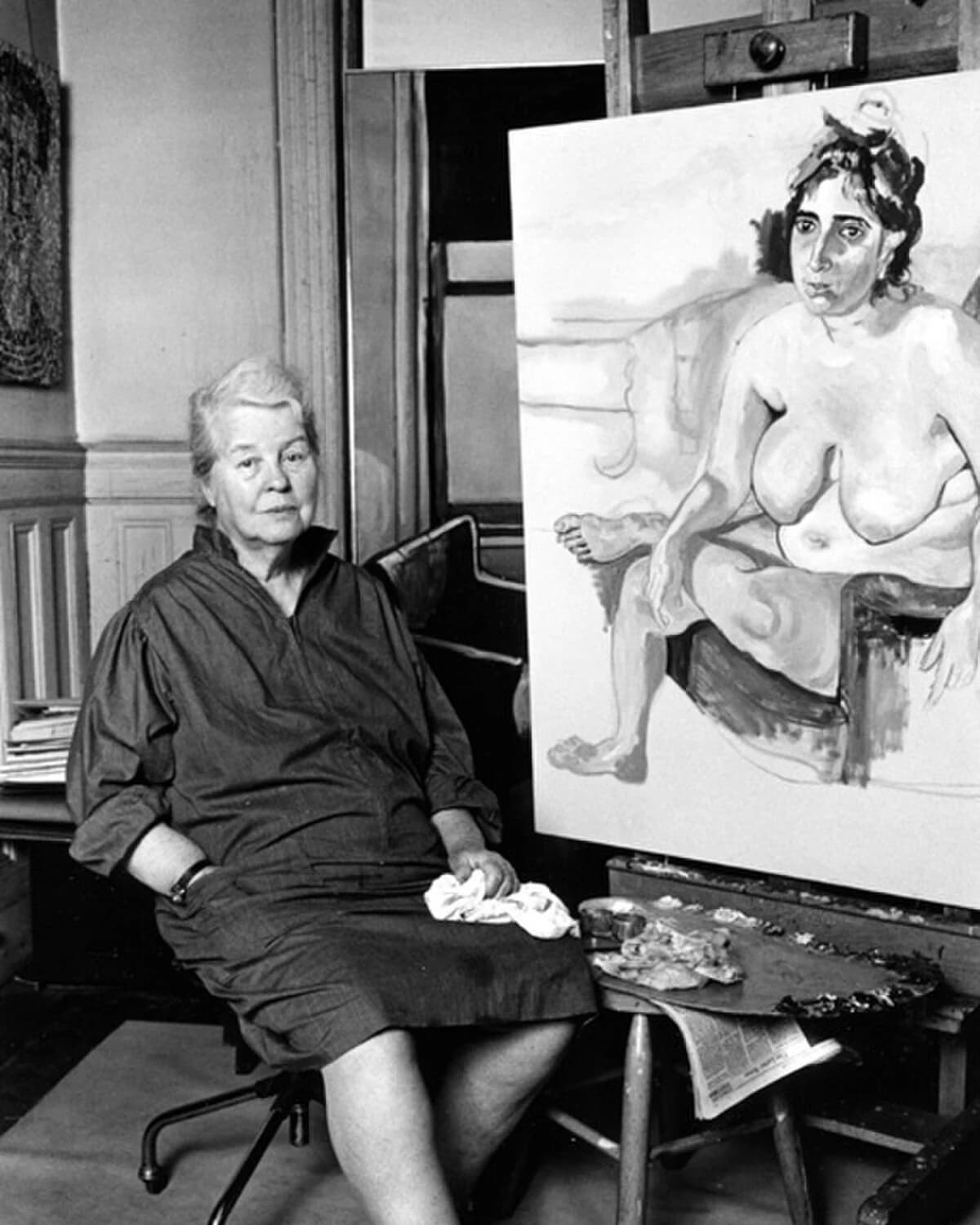
Lynn Gilbert; Wikimedia Commons; CC BY-SA 4.0.
