
03.11.1860–09.08.1935
Alfredo Andersen
Alfredo Andersen (in Norwegian, Alfred) was born in Kristiansand, studied in Christiania and Copenhagen, and in 1893 stayed on in Paranaguá, where he arrived almost by accident. From 1902 he lived in Curitiba, opened a private school of drawing and painting there, and the state of Paraná still calls him the father of its painting. His house and studio became a museum bearing his name.
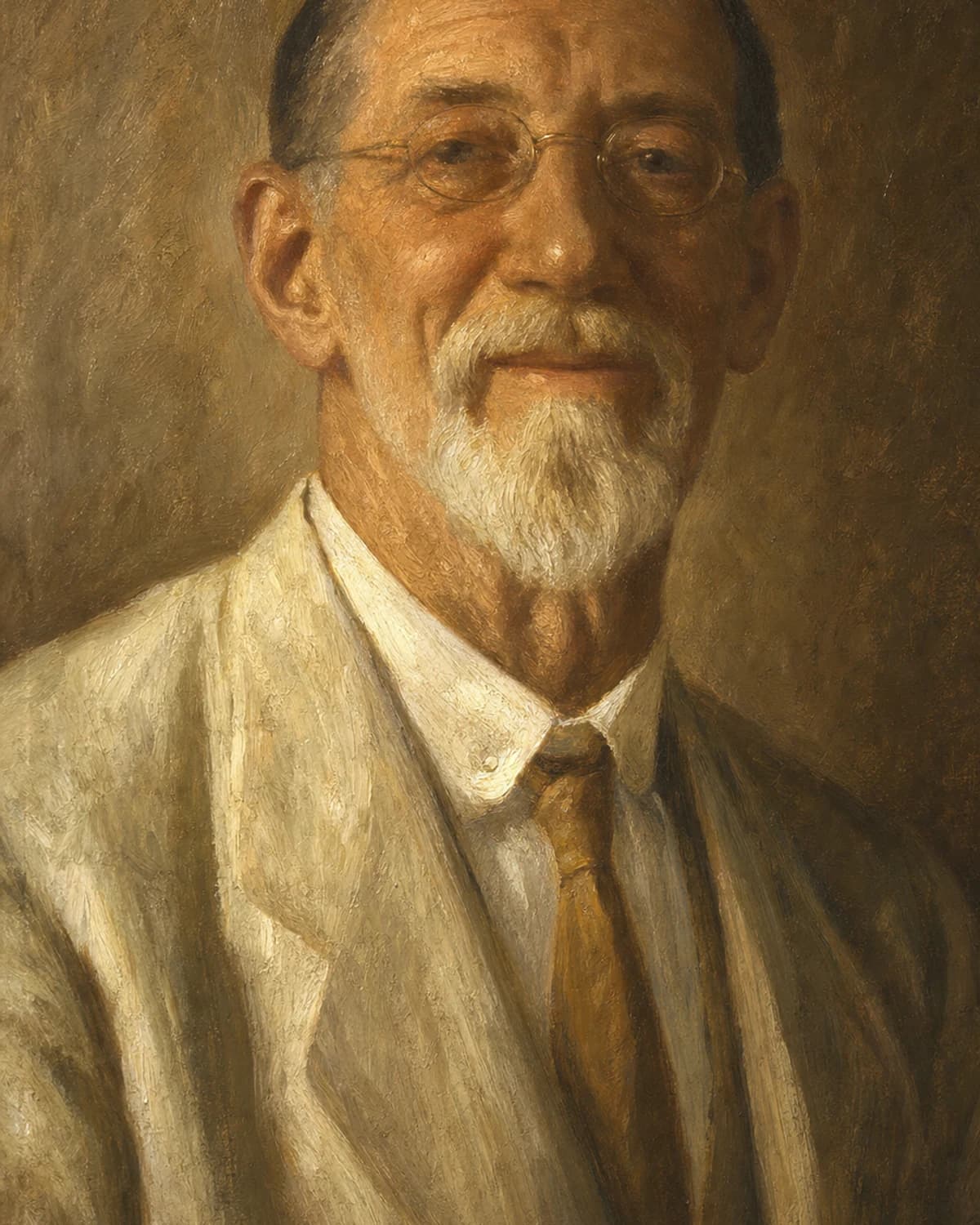
Biography
The ship on which Andersen was sailing to Buenos Aires put in at Paranaguá for repairs, and he liked the place so much that he decided to stay. That, by one account, is how a Norwegian painter came to be in the south of Brazil. By another, he arrived in 1891 with his father: their ship was wrecked at the port of Antonina, in Paraná, and while it was being mended Andersen painted landscapes. Which version is closer to the truth is hard to check.
He was born on 3 November 1860 in Kristiansand, the son of Tobias Andersen, a merchant-navy captain, and Hanna Karine Andersen. He painted his first picture, “Akt”, at thirteen. At seventeen he began studying at the Academy of Fine Arts in Christiania (now Oslo) under Wilhelm Krogh, a well-known Norwegian painter, whose assistant he had earlier been: according to some sources from 1874 to 1877, according to others from 1877 to 1879. In Krogh’s studio he painted terracotta and made stage-design sketches. From 1879 to 1883 he studied on a scholarship at the Royal Danish Academy of Fine Arts in Copenhagen, and at the same time taught drawing at a boys’ school in Vesterbro. He then found himself in Christiania again, where he took private lessons from the landscape painter Olaf Isaachsen. His first solo exhibition was held in 1884.
In the 1890s he set out on a long voyage through the tropics: Mexico, Barbados and north-eastern Brazil, where he painted a canvas in the port of Cabedelo, in the state of Paraíba. At home in Kristiansand he found a town badly damaged by fire, and the technical school to which he applied turned him down: he was thought a freethinker. He left again for South America, first to Buenos Aires, then to Brazil, and in 1893 settled in Paranaguá.
There he met Anna de Oliveira, a young woman of Carijó descent, much younger than himself. They had four children; one of the sons, Thorstein Andersen (1905–1964), also became a painter.
Around 1902 the family moved to Curitiba. In his own studio Andersen founded a private school of drawing and painting, and many future artists of Paraná passed through it. He taught drawing at the German School and at the Colégio Paranaense, and in 1909 became director of the evening classes at the School of Fine Arts and Industry. His first exhibition in Curitiba took place in 1907: eighteen oil paintings, four of them portraits, the rest landscapes and genre scenes. Shows followed in Curitiba in 1914, 1920, 1923 and 1930, in Rio de Janeiro in 1918 and in São Paulo in 1921. At the Salão de Belas Artes (the Salon of Fine Arts) he received an honourable mention (1916) and a bronze medal (1933).
In 1927 the Norwegian government offered him the directorship of a school of fine arts. He went to his homeland, stayed in Krogh’s house, and a year later returned to Paraná. From Norway he brought back a “Portrait of Knut Hamsun”, which is now in the National Gallery of Norway.
On 3 November 1931, his seventy-first birthday, Andersen was made an honorary citizen of Curitiba for his services to the art of Paraná. The city council had never before given the title to anyone. In 1932 he painted his best-known self-portrait, now in the National Museum of Fine Arts.
Andersen died on 9 August 1935 in his house and studio in Curitiba. Friends and admirers, among them the sculptor João Turin, founded the Society of Friends of Alfredo Andersen in 1940, and in 1947 the house was acquired to preserve the painter’s memory. In 1959 it was officially opened as the “House of Alfredo Andersen: School and Art Museum”, and since 1979 it has been the Alfredo Andersen Museum. For the centenary of his birth, in 1960, his works were shown at the 17th Paraná Salon of Fine Arts in the Public Library of the state.
Related context
Associations
Works connected through artistic movements, cultural context and period. Priced works available in this market appear first.








Profile notes
Profile and sources
Image
Artist image
На основе открытого изображения: Alfredo Andersen; Wikimedia Commons; Public domain.
