
30.10.1839–29.01.1899
Alfred Sisley
Alfred Sisley (1839–1899) was born in Paris to an English family, lived his whole life in France and died a British subject. He painted almost nothing but landscapes: the Seine west of Paris, the Thames at Hampton Court and, from 1880, the Loing and the small town of Moret. He took part in the first Impressionist exhibition in 1874, but never won recognition in his lifetime.
Biography
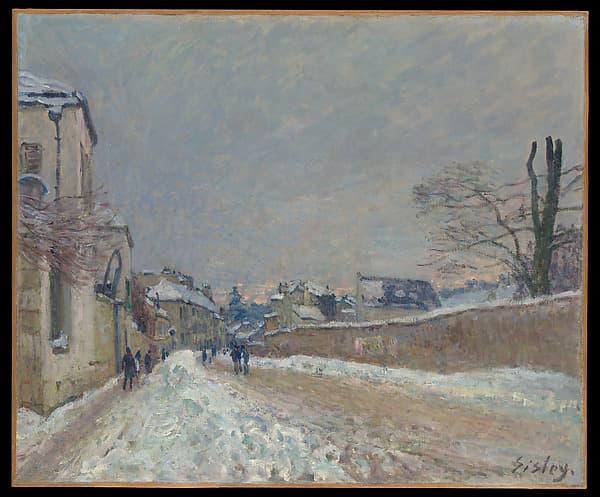
In March 1876 the Seine burst its banks at Marly-le-Roi, where Sisley was then living in a house near the old watering place. He devoted seven paintings to the flood, among them “Flood at Port-Marly”. In winter at Marly he often worked from an upstairs room, although “Snow Effect at Louveciennes” of 1874 was clearly painted with the easel set up out in the street. The snow on these canvases takes on pink, yellow and blue reflections. “The Place du Chenil at Marly, Snow Effect” also belongs to those Marly winters.
Sisley was thirty-six. Almost all the years left to him were spent in poverty.
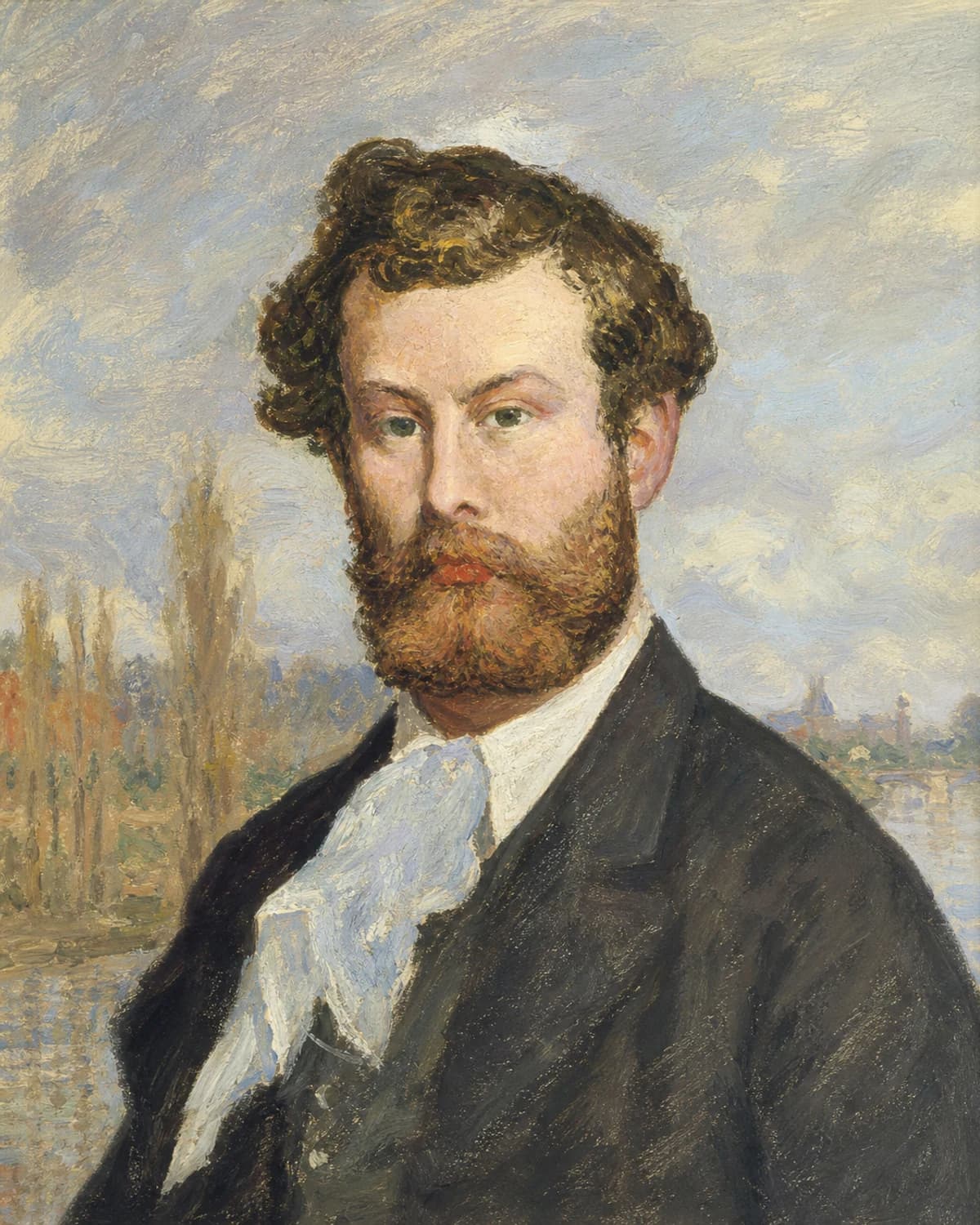
He was born on 30 October 1839 in the Rue des Trois-Bornes, in what was then the 4th arrondissement of Paris (now the 11th), the youngest of the four children of William Sisley, who traded in imported luxury goods, and Felicia Sell. At home the family spoke French and English. In 1857 the eighteen-year-old was sent to London to learn the trade, but he spent more time in museums, looking at Turner and Constable and reading Shakespeare. Back in Paris in the early 1860s, he persuaded his parents to let him give up commerce. Around then he went to the Pasdeloup concerts, and many years later he told the critic Arsène Alexandre that a theme from the scherzo of Beethoven’s Septet had stayed with him ever since: he hummed it as he worked. In October 1862 he entered the studio of Charles Gleyre and there became friends with Monet, Renoir and Bazille. By March 1863 all four had left Gleyre to paint outdoors in the forest of Fontainebleau, at Chailly-en-Bière, Barbizon and Marlotte. Unlike Monet and Renoir, Sisley lived on family money in these years. He shared a studio with Renoir, who painted a portrait of his father, while Bazille painted Sisley himself in the winter of 1867–1868.
In 1866 he met Eugénie Lescouezec, from the Batignolles quarter; his father disapproved of the union. Sisley’s early landscapes are dark, brown and deep green, and they show how closely he had looked at Corot and Courbet. At the Salon of 1870 he showed two views of the Canal Saint-Martin. The Franco-Prussian War ruined his father’s business, and the money from home ran out; his studio at Bougival was wrecked by the Prussians, which is why few works from before 1871 survive. From March 1871 the family lived at Voisins, a hamlet belonging to Louveciennes. Here his palette grew lighter, and the many views of Louveciennes, Marly and Bougival from the months when there was still fighting near Versailles show not a single trace of the war. In January 1872 Monet and Pissarro introduced him to Paul Durand-Ruel, and within two years the dealer had bought almost everything he painted.
In 1873, together with Monet, Renoir, Pissarro, Degas and Berthe Morisot, he founded the Société Anonyme des Artistes Peintres, Sculpteurs et Graveurs. At the society’s first exhibition, which opened on 15 April 1874 in the premises of the photographer Nadar, six of his landscapes were hung. Which ones is not fully known: the catalogue lists five numbers, the sixth canvas was shown outside the catalogue, and the guess that it was “The Machine at Marly” is supported by nothing. Critics praised Sisley, and the mockery aimed at Monet and Cézanne passed him by. From July to October 1874, at the expense of the baritone Jean-Baptiste Faure, he lived in England and painted about twenty views of the Thames at Molesey and Hampton Court; Kenneth Clark later called them a perfect moment of Impressionism. Sisley also showed at the group’s second (1876) and third (1877) exhibitions, and after that only at the seventh, in 1882, where he showed twenty-seven paintings.
From Marly he moved to Sèvres, and in 1880 poverty forced him to leave for Veneux-Nadon, a quiet village near Moret-sur-Loing, seventy-five kilometres south-east of Paris. His first solo exhibitions, in 1881 at the offices of the magazine La Vie Moderne and in 1883 at Durand-Ruel’s, brought no success. He was supported by the doctor and collector Georges de Bellio. From 1882 to 1885 Sisley explored the banks of the Loing between Moret and Saint-Mammès, and in 1885 he painted a group of houses by the locks again and again, filling sketchbooks with drawings annotated with technical notes. In February 1888 the state bought his “September Morning”, but his first application for French citizenship, made in May, came to nothing. In 1889 he settled in Moret itself; in 1890 he became a member of the Société Nationale des Beaux-Arts and showed there almost every year. The early 1890s brought the series: the old houses of Saint-Mammès, the avenues along the Loing, the Gothic church at Moret. He wrote to the journalist Adolphe Tavernier that Moret was where he had made the most progress in his art. To my mind, this is one of the few places where he speaks about himself at all.
In 1895 Pissarro wrote to his son that he and Sisley had been left as “the tail-end of Impressionism”.
In February 1897 Georges Petit staged a large retrospective in his gallery: 146 paintings and six pastels. Only Alexandre and Tavernier wrote about it, and not a single canvas was sold. That summer Sisley and Eugénie went to Britain, to Penarth near Cardiff, and there on 5 August they were married. On the Gower Peninsula, at Langland Bay, he painted cliffs, boulders and green waves crested with foam; this was the last major work of his life. In the autumn they returned to Moret, and Sisley again applied for citizenship, but lost papers held the matter up. Eugénie died on 8 October 1898. Sisley died at his home in Moret on 29 January 1899, having first sent for Monet and entrusted his children to him. He was buried on 1 February in the cemetery at Moret, beside his wife, in the vault of the Greatorexes, a family of American women painters; Monet, Renoir and Pissarro came from Paris, and Jean-Charles Cazin spoke on behalf of the Société Nationale. His own words are carved on the tomb: “Objects must be enveloped in light, as they are in nature.” On 15 July 1911 a monument to him was unveiled in Moret.
Artist works
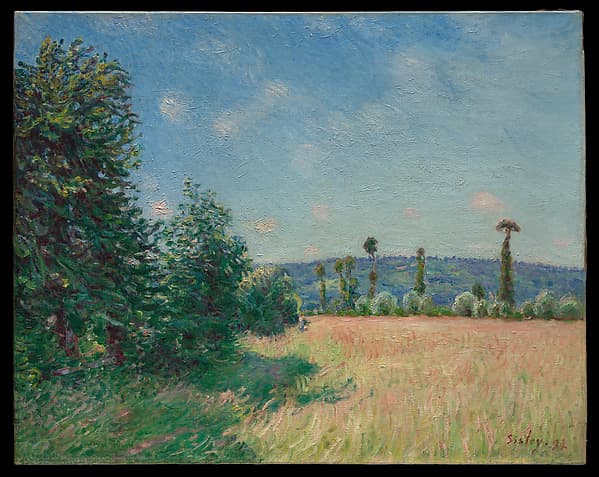
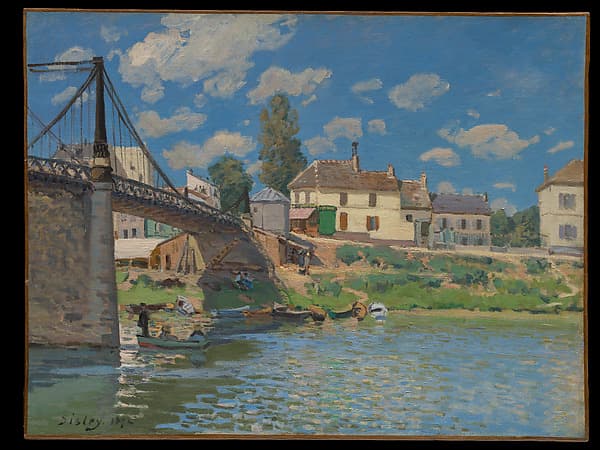
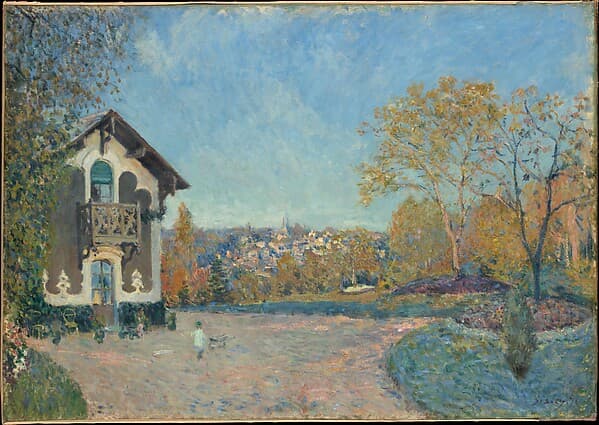
Works by the artist
Works by Alfred Sisley available in this edition of NEOARCA.
Related context
Associations
Works connected through artistic movements, cultural context and period. Priced works available in this market appear first.








Profile notes
Profile and sources
Image
Artist image
На основе открытого изображения: Pierre-Auguste Renoir; Wikimedia Commons; Public domain.
