
03.01.1872–18.01.1951
Alfred Eberling
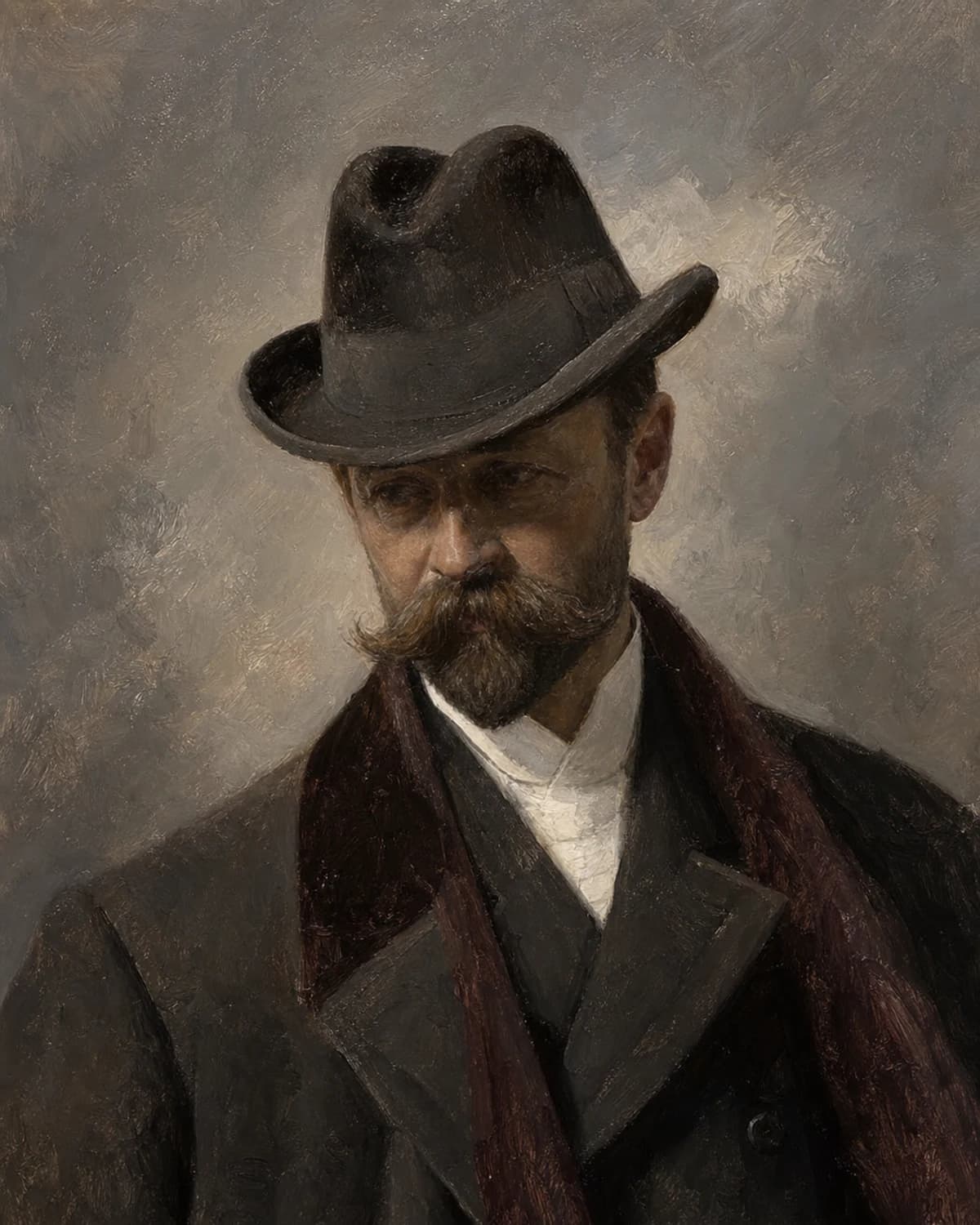
Alfred Eberling (1872–1951) studied under Ilya Repin, painted portraits of theatre people and in 1924 won the Goznak competition for the best portrait of Lenin. His drawing appeared on banknotes in 1937 and later served as a watermark on notes of 1947 and 1957. He taught in St Petersburg and Leningrad for almost half a century; his pupils included the art historian Mikhail German.
Biography
In 1924 Goznak, the Soviet state printing works that produced banknotes and securities, announced a competition for the best portrait of Lenin, and Alfred Eberling won it. His drawing was later used for banknotes: the notes of 1937, and after the war the same portrait became the watermark on Soviet banknotes of 1947 and 1957. Few of those who held this money in their hands can have known the name of its author.
He was born on 3 January 1872 (22 December 1871, Old Style) in Zgierz, in Piotrków Governorate, into a petty-bourgeois family of German descent; his father, according to biographers, was a prosperous cloth manufacturer. His full name at birth was Wilhelm Alfred. Besides Russian, he spoke German, Polish, French and Italian. He studied in St Petersburg, at the Higher Art School of the Imperial Academy of Arts; the sources disagree on the dates: by some accounts he studied there from 1889 to 1897, by others he completed the course in 1898. He was awarded the title of artist of the first degree for a painting called “Spring”. Repin’s studio was his main school, but the literature also mentions his closeness to the circle of Pavel Chistyakov; there are also indications of a strong influence from Arkhip Kuindzhi, and Eberling later tied his exhibiting career to Kuindzhi’s society. Some sources also name studies with Franz von Lenbach in Munich, which is hard to verify from the texts available.
While still a student, in 1896, he painted the allegory “Old and ‘New’ Painting”, a mockery of the Decadent art then spreading. The picture was shown at the Academy exhibition in St Petersburg and at an international exhibition in Berlin, and the artist later gave it to the Penza Art School.
In 1899 Eberling went to Constantinople with a group of artists: the government had commissioned them to decorate an Orthodox church. From 1900 to 1917 he visited many European countries and spent time in their museums. In 1902, in Florence, he painted the largest of his pictures, “The Artist’s Dream”. It was shown in Florence, Warsaw, St Petersburg and Moscow; in 1904 it appeared at exhibitions in St Louis and New York, and there a San Francisco museum bought it. Several other works were also bought in the United States: “Constantinople. Cemetery”, “In the Mountains of Tuscany”, “Venice” and “Under the White Banner”. According to some accounts, in his early years he painted large compositions close to Symbolism but soon concentrated on portraits, worked for Nicholas II and for Tsar Ferdinand I of Bulgaria, and painted ballerinas, among them Anna Pavlova, and actresses. This rests on a single article, and I would check it.
His teaching began in 1904 and went on for decades. Eberling taught at the drawing school of the Society for the Encouragement of the Arts, and in those same years painted about a hundred portraits, mostly of people from the theatre. From 1905 he lived and worked on Sergievskaya Street (later Tchaikovsky Street). There, in his studio, he also gave private lessons: Vyacheslav Zagonek, Yuri Tulin, Boris Ugarov and the future art historian Mikhail German studied with him. In 1909 he was among the founders of the Kuindzhi Society, and he also exhibited with the Society of Watercolourists and other St Petersburg associations. In 1910 Lermontov’s poem “The Demon” was published with his illustrations, and in 1912–1913, in the series “Library of the Blue Journal”, Bram Stoker’s novel “Dracula” appeared, also with his drawings.
After the Revolution he stayed in Petrograd. In 1918 he took part in founding the Art and Teaching Technical School on the basis of the drawing school (now the Roerich Art College) and taught there until 1933. In 1925–1930 he headed the art studio of the Association of Artists of Revolutionary Russia in Leningrad. In 1934, at the invitation of Isaak Brodsky, he became professor of painting, drawing and composition at the Ilya Repin Institute of Painting, Sculpture and Architecture, where he worked until 1937 or 1938; the sources differ slightly on the date. In parallel, until 1940, he gave classes at the art studios of the Leningrad Palace of Pioneers and the House of Scientists.
In the 1920s and 1930s Goznak commissioned from him portraits of Marx, Lenin, Stalin, Molotov, Kaganovich and Kalinin for mass print runs. His easel paintings of those years include “The First News of October” (1918), portraits of Sergo Ordzhonikidze, of the Stakhanovite worker Smirnova and of Maxim Gorky (all 1937), and a portrait of the ballerina Marina Semyonova (finished in 1940, now in the Academy of Russian Ballet). In 1946 he painted “Lenin in 1895”, commissioned for the Leningrad branch of the Lenin Museum; the canvas is now in the Smolny Museum, and in 1976 it was shown at the Manege in Moscow in an exhibition of Leningrad artists. In the postwar years came portraits of Konstantin Ushinsky, of Stalin and of Academician Nikolai Khlopin, and the last one recorded is the portrait of Academician Sergei Davidenkov (1951).
Eberling died in Leningrad in January 1951, in his eightieth year, and was buried in the Shuvalov Cemetery.
Related context
Associations
Works connected through artistic movements, cultural context and period. Priced works available in this market appear first.








Profile notes
Profile and sources
Image
Artist image
На основе открытого изображения: Alfred Eberling; Wikimedia Commons; Public domain.
