
07.02.1780–04.12.1847
Alexey Venetsianov
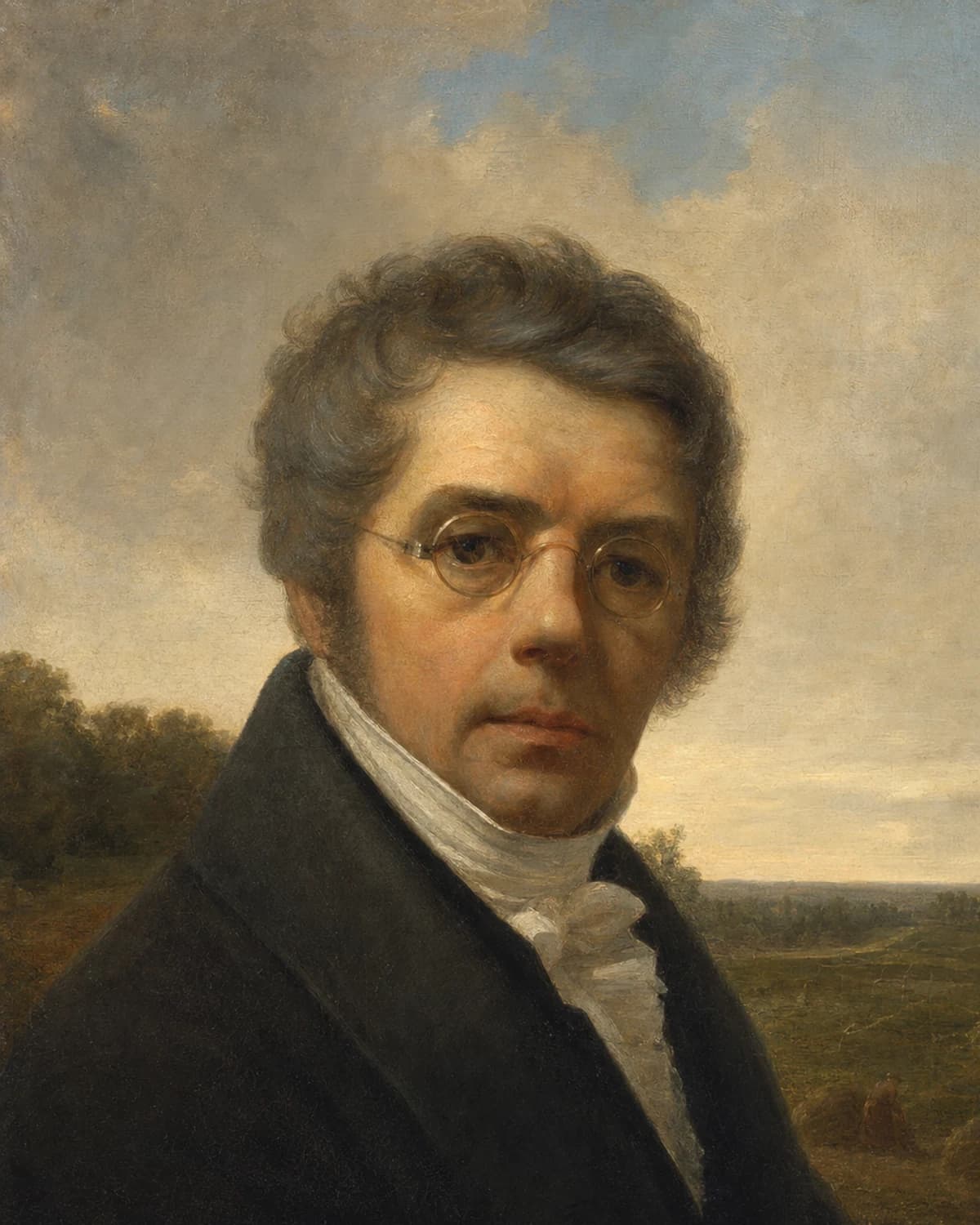
Alexey Venetsianov (1780–1847) learned to paint outside the Academy of Arts and spent twelve years as a land surveyor before leaving in 1819 for the village of Safonkovo in Tver Province. There he painted “The Threshing Floor”, “Reapers” and “Sleeping Shepherd Boy”, making peasant life a full-fledged subject of Russian painting, and taught village boys to draw free of charge; from them grew the Venetsianov school.
Biography
To paint “The Threshing Floor”, Venetsianov sawed a wall out of a log hut on his estate: otherwise the whole interior space would not fit into the picture. He seated the peasants in the poses he needed and painted them from life. The work went on in 1823–1824, and he explained that he wanted to establish himself on a path that rests “on the firm foundation of perspective and the most detailed attention to nature”.
The impulse came from someone else’s picture. In 1821 the French painter François Marius Granet presented Alexander I with a version of his “Interior View of the Choir of the Capuchin Church on Piazza Barberini in Rome”, and it was hung in the Hermitage. Venetsianov was struck by the way depth and light were rendered in it. He dreamed of hanging “in the Hermitage on the same wall as Granet” and even wrote an essay, “Something on Perspective”.
In 1824 his peasant pictures had a great success at the exhibition. Pavel Svinyin wrote that at last we had lived to see an artist who had turned his talent to depicting “nothing but what is our own”.
His origins were anything but rustic. His ancestors, Greeks by the name of Proko, moved to Russia in the 1730s–1740s and settled in Nezhin; there they picked up the nickname Venetsiano, which in time became a surname. Alexey Venetsianov was born on 7 (18) February 1780 in Moscow, the son of Gavrila Yuryevich, a merchant of the second guild, and Anna Lukinichna, née Kalinina. The family traded in currant bushes, tulip bulbs and pictures. He learned to paint without going through the Academy of Arts: on his own, copying pictures in the Hermitage, and with advice from Vladimir Borovikovsky, in whose house he lived for a time. His first works are quiet portraits: of his mother (1802), of A. I. Bibikov (1805), of M. A. Fonvizin (1812). From 1807 he served in St Petersburg as a land surveyor in the forestry department; as a freelance portraitist he had few commissions.
In 1808 Venetsianov launched a “Journal of Caricatures” made up of engraved sheets. The censors soon banned it; it is thought that Alexander I was angered by the satirical sheet “The Grandee”. In February 1811 the Council of the Academy of Arts made him a candidate (“designated”) academician on the strength of a self-portrait and set the test piece for the title of academician: a portrait of the inspector Kirill Golovachevsky. Venetsianov painted the inspector surrounded by three boys, said to personify painting, sculpture and architecture, and on 1 September 1811 he became an academician. In 1812, together with Ivan Terebenev, he drew caricatures of the French and of Gallomaniac noblemen. In 1817–1818 the magazine “The Magic Lantern” appeared in St Petersburg with engravings after his drawings of the empire’s “characteristic types”, and his designs were used for porcelain: statuettes at the Gardner factory and figures for the Guryev Service, modelled by Stepan Pimenov at the Imperial factory.
In 1819 he left the service and settled at Safonkovo in Tver Province with his wife, Marfa Afanasyevna, and his daughters, Alexandra and Felitsata. That is where his “peasant genre” was born: “Reapers”, “Sleeping Shepherd Boy”, “Zakharka”, pictures that still win the viewer over with their freshness. There, too, a school appeared that no one had ever officially founded. More than seventy boys passed through it, seven of them serfs; they studied almost free of charge, Venetsianov supported many of them out of his own pocket, and Vasily Zhukovsky took an active part in their fortunes. He showed his pupils’ work at the Academy exhibitions beside his own, and some of them also attended classes at the Academy. Among his pupils were Grigory Soroka, a serf of the landowner Milyukov, who had intended him to be a gardener, Evgraf Krendovsky and Kapiton Zelentsov. To my mind, this village school matters in his biography no less than any picture: the name “Venetsianov school” took root in the history of art, although it never had any official status.
In 1830 Nicholas I made him a court painter, which helped him support his pupils. The emperor bought his pictures for the Academy and the Hermitage. Venetsianov never became a professor at the Academy: the academicians withheld their consent, mainly because he had no academic training. He painted portraits of his contemporaries, Karamzin (1828), Gogol (1834), V. P. Kochubey, worked in pastel on paper and parchment and in lithography; as early as 1826 the critic Grigorovich praised his works done “in dry colours”. At the end of the 1830s he turned to narrative scenes: “Seeing Off a Recruit” (Pavlovsk) and “The Soldier’s Return” (Russian Museum). He also wrote theoretical notes, among them “The Secret of Lipman’s Pictures” and “On the System of Teaching in Drawing Classes”.
In his last years much of his energy went into icons: for the Smolny Cathedral, for the church of the Obukhov Hospital, and in 1847 for the church of the boarding school for young noblemen in Tver.
Alexey Venetsianov died on 4 (16) December 1847 in the village of Poddubye in Tver Province, on the road to Tver. He was buried in the village cemetery at Dubrovskoye, which is now called Venetsianovo. A memorial cross was put up near Poddubye in the year of his death; it has been replaced several times since.
Related context
Associations
Works connected through artistic movements, cultural context and period. Priced works available in this market appear first.








Profile notes
Profile and sources
Image
Artist image
На основе открытого изображения: Alexey Venetsianov; Wikimedia Commons; Public domain.
