
12.05.1830–26.09.1897
Alexei Savrasov
For more than twenty years Alexei Savrasov (1830–1897) led the landscape class of the Moscow School of Painting, Sculpture and Architecture, where Levitan and Korovin studied. His “The Rooks Have Returned” (1871), a plain spring view with birches and birds, is usually regarded as the beginning of the Russian lyrical landscape. He was among the founders of the Itinerants and spent his last fifteen years in poverty.
Biography
In 1851 the sculptor Nikolai Ramazanov, who taught at the Moscow School of Painting and Sculpture, wrote of a new landscape by a twenty-year-old pupil that in it one could see the clouds moving and hear the noise of branches and grass: “there will be a downpour”. The picture was “View of the Kremlin from the Crimean Bridge in Inclement Weather”, and with it the author’s name became known.
At that time he still signed his name with an “o”: Sovrasov.
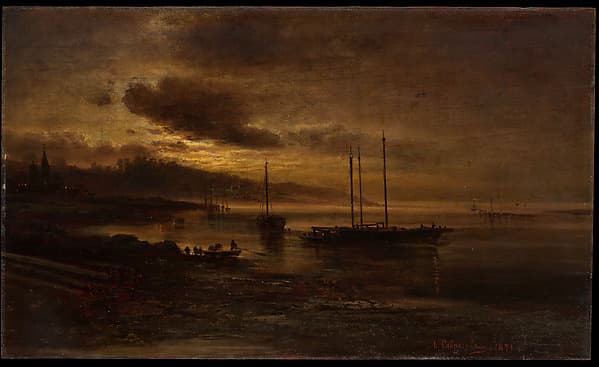
Alexei Savrasov was born on 12 (24) May 1830 in Moscow, the son of Kondraty Artemyevich Savrasov, a merchant of the third guild, who wanted to set his son to trade. The son, however, began drawing early and, against his father’s will, entered the School of Painting and Sculpture, in the class of the landscape painter Karl Rabus. While still a student he painted “A Rock in the Forest near Razliv” (1850), whose composition art historians find clumsy, and in the same year “View of the Moscow Kremlin by Moonlight” earned him the title of non-class artist. In 1852 he travelled to the southern provinces and painted “The Steppe by Day”. In the summer of 1854, the year he finished at the School, he worked near Oranienbaum, where he had been invited by the President of the Academy of Arts, Grand Duchess Maria Nikolaevna, and for two views of the area he was made an academician. One of them was bought by Pavel Tretyakov in 1858.
From the late 1850s Savrasov headed the School’s landscape class and remained in that post until 1882. His pupils, among them Isaac Levitan, Konstantin Korovin, Mikhail Nesterov and Lev Kamenev, remembered him with admiration and gratitude. In 1857 he married Sofia Hertz, sister of the art historian Karl Hertz, and their home was visited by artists and collectors, Tretyakov among them. In 1860 he took part in the first exhibition of the Moscow Society of Art Lovers. He grew especially close to Vasily Perov. The friends helped each other: Perov painted the figures of the barge haulers in Savrasov’s “The Volga near Yuryevets”, and Savrasov painted the landscape for Perov’s “The Bird Catcher” and “Hunters at Rest”. In 1862 Savrasov visited the International Exhibition in London, as well as France, Germany and Switzerland, and wrote afterwards that no academy could advance an artist as much as this exhibition. The painters who affected him most were John Constable and the Swiss Alexandre Calame. In 1869, together with Vasily Pukirev, he prepared a lithographed “Drawing Course” for the School’s students and himself drew several landscapes on the stone for it.
In 1870 he became one of the founders of the Society of Itinerant Art Exhibitions, and in 1871 he painted “The Rooks Have Returned”: a spring view with birches, rooks’ nests, a church and snow not yet melted. The subject is almost humdrum, and critics would later call this kind of landscape a mood landscape. It seems to me that the picture rests on something very simple: the feeling that winter is already over and spring has not yet begun. The same year, 1871, produced “The Pechersky Monastery near Nizhny Novgorod” and “The Volga in Flood near Yaroslavl”, followed by “Country Road” (1873), “A Grave on the Volga” (1874) and “The Rainbow” (1875). He painted a great deal around Moscow, in Sokolniki, Fili and Kuntsevo (“Elk Island in Sokolniki” dates from earlier, 1869), and travelled to the Volga and the northern provinces. His paintings were shown at the world’s fairs in Vienna in 1873 and in Paris in 1878.
In 1871 a newborn daughter died in Yaroslavl. At the end of 1876 his marriage broke up: his wife left for St Petersburg with their daughters Vera and Evgenia. From the late 1870s Savrasov suffered from alcoholism, and dark motifs appeared in his pictures. In 1882 he was dismissed from the School, and the attempts of his relatives and friends to help him came to nothing.
He spent the following years in want, in the end drifting from shelter to shelter. Vladimir Gilyarovsky recalled that the artist sometimes came to the studio in rags. His work became uneven, although it includes “Landscape. The Village of Volynskoye” (1887), where factory smoke creeps over the church beside it, “Spring. Kitchen Gardens” (1893) and “Mud Season” (1894). He no longer appeared at exhibitions, and Levitan remarked that he seemed to have been forgotten.
Savrasov died on 26 September (8 October) 1897 in Moscow, in the hospital for the poor at Khitrovka, and was buried in the Vagankovo Cemetery. Only the School’s doorkeeper and Pavel Tretyakov, so it is said, attended the funeral. Levitan responded to his teacher’s death with the words that only with Savrasov had “lyricism appeared in landscape painting”.
Artist works
Works by the artist
Works by Alexei Savrasov available in this edition of NEOARCA.
Related context
Associations
Works connected through artistic movements, cultural context and period. Priced works available in this market appear first.








Profile notes
Profile and sources
Image
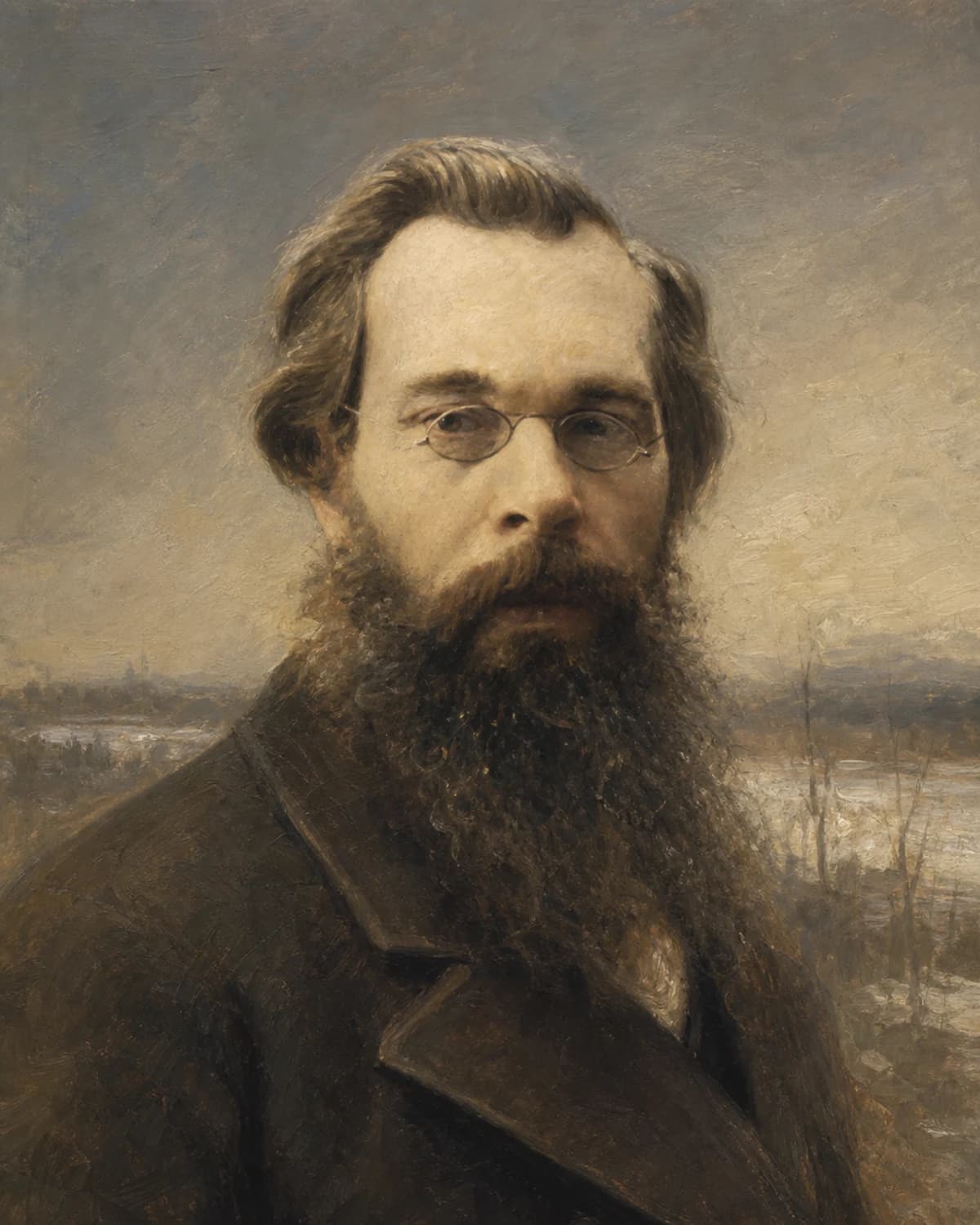
Artist image
На основе открытого изображения: Unknown author Unknown author; Wikimedia Commons; Public domain.
