
13.06.1887–12.05.1938
Alexandre Jacovleff
Alexandre Jacovleff (1887–1938), a pupil of Kardovsky and the inseparable friend of Vasily Shukhaev, left in 1917 on a study trip to the Far East and never returned to Russia. In Paris he became the official artist of two Citroën motor expeditions, across Africa and across Asia, and brought back hundreds of portraits and sketches from them. In his last years he taught in Boston.
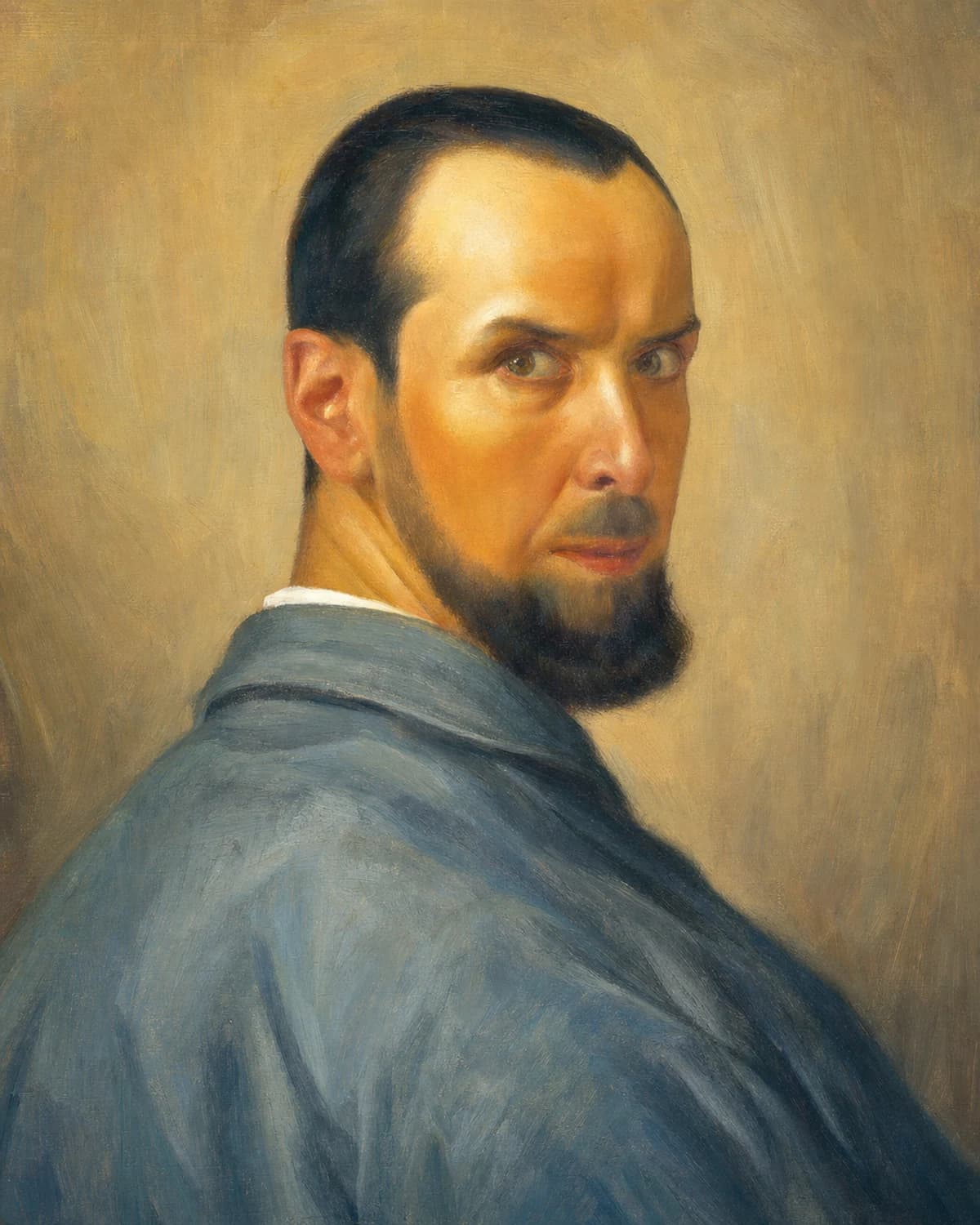
Biography
On the Japanese island of Oshima, the St Petersburg painter Alexandre Jacovleff lived among fishermen and learned diving from them. For underwater photographs he devised a camera of his own. This was during his Far Eastern journey of 1917–1919: he travelled through Mongolia, China and Japan on an Academy of Arts scholarship, painting portraits, making ethnographic sketches and studying Chinese and Japanese theatre.
He learned of the October Revolution in Beijing. He never went home.
He was born on 13 (25) June 1887 in St Petersburg. His father, Yevgeny, a naval officer and engineer-inventor, founded the first factory in Russia for gas and kerosene engines. His mother, Sofia Kuzmina, was a mathematician; his sister Alexandra became an opera singer, his elder brother Alexei an architect. After the Karl May school, Jacovleff studied from 1905 to 1913 at the Higher Art School of the Academy of Arts, from 1907 in the studio of Dmitry Kardovsky. There he became friends with Boris Grigoriev and Vasily Shukhaev. He and Shukhaev were almost inseparable, they were even nicknamed “the twins”, and the friendship lasted all their lives.
While still a student he drew for Apollon, Satirikon, Novy Satirikon and Niva. From 1909 he exhibited with the Union of Russian Artists, became a member in 1911, and in 1913 joined the World of Art. His large group portrait “At the Academy Dacha” was shown in 1912 at the Baltic Exhibition in Malmö, and Alexandre Benois praised it. In 1913, for his competition paintings “In the Bathhouse” and “Bathing”, Jacovleff received the title of artist and the right to four years’ study abroad as a pensioner of the Academy.
In 1913–1915 he and Shukhaev lived in Italy and studied Renaissance painting, then made their way to Spain, to Majorca. In these years came their double self-portrait as Harlequin and Pierrot. In 1915 he painted “Violinist”. Jacovleff was trying to combine the lessons of the Renaissance with the primitive, above all with the Russian lubok. The Italian works hung that same year, 1915, at the World of Art exhibition in Petrograd, and they were received in different ways: some critics praised them, the Academy rejected them. It seems to me that even then it was clear the academic manner was not enough for him.
In Petrograd he taught drawing at Ye. F. Bagaeva’s architecture courses and, at the invitation of the Benois sisters, at the New Art Workshop on Vasilyevsky Island, and drew in sanguine, including a portrait of Chaliapin. He also took on walls: he decorated the artists’ cabaret Prival Komediantov, painted the ceiling “Nine Muses” with Shukhaev in the Firsanov mansion on Prechistenka in Moscow, and made designs for murals in the church of St Nicholas in Bari, Italy, and for the waiting hall of the Kazansky station in Moscow. With Shukhaev, Radlov and Kardovsky he founded the Guild of Painters of St Luke. In 1917 the Academy gave him a scholarship for another journey, this time to the Far East. In 1919 an exhibition of his work was held in Shanghai, and that same year he arrived in Paris.
He started out in a tiny room in Montmartre. In April 1920 the Galerie Barbazanges showed 169 of his works on Eastern themes; the same year there was an exhibition in London, and in 1922 one in Chicago. In 1922 the publisher Lucien Vogel issued fifty of his sheets as a book, “Dessins et peintures d’Extrême-Orient”, in 150 numbered copies. At the same time Jacovleff rented a flat with a studio in Montmartre and opened a school of painting and drawing there with Shukhaev. In 1924 he painted the ballerina Anna Pavlova, and his work was entered in the art competition of the Summer Olympic Games.
From October 1924 to August 1925 he was the official artist of the expedition that the Citroën company sent across Africa in its motor cars. The Croisière noire, or Black Cruise, was both an advertisement for the cars and an ethnographic and zoological expedition through little-studied regions: the Sahara, Sudan, Niger, Chad, the Belgian Congo, Mozambique, Madagascar. Jacovleff brought back about three hundred paintings and drawings. Separately he painted a full-length group portrait of the expedition’s members, four and a half metres by three. In May 1926 the Galerie Charpentier exhibited 228 of the African works. Anna Ostroumova-Lebedeva and Konstantin Somov, who saw the exhibition, wrote in their letters and diaries about the almost illusionistic precision of the portrait’s details. That same year Jacovleff was made a Chevalier of the Legion of Honour, and in 1927 Vogel published the album “Dessins et peintures d’Afrique” in an edition of 1,020 copies. He became established as a master of exotic subjects.
His exhibitions were held in New York, Amsterdam and The Hague, Pittsburgh, Brussels, Birmingham, Copenhagen and Belgrade. In 1928 his work was shown at home too, in the Russian section of the exhibition “Contemporary French Art” in Moscow and in the halls of the Academy of Arts in Leningrad.
In 1931–1932 Citroën sent out a second expedition, the Croisière jaune, or Yellow Cruise, across Syria, Iran, Afghanistan, Mongolia and China. Conditions were harder than in Africa, and Jacovleff brought back several hundred works. Of the Paris exhibition of 1933, Benois, astonished at how much one hand had done on the road, wrote: “In the Middle Ages Jacovleff would have been suspected of witchcraft.” The album “Dessins et peintures d’Asie” came out from Vogel in 1934 in an edition of 720 copies, with a preface by the orientalist V. S. Elisséeff. A year earlier Jacovleff had illustrated a book on Kabuki theatre by his father, the Japanologist S. G. Elisséeff.
In 1934 he was invited to America to head the painting department of the school of the Museum of Fine Arts in Boston. He travelled widely in the United States and Mexico and organised exhibitions, and in 1937 he returned to Paris; his last months were spent there and on Capri. His friends, following Benois, called him “Sasha-Yasha” and remembered his infectious laugh.
Alexandre Jacovleff died in Paris on 12 May 1938, at the age of fifty.
Related context
Associations
Works connected through artistic movements, cultural context and period. Priced works available in this market appear first.








Profile notes
Profile and sources
Image
Artist image
На основе открытого изображения: Alexandre Jacovleff; Wikimedia Commons; Public domain.
